







Question: Open the provided document ITSAP.40.003 entitled DEVELOPING YOUR INCIDENT RESPONSE PLAN and respond to the questions below justifying your opinion, supporting them with other sources
Open the provided document ITSAP.40.003 entitled DEVELOPING YOUR INCIDENT RESPONSE PLAN and respond to the questions below justifying your opinion, supporting them with other sources if necessary.
1. You are facing two simultaneous incidents. The first is related to the availability of a web server your company uses to sell their products (an e-commerce website). The second is about a disgruntled employee sending out descriptions and prices of products in a research stage exfiltrated from an internal database. What stage of the incident response plan should help determine the priority of these incidents?
2. What would be your choice if you could manage only one at a time?
3. Early in the morning, an employee powers up their computer and detects that My PC shows a unit F: identified as a pendrive. While checking the USB ports, the employee observes there was effectively a pendrive plug in on one of the rear ports. As it belonged to someone else, the pendrive is just unplugged and left on the table. The day continues with normality. What did the employee do wrong? What should change for this not to happen again?
4. Among the proposed roles for the incident response team, there is a communications advisor. How this profile could be useful beyond internal communications within the organization? Name two external entities that might need to be contacted during an incident.
5. After an incident, you help the IT team to recover from it. Is there anything else that needs to be done?
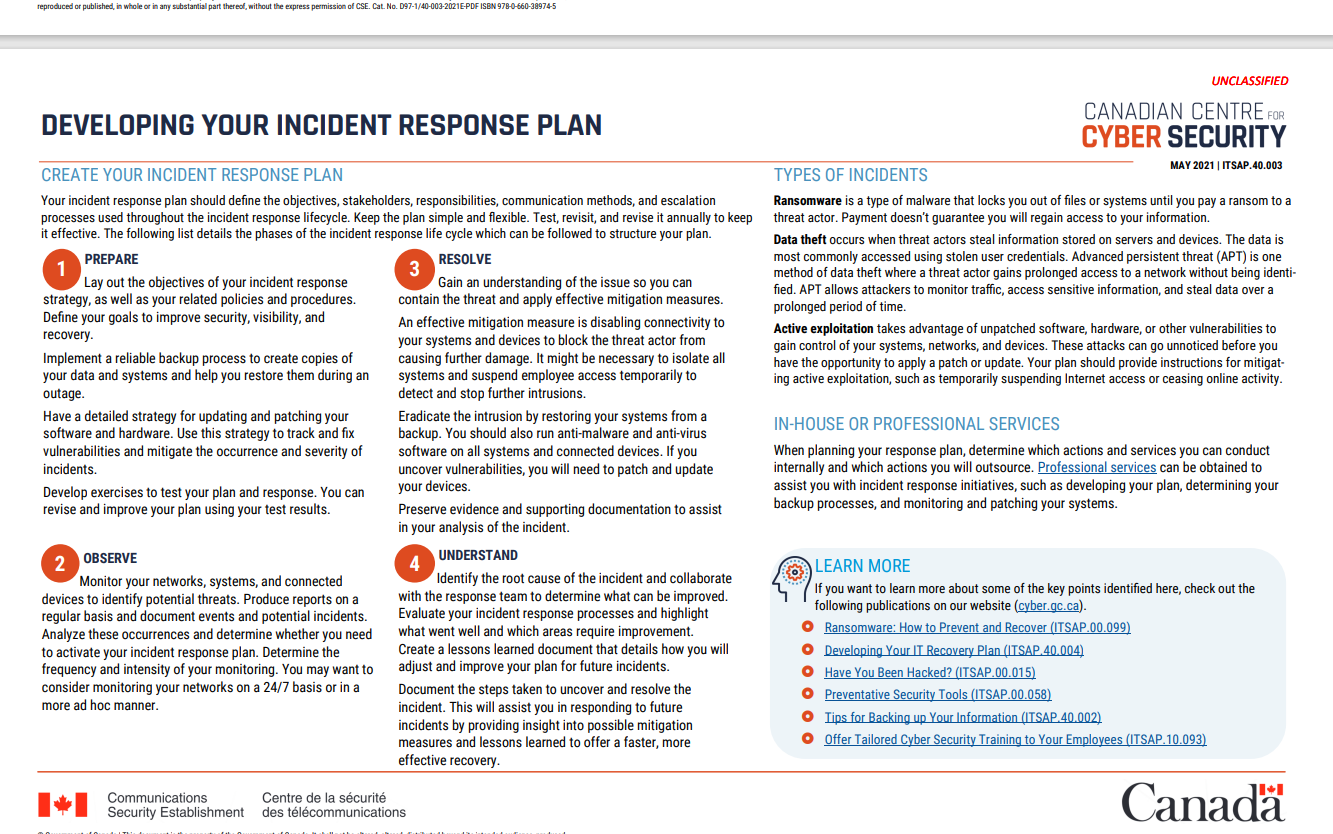
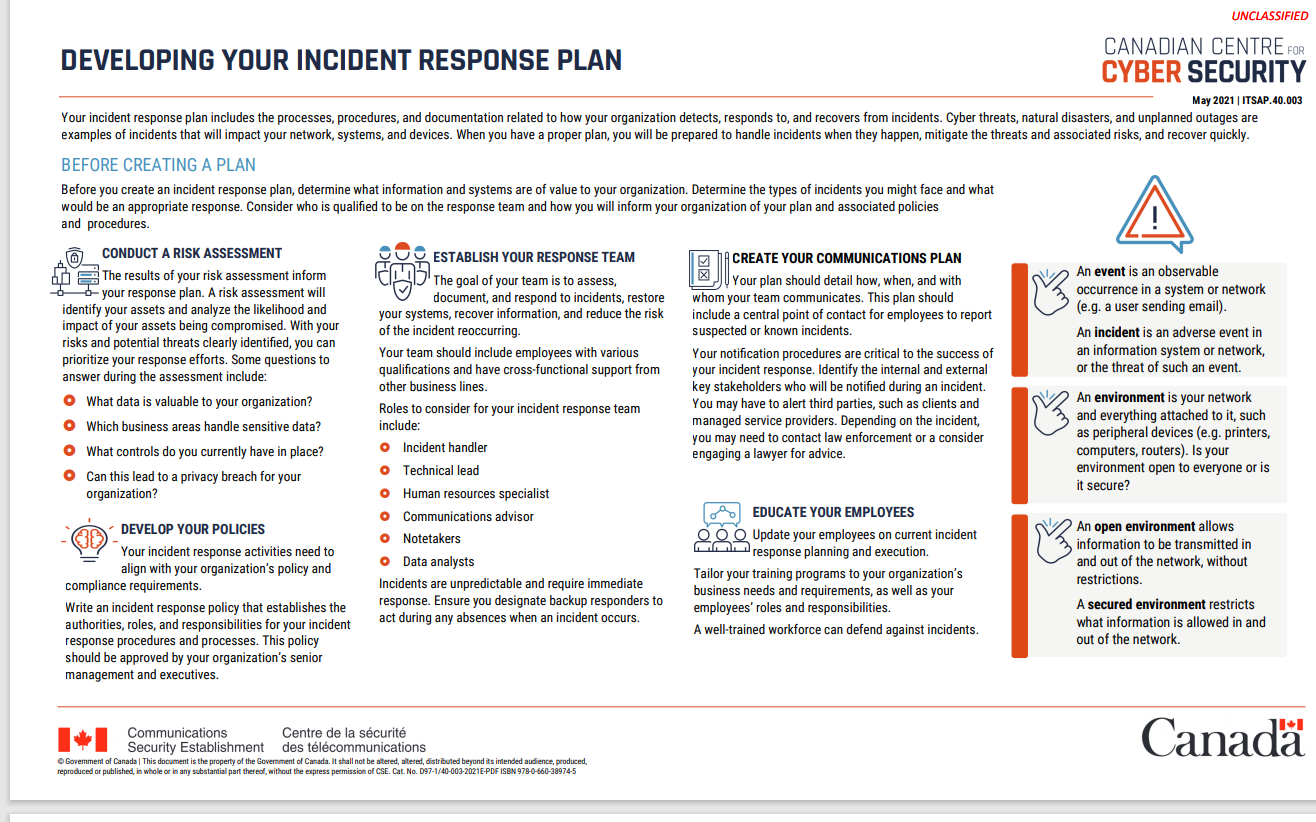
DEVELOPING YOUR INCIDENT RESPONSE PLAN CANADIAN CENTRE for CYBER SECURITY CREATE YOUR INCIDENT RESPONSE PLAN Your incident response plan should define the objectives, stakeholders, responsibilities, communication methods, and escalation processes used throughout the incident response lifecycle. Keep the plan simple and flexible. Test, revisit, and revise it annually to keep it effective. The following list details the phases of the incident response life cycle which can be followed to structure your plan. PREPARE Lay out the objectives of your incident response strategy, as well as your related policies and procedures. Define your goals to improve security, visibility, and recovery. Implement a reliable backup process to create copies of your data and systems and help you restore them during an outage. Have a detailed strategy for updating and patching your software and hardware. Use this strategy to track and fix vulnerabilities and mitigate the occurrence and severity of incidents. Develop exercises to test your plan and response. You can revise and improve your plan using your test results. OBSERVE Monitor your networks, systems, and connected devices to identify potential threats. Produce reports on a regular basis and document events and potential incidents. Analyze these occurrences and determine whether you need to activate your incident response plan. Determine the frequency and intensity of your monitoring. You may want to consider monitoring your networks on a 24/7 basis or in a more ad hoc manner. TYPES OF INCIDENTS MAY 2021 | ITSAP. 40.003 Ransomware is a type of malware that locks you out of files or systems until you pay a ransom to a threat actor. Payment doesn't guarantee you will regain access to your information. Data theft occurs when threat actors steal information stored on servers and devices. The data is most commonly accessed using stolen user credentials. Advanced persistent threat (APT) is one method of data theft where a threat actor gains prolonged access to a network without being identified. APT allows attackers to monitor traffic, access sensitive information, and steal data over a prolonged period of time. Active exploitation takes advantage of unpatched software, hardware, or other vulnerabilities to gain control of your systems, networks, and devices. These attacks can go unnoticed before you have the opportunity to apply a patch or update. Your plan should provide instructions for mitigating active exploitation, such as temporarily suspending Internet access or ceasing online activity. IN-HOUSE OR PROFESSIONAL SERVICES When planning your response plan, determine which actions and services you can conduct internally and which actions you will outsource. Professional services can be obtained to assist you with incident response initiatives, such as developing your plan, determining your backup processes, and monitoring and patching your systems. Preserve evidence and supporting documentation to assist in your analysis of the incident. 4 UNDERSTAND Identify the root cause of the incident and collaborate with the response team to determine what can be improved. Evaluate your incident response processes and highlight what went well and which areas require improvement. Create a lessons learned document that details how you will adjust and improve your plan for future incidents. Document the steps taken to uncover and resolve the incident. This will assist you in responding to future incidents by providing insight into possible mitigation measures and lessons learned to offer a faster, more effective recovery. LEARN MORE If you want to learn more about some of the key points identified here, check out the following publications on our website (cyber.gc.ca). Ransomware: How to Prevent and Recover (ITSAP.00.099) Developing Your IT Recovery Plan (ITSAP.40.004) Have You Been Hacked? (ITSAP.00.015) Preventative Security Tools (ITSAP.00.058) Tips for Backing up Your Information (ITSAP. 40.002) Offer Tailored Cyber Security Training to Your Employees (ITSAP. 10.093) Communications Security Establishment Centre de la scurit des tlcommunications Canad DEVELOPING YOUR INCIDENT RESPONSE PLAN CANADIAN CENTRE for CYBER SECURITY May 2021 | ITSAP.40.003 BEFORE CREATING A PLAN Before you create an incident response plan, determine what information and systems are of value to your organization. Determine the types of incidents you might face and what would be an appropriate response. Consider who is qualified to be on the response team and how you will inform your organization of your plan and associated policies and procedures. CONDUCT A RISK ASSESSMENT The results of your risk assessment inform your response plan. A risk assessment will identify your assets and analyze the likelihood and impact of your assets being compromised. With your risks and potential threats clearly identified, you can prioritize your response efforts. Some questions to answer during the assessment include: - What data is valuable to your organization? - Which business areas handle sensitive data? - What controls do you currently have in place? - Can this lead to a privacy breach for your organization? DEVELOP YOUR POLICIES Your incident response activities need to align with your organization's policy and compliance requirements. Write an incident response policy that establishes the authorities, roles, and responsibilities for your incident response procedures and processes. This policy should be approved by your organization's senior management and executives. ESTABLISH YOUR RESPONSE TEAM The goal of your team is to assess, document, and respond to incidents, restore your systems, recover information, and reduce the risk of the incident reoccurring. Your team should include employees with various qualifications and have cross-functional support from other business lines. Roles to consider for your incident response team include: - Incident handler - Technical lead - Human resources specialist - Communications advisor - Notetakers - Data analysts Incidents are unpredictable and require immediate response. Ensure you designate backup responders to act during any absences when an incident occurs. CREATE YOUR COMMUNICATIONS PLAN Your plan should detail how, when, and with whom your team communicates. This plan should include a central point of contact for employees to report suspected or known incidents. Your notification procedures are critical to the success of your incident response. Identify the internal and external key stakeholders who will be notified during an incident. You may have to alert third parties, such as clients and managed service providers. Depending on the incident, you may need to contact law enforcement or a consider engaging a lawyer for advice. EDUCATE YOUR EMPLOYEES Update your employees on current incident response planning and execution. Tailor your training programs to your organization's business needs and requirements, as well as your employees' roles and responsibilities. A well-trained workforce can defend against incidents. An event is an observable occurrence in a system or network (e.g. a user sending email). An incident is an adverse event in an information system or network, or the threat of such an event. An environment is your network and everything attached to it, such as peripheral devices (e.g. printers, computers, routers). Is your environment open to everyone or is it secure? An open environment allows information to be transmitted in and out of the network, without restrictions. A secured environment restricts what information is allowed in and out of the network. Communications Security Establishment Centre de la scurit des tlcommunications Q Government of Canada | This document is the property of the Government of Canada. It shall not be altered, altered, distributed beyond its intended audience, peoduced, reproduced or published, in whole or in any s.bstantial part thereof, without the express permission of CSE. Cat. No. D97-1/40-003-2021E-PDF ISEN 9780660389745
Step by Step Solution
There are 3 Steps involved in it

Get step-by-step solutions from verified subject matter experts
 Study Help