Question: organizational behaviour case study Answer the questions for the case study Do you think Cohen had a right to be offended? Why or why not?
organizational behaviour case study
Answer the questions for the case study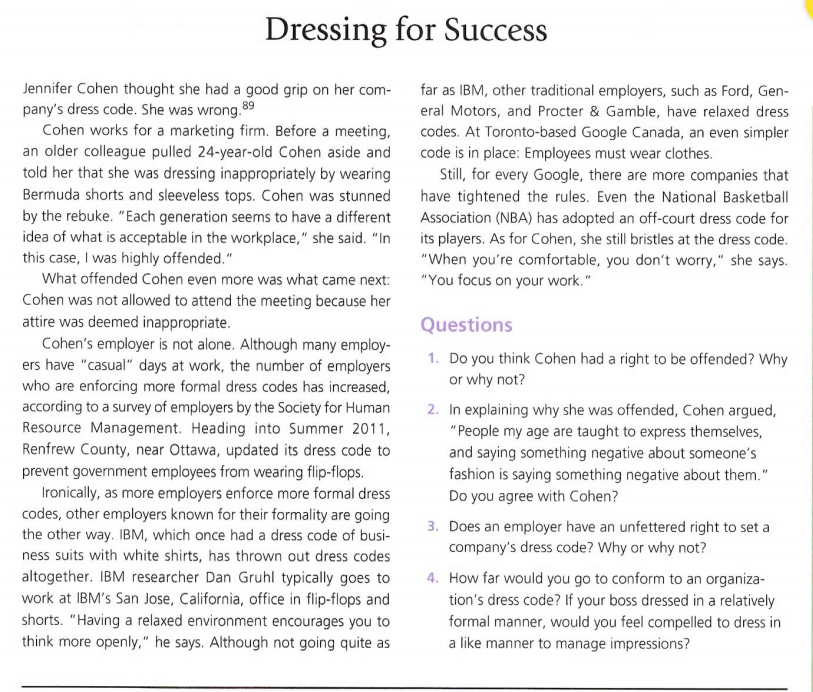
- Do you think Cohen had a right to be offended? Why or why not?
- In explaining why she was offended, Cohen argued, People my are taught to express themselves, and saying something negative about someones fashion is saying something negative about them. Do you agree with Cohen?
- Does an employer have an unfettered right to set a companys dress code? Why or why not?
- How far would go to conform to an organizations dress code? If your boss dressed in a relatively formal manner, would you fell compelled to dress in a like manager to manage impressions?
Dressing for Success far as IBM, other traditional employers, such as Ford, Gen- eral Motors, and Procter & Gamble, have relaxed dress codes. At Toronto-based Google Canada, an even simpler code is in place: Employees must wear clothes. Still, for every Google, there are more companies that have tightened the rules. Even the National Basketball Association (NBA) has adopted an off-court dress code for its players. As for Cohen, she still bristles at the dress code. "When you're comfortable, you don't worry," she says. "You focus on your work." Jennifer Cohen thought she had a good grip on her com- pany's dress code. She was wrong. 89 Cohen works for a marketing firm. Before a meeting, an older colleague pulled 24-year-old Cohen aside and told her that she was dressing inappropriately by wearing Bermuda shorts and sleeveless tops. Cohen was stunned by the rebuke. "Each generation seems to have a different idea of what is acceptable in the workplace," she said. "In this case, I was highly offended." What offended Cohen even more was what came next: Cohen was not allowed to attend the meeting because her attire was deemed inappropriate. Cohen's employer is not alone. Although many employ- ers have "casual" days at work, the number of employers who are enforcing more formal dress codes has increased, according to a survey of employers by the Society for Human Resource Management. Heading into Summer 2011, Renfrew County, near Ottawa, updated its dress code to prevent government employees from wearing flip-flops. Ironically, as more employers enforce more formal dress codes, other employers known for their formality are going the other way. IBM, which once had a dress code of busi- ness suits with white shirts, has thrown out dress codes altogether. IBM researcher Dan Gruhl typically goes to work at IBM's San Jose, California, office in flip-flops and shorts. "Having a relaxed environment encourages you to think more openly," he says. Although not going quite as Questions 1. Do you think Cohen had a right to be offended? Why or why not? 2. In explaining why she was offended, Cohen argued, "People my age are taught to express themselves, and saying something negative about someone's fashion is saying something negative about them." Do you agree with Cohen? 3. Does an employer have an unfettered right to set a company's dress code? Why or why not? 4. How far would you go to conform to an organiza- tion's dress code? If your boss dressed in a relatively formal manner, would you feel compelled to dress in a like manner to manage impressions









 Study Help