





Question: Overlooking a possible common cause A fallacy that occurs when a speaker or writer assumes that the fact that two events happen at about the
Overlooking a possible common cause A fallacy

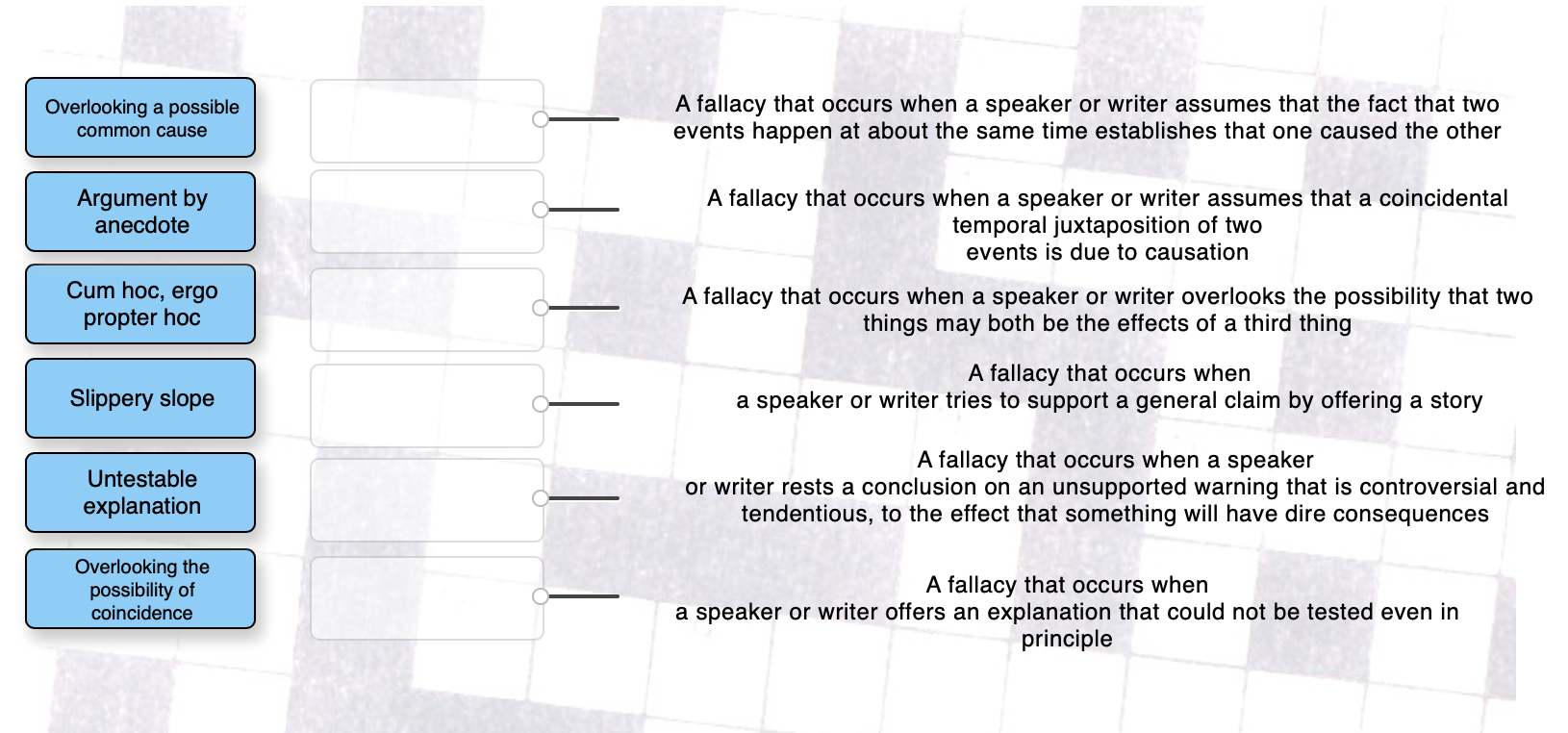
Overlooking a possible common cause A fallacy that occurs when a speaker or writer assumes that the fact that two events happen at about the same time establishes that one caused the other Argument by anecdote A fallacy that occurs when a speaker or writer assumes that a coincidental temporal juxtaposition of two events is due to causation Cum hoc, ergo propter hoc A fallacy that occurs when a speaker or writer overlooks the possibility that two things may both be the effects of a third thing Slippery slope A fallacy that occurs when a speaker or writer tries to support a general claim by offering a story Untestable explanation A fallacy that occurs when a speaker or writer rests a conclusion on an unsupported warning that is controversial and tendentious, to the effect that something will have dire consequences Overlooking the possibility of coincidence A fallacy that occurs when a speaker or writer offers an explanation that could not be tested even in principle

Step by Step Solution

There are 3 Steps involved in it

1 Expert Approved Answer
Step: 1 Unlock blur-text-image

Question Has Been Solved by an Expert!

Get step-by-step solutions from verified subject matter experts

Step: 2 Unlock
Step: 3 Unlock

Students Have Also Explored These Related General Management Questions!