







Question: Overview The focus of this project is to develop a molecular statics simulation tool in Matlab that computes: (1) the energy of any atomic
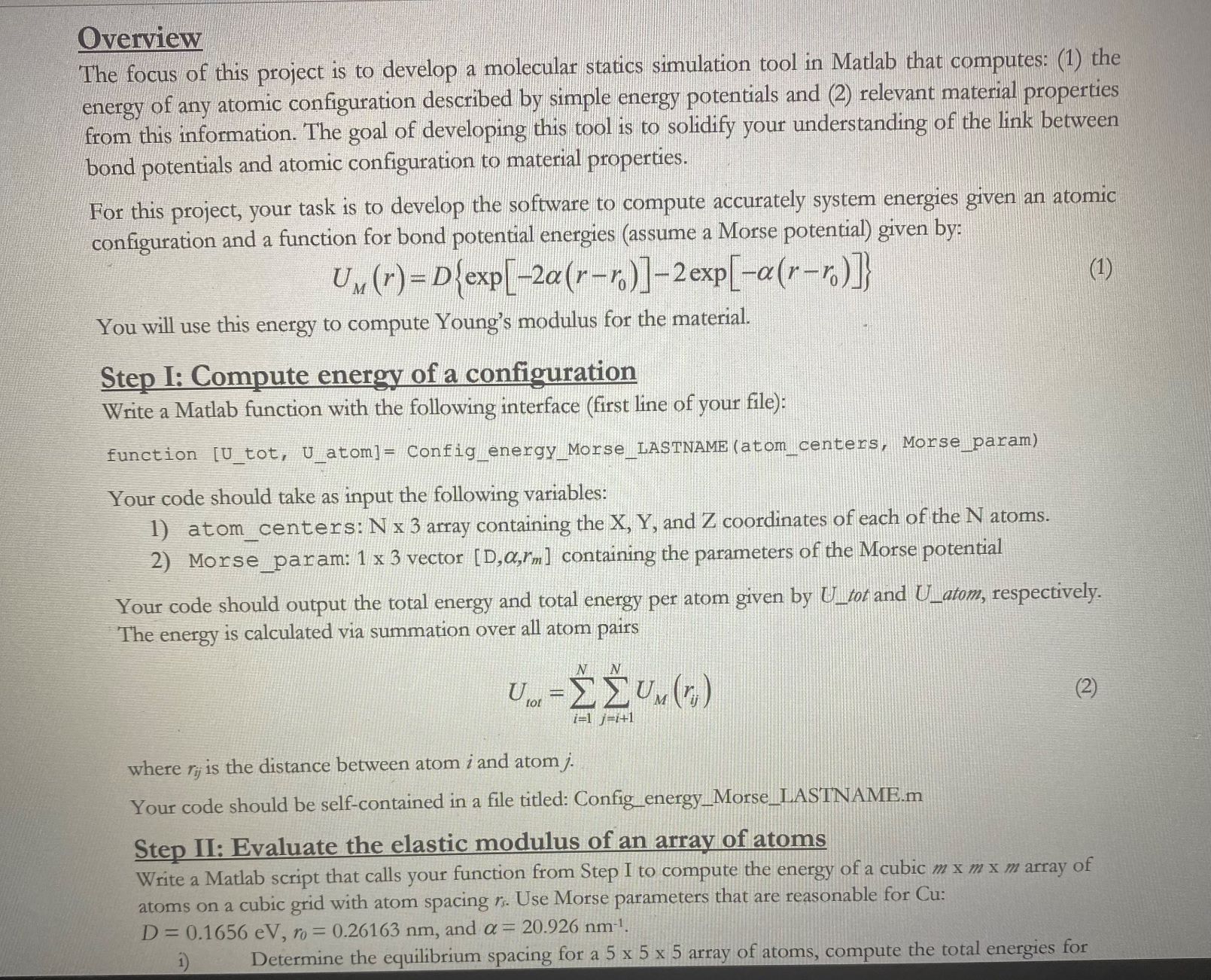
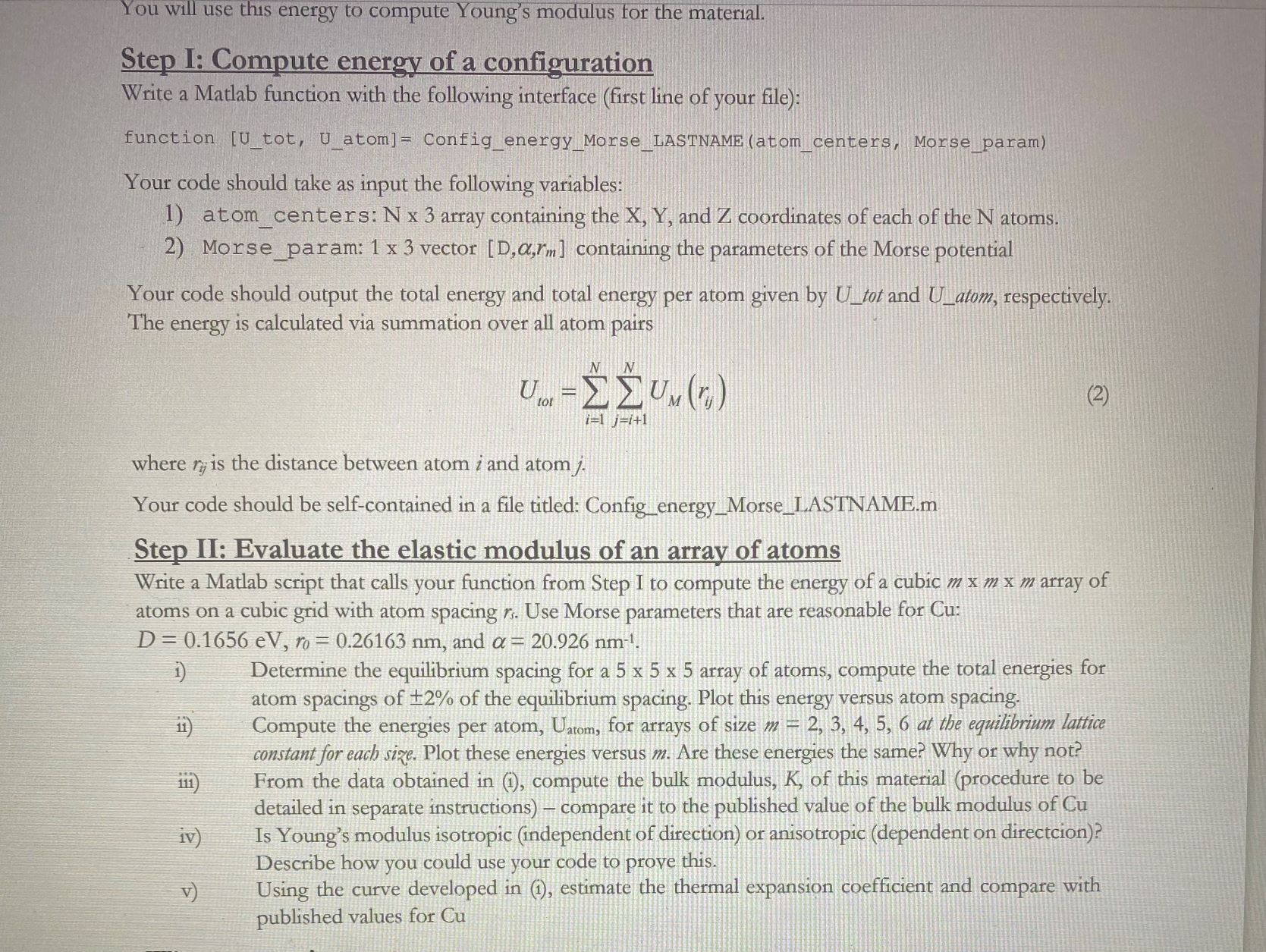
Overview The focus of this project is to develop a molecular statics simulation tool in Matlab that computes: (1) the energy of any atomic configuration described by simple energy potentials and (2) relevant material properties from this information. The goal of developing this tool is to solidify your understanding of the link between bond potentials and atomic configuration to material properties. For this project, your task is to develop the software to compute accurately system energies given an atomic configuration and a function for bond potential energies (assume a Morse potential) given by: UM(r) D{exp[-2a(r-r)]-2 exp[-a(r-r)]} You will use this energy to compute Young's modulus for the material. Step I: Compute energy of a configuration Write a Matlab function with the following interface (first line of your file): function [U tot, U_atom] = Config_energy_Morse_LASTNAME (atom_centers, Morse_param) Your code should take as input the following variables: 1) atom_centers: N x 3 array containing the X, Y, and Z coordinates of each of the N atoms. 2) Morse_param: 1 x 3 vector [D,a,rm] containing the parameters of the Morse potential Your code should output the total energy and total energy per atom given by U_tot and U_atom, respectively. The energy is calculated via summation over all atom pairs N (1) tot i=1 j=i+1 (2) where Tij is the distance between atom i and atom j. Your code should be self-contained in a file titled: Config_energy_Morse_LASTNAME.m Step II: Evaluate the elastic modulus of an array of atoms Write a Matlab script that calls your function from Step I to compute the energy of a cubic m x mx m array of atoms on a cubic grid with atom spacing rs. Use Morse parameters that are reasonable for Cu: D= 0.1656 eV, ro = 0.26163 nm, and a = 20.926 nm-. 1) Determine the equilibrium spacing for a 5 x 5 x 5 array of atoms, compute the total energies for You will use this energy to compute Young's modulus for the material. Step I: Compute energy of a configuration Write a Matlab function with the following interface (first line of your file): function [U_tot, U_atom]= Config_energy_Morse_LASTNAME (atom_centers, Morse_param) Your code should take as input the following variables: 1) atom_centers: N x 3 array containing the X, Y, and Z coordinates of each of the N atoms. 2) Morse_param: 1 x 3 vector [D,a,rm] containing the parameters of the Morse potential Your code should output the total energy and total energy per atom given by U_tot and U_atom, respectively. The energy is calculated via summation over all atom pairs N U - () tot where rij is the distance between atom i and atomj. i=1 j=i+1 Your code should be self-contained in a file titled: Config_energy_Morse_LASTNAME.m Step II: Evaluate the elastic modulus of an array of atoms Write a Matlab script that calls your function from Step I to compute the energy of a cubic m x m x m array of atoms on a cubic grid with atom spacing rs. Use Morse parameters that are reasonable for Cu: D= 0.1656 eV, ro = 0.26163 nm, and a = 20.926 nm-1. 1) 11) 111) iv) A v) Determine the equilibrium spacing for a 5 x 5 x 5 array of atoms, compute the total energies for atom spacings of 2% of the equilibrium spacing. Plot this energy versus atom spacing. Compute the energies per atom, Uatom, for arrays of size m = 2, 3, 4, 5, 6 at the equilibrium lattice constant for each size. Plot these energies versus m. Are these energies the same? Why or why not? From the data obtained in (i), compute the bulk modulus, K, of this material (procedure to be detailed in separate instructions) - compare it to the published value of the bulk modulus of Cu Is Young's modulus isotropic (independent of direction) or anisotropic (dependent on directcion)? Describe how you could use your code to prove this. Using the curve developed in (i), estimate the thermal expansion coefficient and compare with published values for Cu
Step by Step Solution
There are 3 Steps involved in it

Get step-by-step solutions from verified subject matter experts
 Study Help