







Question: Overview With a few years as Java programmers you may have had an opportunity to use a Java PriorityQueue. In this assignment we will

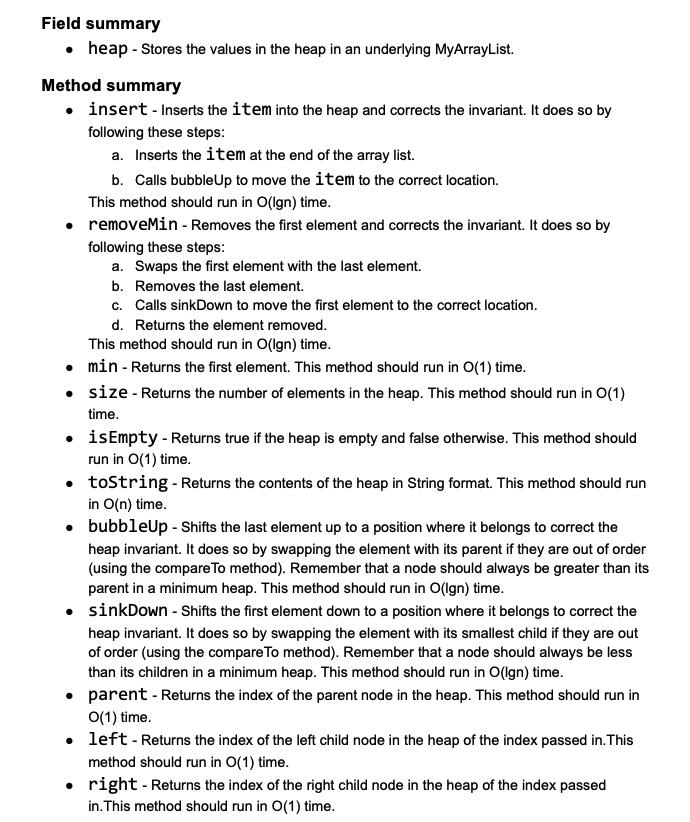
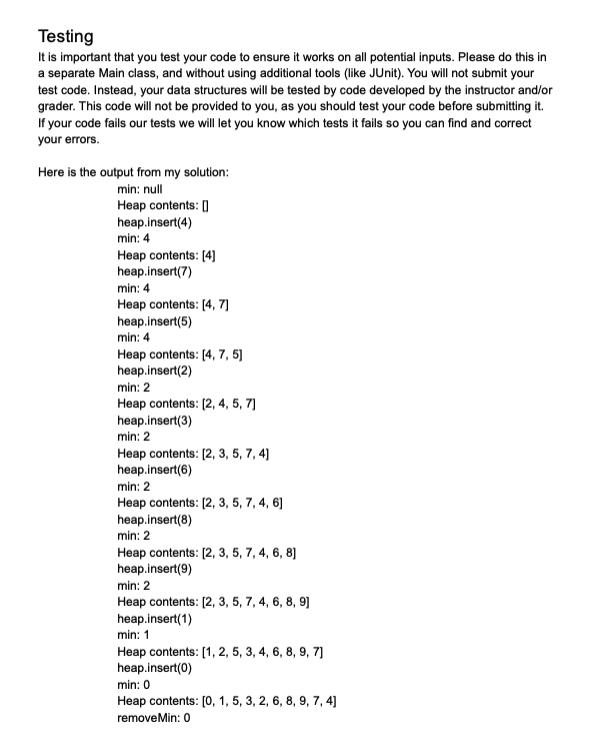

Overview With a few years as Java programmers you may have had an opportunity to use a Java PriorityQueue. In this assignment we will build our own priority queue. There are multiple ways to build this data structure. We have already built one last assignment when we built an ordered list. A (minimum) binary heap is a specialized data structure that also implements a priority queue more efficiently than an ordered list. For this reason we will build our priority queue out of a (minimum) binary heap. To complete this you will implement one public class: MyPriority Queue Formal Specifications MyPriorityQueue |-heap MyArrayList +insert(item : Type) +removeMin() : Type +min(): Type +size(): int +isEmpty(): boolean +toString(): String -bubbleUp() -sinkDown () -parent (index: int) : int -right(index : int) : int -left(index: int) : int Field summary heap-Stores the values in the heap in an underlying MyArrayList. Method summary .insert - Inserts the item into the heap and corrects the invariant. It does so by following these steps: a. Inserts the item at the end of the array list. b. Calls bubble Up to move the item to the correct location. This method should run in O(Ign) time. removeMin - Removes the first element and corrects the invariant. It does so by following these steps: a. Swaps the first element with the last element. b. Removes the last element. c. Calls sinkDown to move the first element to the correct location. d. Returns the element removed. This method should run in O(Ign) time. min - Returns the first element. This method should run in O(1) time. size - Returns the number of elements in the heap. This method should run in O(1) time. isEmpty - Returns true if the heap is empty and false otherwise. This method should run in O(1) time. toString - Returns the contents of the heap in String format. This method should run in O(n) time. bubbleUp - Shifts the last element up to a position where it belongs to correct the heap invariant. It does so by swapping the element with its parent if they are out of order (using the compare To method). Remember that a node should always be greater than its parent in a minimum heap. This method should run in O(Ign) time. sinkDown - Shifts the first element down to a position where it belongs to correct the heap invariant. It does so by swapping the element with its smallest child if they are out of order (using the compare To method). Remember that a node should always be less than its children in a minimum heap. This method should run in O(Ign) time. parent - Returns the index of the parent node in the heap. This method should run in O(1) time. left - Returns the index of the left child node in the heap of the index passed in. This method should run in O(1) time. right - Returns the index of the right child node in the heap of the index passed in. This method should run in O(1) time. Testing It is important that you test your code to ensure it works on all potential inputs. Please do this in a separate Main class, and without using additional tools (like JUnit). You will not submit your test code. Instead, your data structures will be tested by code developed by the instructor and/or grader. This code will not be provided to you, as you should test your code before submitting it. If your code fails our tests we will let you know which tests it fails so you can find and correct your errors. Here is the output from my solution: min: null Heap contents: [] heap.insert(4) min: 4 Heap contents: [4] heap.insert(7) min: 4 Heap contents: [47] heap.insert(5) min: 4 Heap contents: [4, 7,5] heap.insert(2) min: 2 Heap contents: [2, 4, 5, 7] heap.insert(3) min: 2 Heap contents: [2, 3, 5, 7, 4] heap.insert(6) min: 2 Heap contents: [2, 3, 5, 7, 4, 6] heap.insert(8) min: 2 Heap contents: [2, 3, 5, 7, 4, 6, 8] heap.insert(9) min: 2 Heap contents: [2, 3, 5, 7, 4, 6, 8, 9] heap.insert(1) min: 1 Heap contents: [1, 2, 5, 3, 4, 6, 8, 9, 7] heap.insert(0) min: 0 Heap contents: [0, 1, 5, 3, 2, 6, 8, 9, 7, 4] removeMin: 0 Heap contents: [1, 2, 5, 3, 4, 6, 8, 9, 7] removeMin: 1 Heap contents: [2, 3, 5, 7, 4, 6, 8, 9] removeMin: 2 Heap contents: [3, 4, 5, 7, 9, 6, 8] removeMin: 3 Heap contents: [4, 7, 5, 8, 9, 6] removeMin: 4 Heap contents: [5, 7, 6, 8, 9] removeMin: 5 Heap contents: [6, 7, 9, 8] removeMin: 6 Heap contents: [7, 8, 9] removeMin: 7 Heap contents: [8, 9] removeMin: 8 Heap contents: [9] removeMin: 9 Heap contents: [] removeMin: null Heap contents: [] Submission You will submit a .zip file containing: MyArrayList.java MyPriorityQueue.java
Step by Step Solution
3.53 Rating (160 Votes )
There are 3 Steps involved in it
The detailed answer for the above question is provided below Solution MyPriorityQueuejava import javautilArrayList public class MyPriorityQueue privat... View full answer

Get step-by-step solutions from verified subject matter experts
 Study Help