







Question: Part 1: Determine the output voltage (Vout) when a step-down transformer with a ratio of 1:220 is used to convert the input voltage. Part 2:
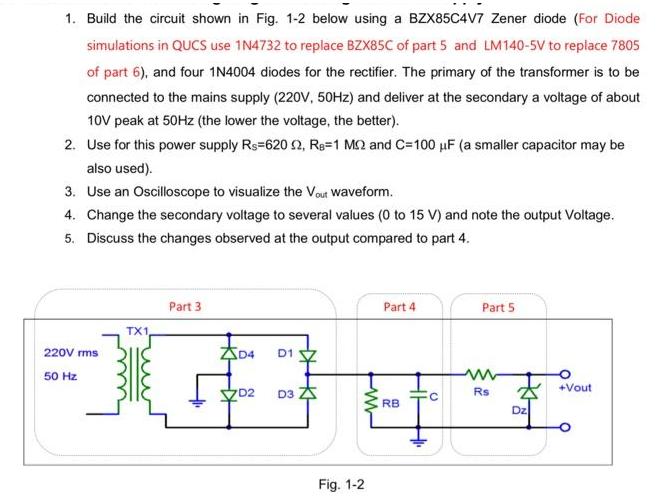
Part 1: Determine the output voltage (Vout) when a step-down transformer with a ratio of 1:220 is used to convert the input voltage.
Part 2: After the transformer, the AC voltage is converted to DC using a capacitor. Calculate the output voltage (Vout) after this conversion.
Part 3: Finally, a zener diode is employed to stabilize the voltage. Find the voltage (Vout) across the zener diode after the voltage stabilization process.
1. Build the circuit shown in Fig. 1-2 below using a BZX85C4V7 Zener diode (For Diode simulations in QUCS use 1N4732 to replace BZX85C of part 5 and LM140-5V to replace 7805 of part 6), and four 1N4004 diodes for the rectifier. The primary of the transformer is to be connected to the mains supply (220V, 50Hz) and deliver at the secondary a voltage of about 10V peak at 50Hz (the lower the voltage, the better). 2. Use for this power supply Rs-6202, Re=1 MC2 and C=100 F (a smaller capacitor may be also used). 3. Use an Oscilloscope to visualize the Vout waveform. 4. Change the secondary voltage to several values (0 to 15 V) and note the output Voltage. Discuss the changes observed at the output compared to part 4. 5. 220V rms ZD4 D1 AGEL 7D2 D3 50 Hz Part 3 TX1, Part 4 Fig. 1-2 RB Part 5 Rs Dz +Vout
Step by Step Solution
3.42 Rating (152 Votes )
There are 3 Steps involved in it
Part 1 To determine the output voltage Vout when a stepdown transformer with a ratio of 1220 is used we need to consider the voltage transformation ra... View full answer

Get step-by-step solutions from verified subject matter experts
 Study Help