







Question: Part A Calibri (Body) ~ 11 A- A Number Paste B I U - - G. A $ - % +E B10 X V
Part A
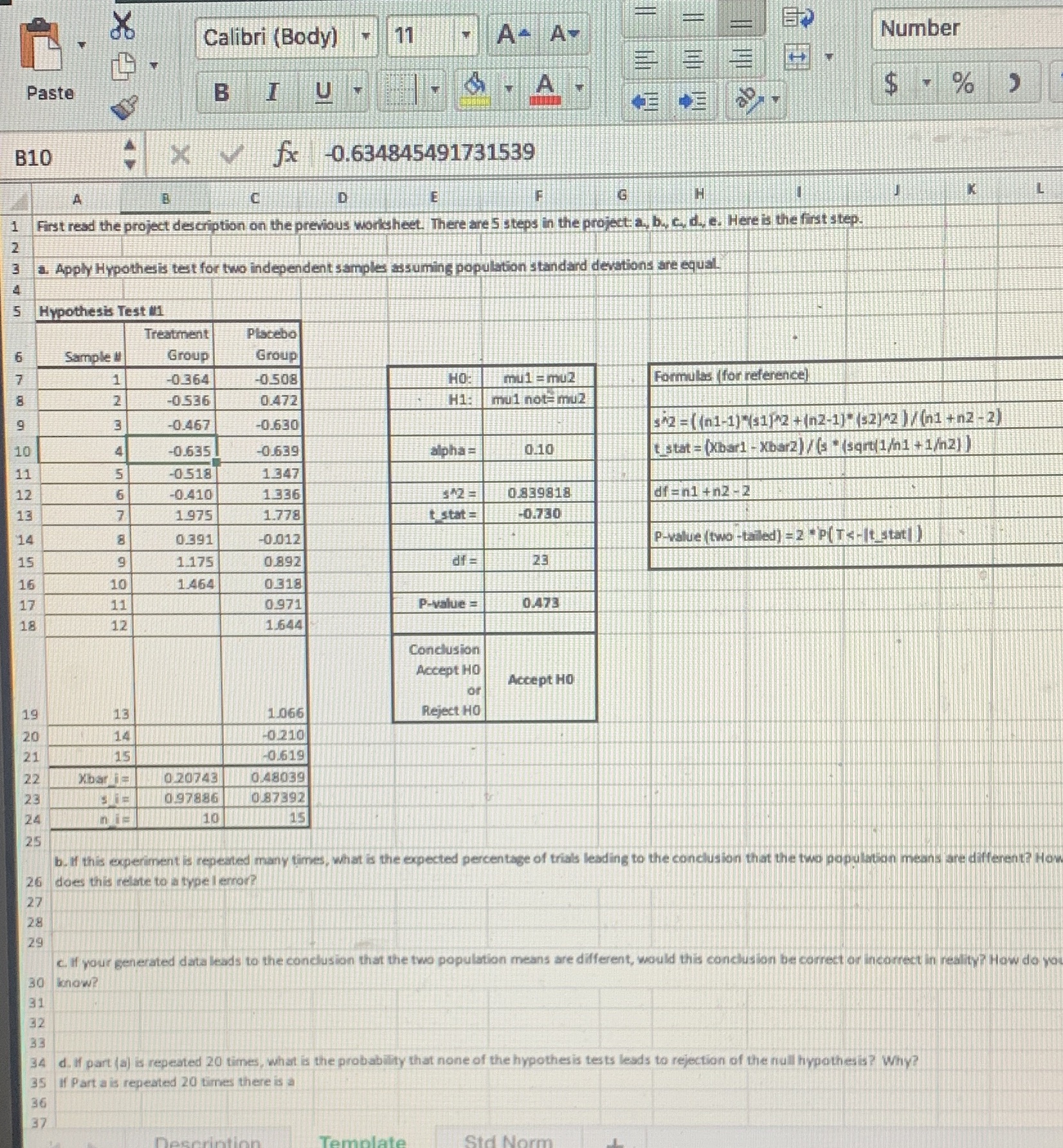
Calibri (Body) ~ 11 A- A Number Paste B I U - - G. A $ - % " +E B10 X V fx -0.634845491731539 D E G First read the project description on the previous Worksheet. There are S steps in the project: a., bijc.d.c. Here is the first step. a. Apply Hypothesis test for two independent samples assuming population standard devations are equal 5 Hypothesis Test ill Treatment Placebo Sample # Group Group 0.364 0.508 HO: mul = mu2 Formulas (for reference) 2 0.536 0.472 H1: mul not= muz -0.467 0.630 $52 = ( (ni-1)"(s1p2 +(n2-1]"(s2]-2 )/ (n1 + n2 - 2) 10 0.635 0.639 alpha 0.10 t stat = (Xbari - Xbar2) / (s "(sqrt(1i + 1/h2]] 11 5 0518 1.347 12 6 0.410 1336 0.839818 df = n1 +h2 - 2 13 1 975 1.778 t stat- -0.730 8 0.391 0.012 P-value (two -tarded) - 2 . POT-CALL 9 1.175 0.892 ar - 23 10 1464 0318 0.971 P-value 0.473 1644 Conclusion Accept HO Accept HO of 19 13 1 066 Reject Ho 20 14 -0.210 21 15 -0.619 22 0.20743 0.48039 23 3 0.97886 0 87392 24 10 15 25 b. If this experiment is repeated many times, what is the expected percentage of trials leading to the conclusion that the two population me s are different? How 26 does this relate to a type l error? 27 28 29 c if your generated data leads to the conclusion that the two population means are different, would this conclusion be correct or incorrect in reality? How do you 30 know? 31 32 33 34 d. If part (a] is repeated 20 times, what is the probability that none of the hypothesis tests leads to rejection of the null hypothesis? Why? 35 if Part a is repeated 20 times there is a 36 37
Step by Step Solution
There are 3 Steps involved in it

Get step-by-step solutions from verified subject matter experts
 Study Help