







Question: Part A In this assignment, design a two-bit signed adder with overflow detection. The two inputs A and B are two-bit signed integers. There are
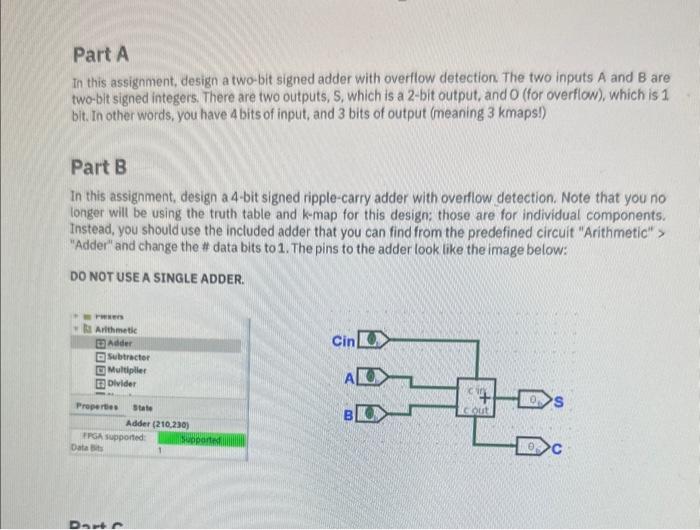
Part A In this assignment, design a two-bit signed adder with overflow detection. The two inputs A and B are two-bit signed integers. There are two outputs, S, which is a 2-bit output, and O (for overflow), which is 1 . bit. In other words, you have 4 bits of input, and 3 bits of output (meaning 3 kmaps!) Part B In this assignment, design a 4-bit signed ripple-carry adder with overflow detection. Note that you no longer will be using the truth table and k-map for this design: those are for individual components. Instead, you should use the included adder that you can find from the predefined circuit "Arithmetic" > "Adder" and change the \# data bits to 1. The pins to the adder look like the image below: DO NOT USE A SINGLE ADDER
Step by Step Solution
There are 3 Steps involved in it

Get step-by-step solutions from verified subject matter experts
 Study Help