







Question: Part (a) Let n be an odd positive integer. Let M be the n x n matrix whose entry in row i and column
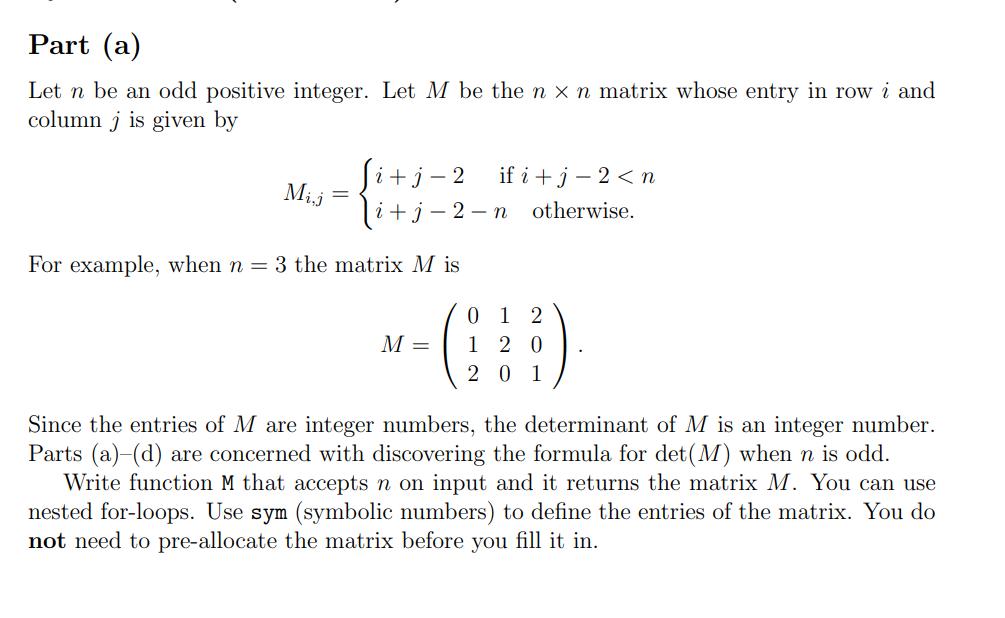
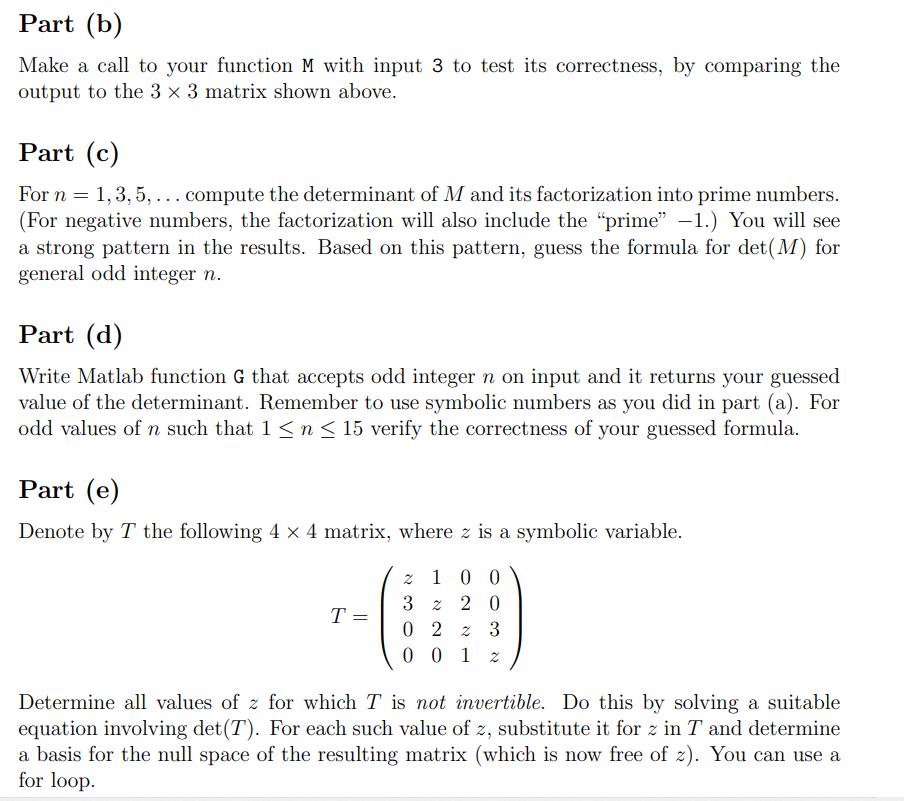
Part (a) Let n be an odd positive integer. Let M be the n x n matrix whose entry in row i and column j is given by Mi,j = i+j-2 i+j-2-n ifi+j 2 < n otherwise. For example, when n = 3 the matrix M is 0 1 2 M = 1 2 0 201 Since the entries of M are integer numbers, the determinant of M is an integer number. Parts (a) (d) are concerned with discovering the formula for det(M) when n is odd. Write function M that accepts n on input and it returns the matrix M. You can use nested for-loops. Use sym (symbolic numbers) to define the entries of the matrix. You do not need to pre-allocate the matrix before you fill it in. Part (b) Make a call to your function M with input 3 to test its correctness, by comparing the output to the 3 x 3 matrix shown above. Part (c) For n = 1,3,5,... compute the determinant of M and its factorization into prime numbers. (For negative numbers, the factorization will also include the "prime" -1.) You will see a strong pattern in the results. Based on this pattern, guess the formula for det (M) for general odd integer n. Part (d) Write Matlab function G that accepts odd integer n on input and it returns your guessed value of the determinant. Remember to use symbolic numbers as you did in part (a). For odd values of n such that 1 n 15 verify the correctness of your guessed formula. Part (e) Denote by T the following 4 x 4 matrix, where z is a symbolic variable. z 100 3 z 20 T = 02 2 3 001 2 Determine all values of z for which T is not invertible. Do this by solving a suitable equation involving det(T). For each such value of z, substitute it for z in T and determine a basis for the null space of the resulting matrix (which is now free of 2). You can use a for loop.
Step by Step Solution
There are 3 Steps involved in it

Get step-by-step solutions from verified subject matter experts
 Study Help