







Question: Part A Suppose a program running on the following machine: The memory is byte addressable. Memory accesses are to 1-byte words (not to 4-byte words).
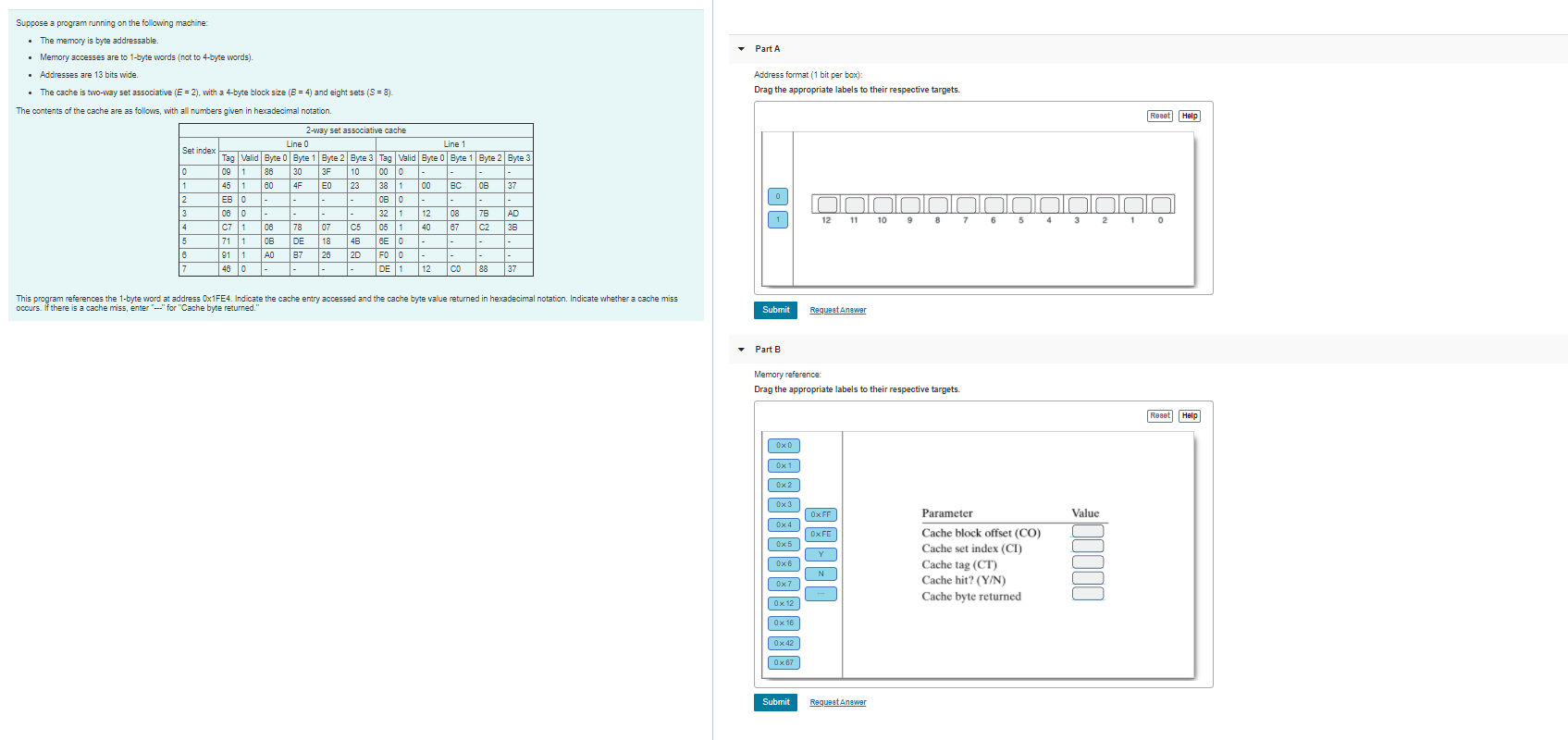
Part A Suppose a program running on the following machine: The memory is byte addressable. Memory accesses are to 1-byte words (not to 4-byte words). Addresses are 13 bits wide. The cache is two-way set associative (E = 2), with a 4-byte block size (B = 4) and eight sets (S = 3). The contents of the cache are as follows, with all numbers given in hexadecimal notation. Address format (1 bit per box): Drag the appropriate labels to their respective targets. Reset Help 0 2-way set associative cache Line 0 Set index Line 1 Tag Valid Byte Byte 1 Byte 2 Byte 3 Tag Valid Byte Byte 1 Byte 2 Byte 3 0 09 1 86 30 3F 10 00 0 1 451 60 4F EO 23 38 1 00 BC OB 37 2 | OBO - 3 06 0 - 32 1 12 08 7B AD 4 C7 1 06 78 07 C5 051 40 87 36 5 711 06 DE 18 48 BEO 8 91 1 AD B7 26 2D FOO | 46 0 DE 1 12 CO 88 37 1 12 11 10 9 8 4 3 2 1 0 This program references the 1-byte word at address Ox 1FE4. Indicate the cache entry accessed and the cache byte value returned in hexadecimal notation. Indicate whether a cache miss occurs. If there is a cache miss, enter --" for "Cache byte returned. Submit Request Answer Part B Memory reference: Drag the appropriate labels to their respective targets. Reset Help I oxo Ox 1 Ox2 0x3 OxFF Value Ox 4 OxFE . 0x5 Y Parameter Cache block offset (CO) Cache set index (CI) Cache tag (CT) Cache hit? (Y/N) Cache byte returned Ox6 N 0x7 | 0x12 0x 16 Ox 42 0 x 67 Submit Request
Step by Step Solution
There are 3 Steps involved in it

Get step-by-step solutions from verified subject matter experts
 Study Help