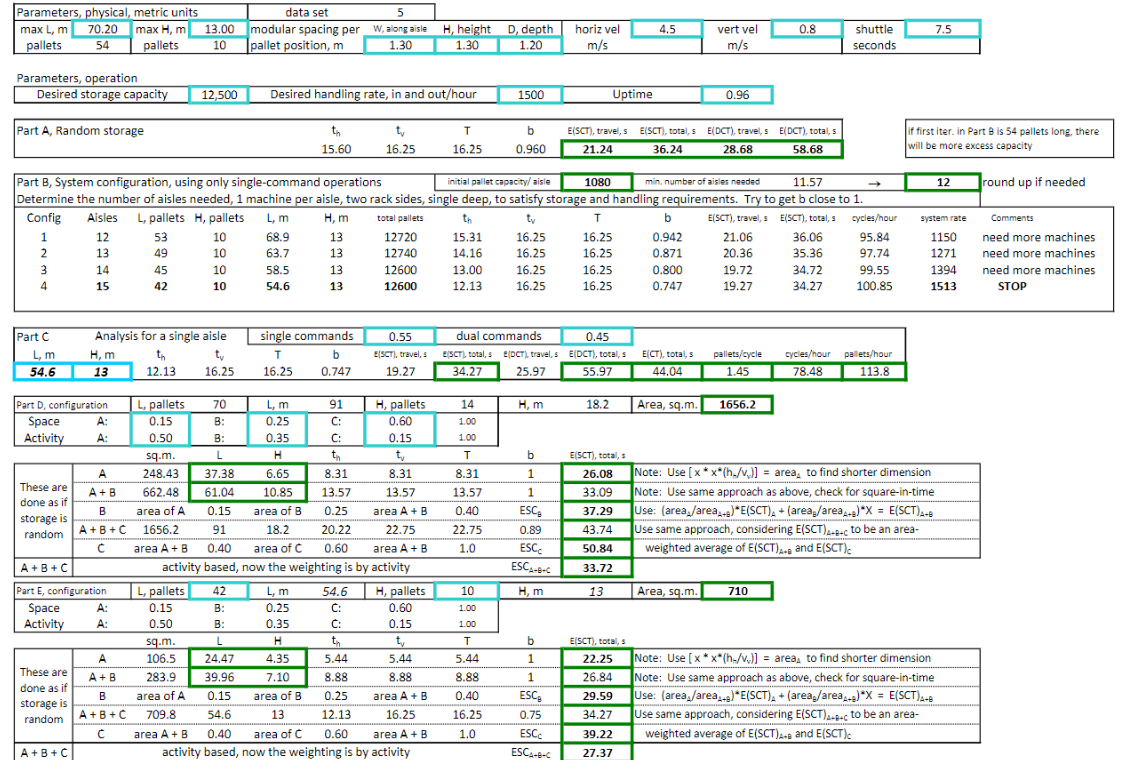
Question: Part E, speeds and modular dimensions are the same as above For a single aisle of height and length determined in Part B, and class-based
Part E, speeds and modular dimensions are the same as above For a single aisle of height and length determined in Part B, and class-based storage, determine the expected single-command cycle time. Storage requirements by class are the same as inpart D, {a%, b%, c%}. Activity by class is the same as imPart D, {e%, %, g%}. Use a continuous representation of the rack, and ignore any possible discrepancy between the modular spacing and what vou determine to be class boundaries. Determine the expected total number of pallets that can be handled per hour. Parameters, physical, metric units data set 5 max L, m 70.20 max H, m 13.00 modular spacing per W, along aisle H, height D, depth horiz vel 4.5 vert vel 0.8 shuttle 7.5 pallets 54 pallets 10 pallet position, m 1.30 1.30 1.20 n/s m/s seconds Parameters, operation Desired storage capacity 12,500 Desired handling rate, in and out/hour 1500 Uptime 0.96 Part A, Random storage th ty E(SCT), travel, s E(SCT), total, s E(DCT), travel, s E(DCT), total, s If first iter. In Part B is 54 pallets long, there 15.60 16.25 16.25 0.960 21.24 16.24 28.68 58.68 will be more excess capacity Part B, System configuration, using only single-command operations initial pallet capacity/ aisle 1080 min, number of aisles needed 11.57 12 round up if needed Determine the number of aisles needed, 1 machine per aisle, two rack sides, single deep, to satisfy storage and handling requirements. Try to get b close to 1 Config Aisles L, pallets H, pallets L, m H, m total pallets ty E(SCT), travel, s E(SCT), total, s cycles/hour system rate Comments 12 53 10 68.9 13 12720 15.31 16.25 16.25 0.942 21.06 36.06 95.84 1150 need more machines 13 49 10 63.7 13 12740 14.16 16.25 16.25 0.871 20.36 35.36 97.74 127 need more machines 14 45 10 58.5 13 12600 13.00 16.25 16.25 0.800 19.72 34.72 99.55 1394 need more machines 15 42 10 54.6 13 12600 12.13 16.25 16.25 0.747 19.27 34.27 100.85 1513 STOP Part C Analysis for a single aisle single commands 0.55 dual commands 0.45 L, m H, m th (SCT), travel, : E(5CT), total, s E(DCT) travel,s E(DCT), total, s E(CT), total, s pallets/cycle cycles/hour pallets/hour 54.6 13 12.13 16.25 16.25 0.747 19.27 34.27 25.97 55.97 44.04 1.45 78.48 113.8 Part D, configuration L, pallets 70 L, m 91 H, pallets 14 H, m 18.2 Area, sq.m. 1656.2 Space A 0.15 0.25 0.60 1.00 Activity 0.50 0.35 0.15 1.00 sq.m. H tv T b E(SCT), total, s A 248.43 37.38 6.65 8.31 8.31 8.31 26.08 Note: Use [ x * x"(h./v.]] = area, to find shorter dimension These are A+ 8 662.48 61.04 10.85 13.57 13.57 13.57 33.09 Note: Use same approach as above, check for square-in-time done as if B area of A 0.15 area of B 0.25 area A + B 0.40 ESC 37.29 Use: (area,/area.+)*E(SCT), + (area,/areaA+:)"X = E(SCT)A-B storage is A+B +C 91 random 1656.2 18.2 20.22 22.75 22.75 0.89 43.74 Use same approach, considering E(SCT)..+c to be an area- area A + B 0.40 area of C 0.60 area A + B 1.0 ESCC 50.84 weighted average of E(SCT).; and E(SCT) A+ B +C activity based, now the weighting is by activity ESCA-B-C 33.72 Part E, configuration L, pallets 42 L, m 54.6 H, pallets 10 H, m 13 Area, sq.m. 710 Space A 0.15 B: 0.25 C: 0.60 1.00 Activity A. 0.50 B: 0.35 0.15 1.00 sq.m. ty b E(SCT), totel, s A 106.5 24.47 4.35 5.44 5.44 5.44 22.25 Note: Use [ x * x"(h./v.]] = area. to find shorter dimension These are A+ B 283.9 39.96 7.10 8.88 8.88 8.88 1 26.84 Note: Use same approach as above, check for square-in-time done as if area of A 0.15 area of B 0.25 area A + B D.40 ESC 29.59 Use: (area,/area.. )"E(SCT), + (area,/area+:)"x = E(SCT)A- storage is random A+B +C 709.8 54.6 13 12.13 16.25 16.25 0.75 34.27 Use same approach, considering E(SCT)...+. to be an area- C area A + B 0.40 area of C 0.60 area A + B 1.0 ESCO 39.27 weighted average of E(SCT)+; and E(SCT) + C activity based, now the weighting is by activity ESCA-B-C 27.37
Step by Step Solution
There are 3 Steps involved in it
1 Expert Approved Answer
Step: 1 Unlock
Question Has Been Solved by an Expert!
Get step-by-step solutions from verified subject matter experts
Step: 2 Unlock
Step: 3 Unlock
Students Have Also Explored These Related Law Questions!










 Study Help