







Question: Part II - Elo Ratings One cf the earliest examples of a convergent, adaptive Markov process was the rating system devised by Arpad Elo to
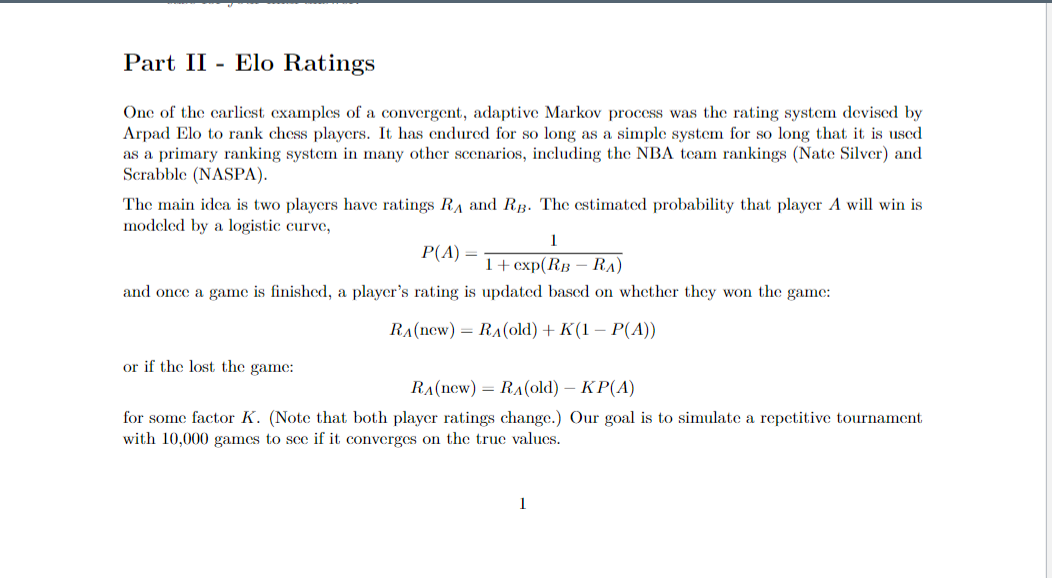
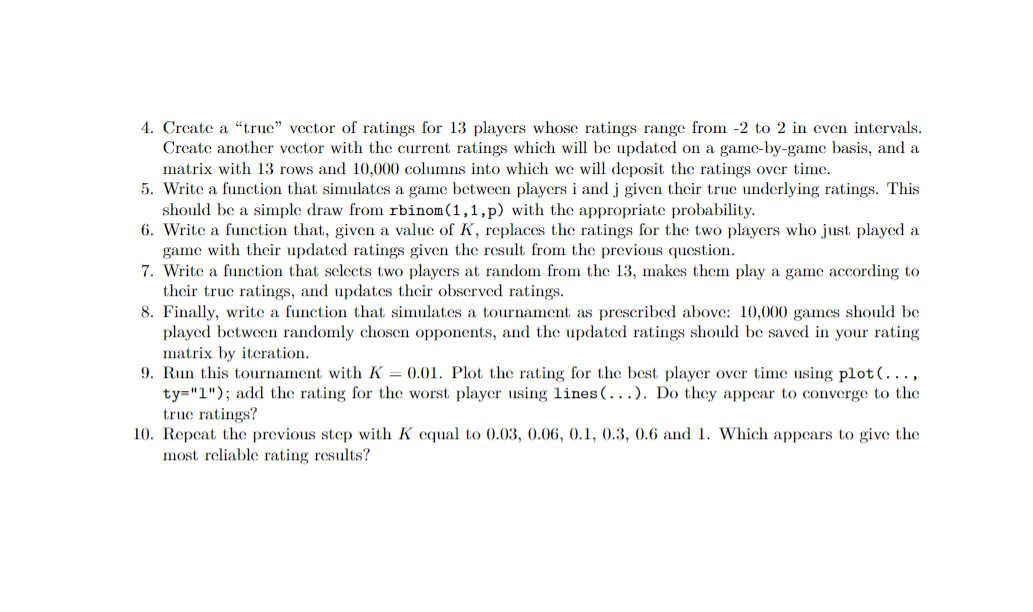
Part II - Elo Ratings One cf the earliest examples of a convergent, adaptive Markov process was the rating system devised by Arpad Elo to rank chess players. It has endured for so long as a simple system for so long that it is used as a primary ranking system in many other scenarios, including the NBA team rankings {Nate Silver} and Scrabble (NASPA). The main idea is two phyers have ratings RA and R\". The estimated probability that player A will win is modeled by a logistic curve, 1 m and once a game is nished, a player's rating is updated based on whether they won the game: PM) = Rx.(new) = R(01{l)+ K(1 PUD) or if the lost the game: Rnew) = Ra(eld) KP(A) for some factor K. [Note that both player ratings change.) Our goal is to s'nmllate a repetitive tournament with 10,000 games to see if it converges on the true values. c1 9. lil. . Create a \"true" vector of ratings for 13 players whose ratings range from 2 to '2 in even intervals. Create another vector with the current ratings which will be updated on a gamebygame basis, and a matrix with 13 rows and 10,000 columns into which we will deposit the ratings over time. . Write a function that simulates a game between players i and j given their true inlderlying ratings. This should be a simple draw from rhinem , l ,p) with the appropriate probability. . Write a function that, given a value of K, replaces the ratings for the two players who just played a game with their updated ratings given the result from the previous question. . Write a function that selects two players at random irom the 13, makes them play a game according to their true ratings, and updates their observed ratings. . Finally, write a function that simulates a tournament as prescribed above: 10,000 games should be. played between randomly chosen opponents. and the updated ratings should he saved in your rating matrix by ileration. Run this tournament with K = (till. Plot the rating for the best player ever Liane using plot(. . . .. ty-"l"); add the rating for the worst player using linas(. . .). Do they appear to eenverge to the true ratings? Helmet the previous step with K equal to [1.03, {1.06, [1.1. 0.3. [L6 and 1. Which appears to give the most reliable rating results
Step by Step Solution
There are 3 Steps involved in it

Get step-by-step solutions from verified subject matter experts
 Study Help