







Question: Percent Yield = Actual Yield x 100 % Theoretical Yield To determine the limiting reactant and theoretical yield proceed as follows: 1) Use the
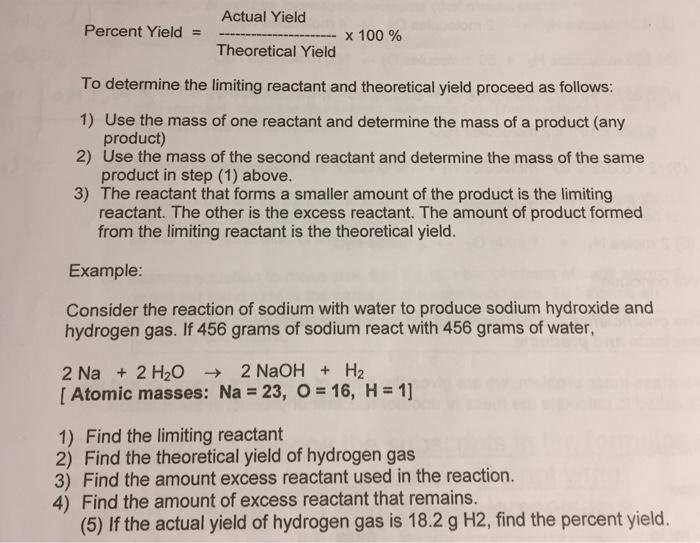
Percent Yield = Actual Yield x 100 % Theoretical Yield To determine the limiting reactant and theoretical yield proceed as follows: 1) Use the mass of one reactant and determine the mass of a product (any product) 2) Use the mass of the second reactant and determine the mass of the same product in step (1) above. 3) The reactant that forms a smaller amount of the product is the limiting reactant. The other is the excess reactant. The amount of product formed from the limiting reactant is the theoretical yield. Example: Consider the reaction of sodium with water to produce sodium hydroxide and hydrogen gas. If 456 grams of sodium react with 456 grams of water, 2 Na + 2 HO 2 NaOH + H [Atomic masses: Na = 23, O=16, H = 1] 1) Find the limiting reactant 2) Find the theoretical yield of hydrogen gas 3) Find the amount excess reactant used in the reaction. 4) Find the amount of excess reactant that remains. (5) If the actual yield of hydrogen gas is 18.2 g H2, find the percent yield.
Step by Step Solution
3.37 Rating (153 Votes )
There are 3 Steps involved in it
1 According to the Reaction 2 Nat 2H0 2NaOH 3 20 46g of Na react with 36 gr of H0 9 4569 of N... View full answer

Get step-by-step solutions from verified subject matter experts
 Study Help