



Question: PhET Lab: Charges and Fields Other charge distributions. Parallel plate: Reset your simulation first. Set 1 nC at its previous spot and now add several
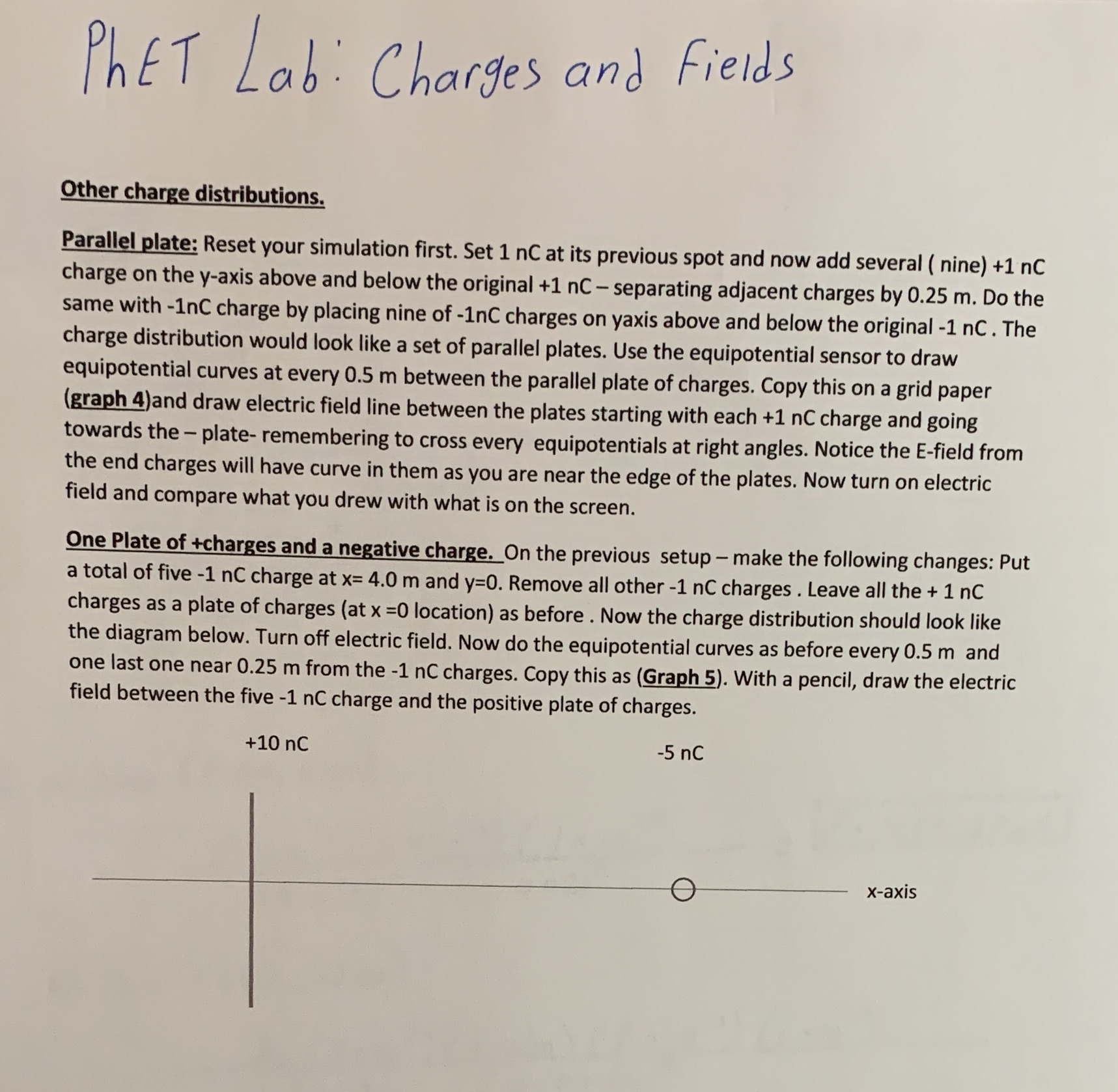
PhET Lab: Charges and Fields Other charge distributions. Parallel plate: Reset your simulation first. Set 1 nC at its previous spot and now add several ( nine) +1 nc charge on the y-axis above and below the original +1 nC - separating adjacent charges by 0.25 m. Do the same with -InC charge by placing nine of -InC charges on yaxis above and below the original -1 nc . The charge distribution would look like a set of parallel plates. Use the equipotential sensor to draw equipotential curves at every 0.5 m between the parallel plate of charges. Copy this on a grid paper (graph 4)and draw electric field line between the plates starting with each +1 nC charge and going towards the - plate- remembering to cross every equipotentials at right angles. Notice the E-field from the end charges will have curve in them as you are near the edge of the plates. Now turn on electric field and compare what you drew with what is on the screen. One Plate of +charges and a negative charge. On the previous setup - make the following changes: Put a total of five -1 nC charge at x= 4.0 m and y=0. Remove all other -1 nC charges . Leave all the + 1 nc charges as a plate of charges (at x =0 location) as before . Now the charge distribution should look like the diagram below. Turn off electric field. Now do the equipotential curves as before every 0.5 m and one last one near 0.25 m from the -1 nC charges. Copy this as (Graph 5). With a pencil, draw the electric field between the five -1 nC charge and the positive plate of charges. +10 nC -5 nc x-axis
Step by Step Solution
There are 3 Steps involved in it

Get step-by-step solutions from verified subject matter experts