Question: Pleaaaase please please answer these 4 questions for the case study : 1- Write a small summary of this case study. 2- Describe at least
Pleaaaase please please answer these 4 questions for the case study :
1- Write a small summary of this case study.
2- Describe at least two of the most important aspects of Wal-Mart Supply chain
3- Define at least two of Wal-Mart operational processes and explain how they are implemented by Wal-Mart.
4- Determine some of the assessment metrics that can be used to evaluate the operational processes defined in question (2).
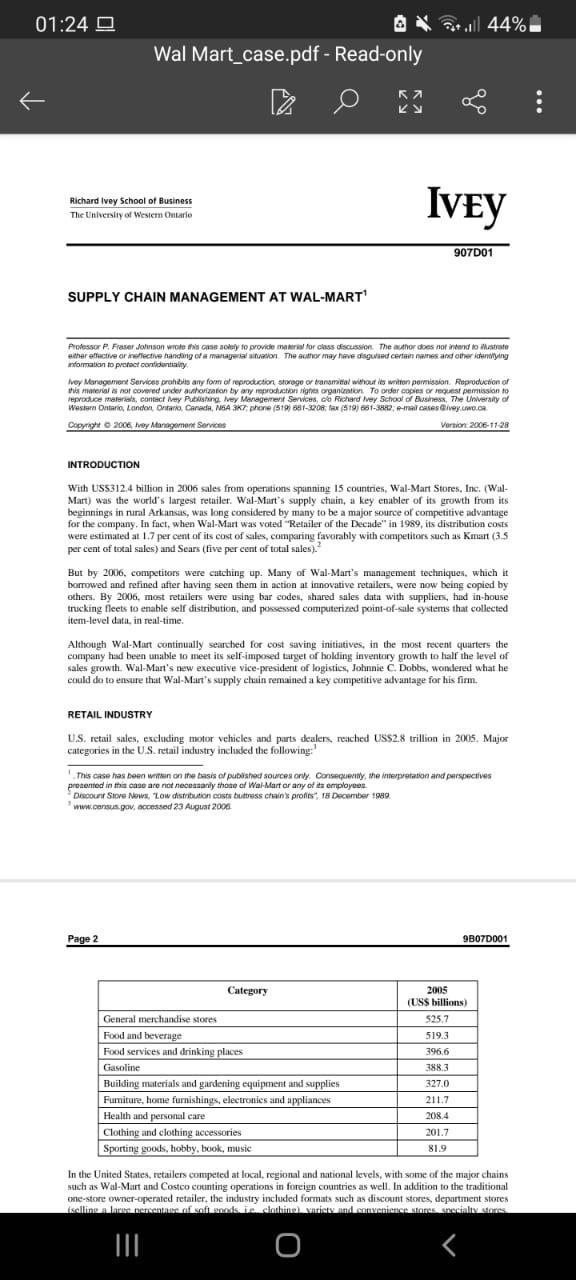
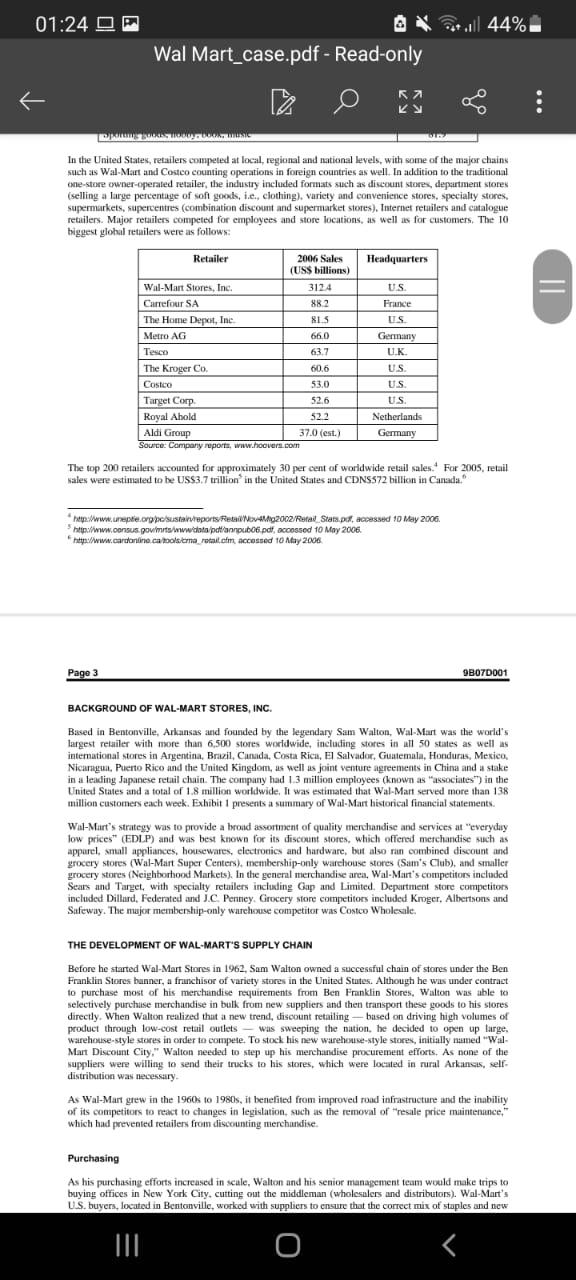
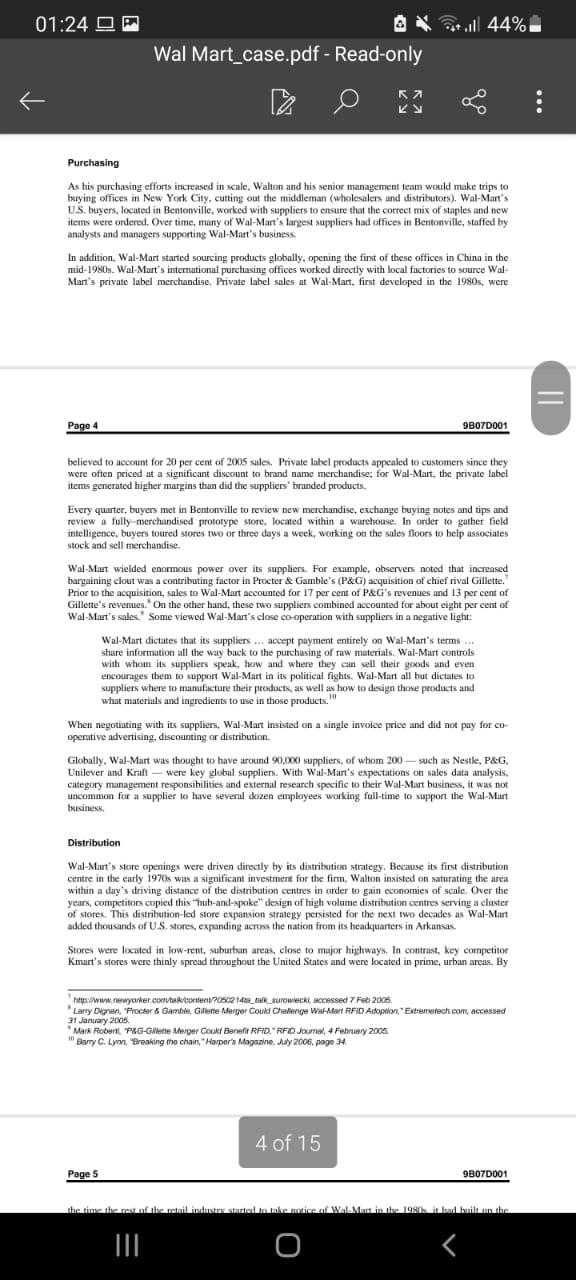
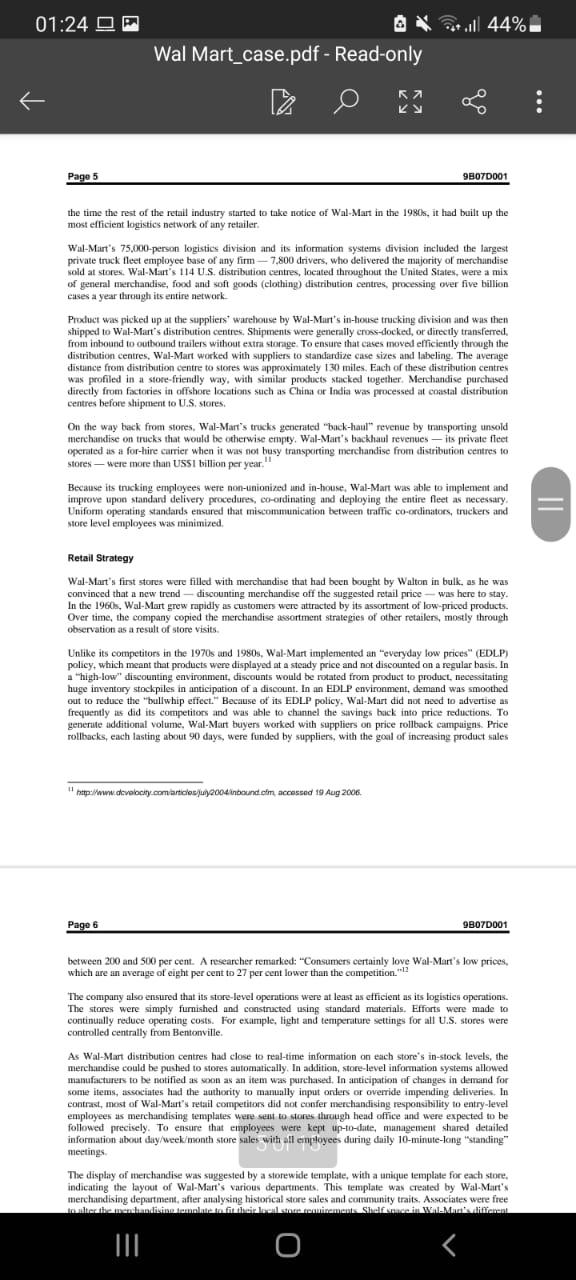
01:24 0 - 44 % * a Wal Mart_case.pdf - Read-only KT Richard Ivey School of Business The University of Westem Ontario Ivey 907D01 SUPPLY CHAIN MANAGEMENT AT WAL-MART Professor P. Fraser Johnson wrote in sy to provide all for class discussion. The author does not intend to Maste either active ar ffective handing of managerialution The author may have disguised certaines and ordentlying information to protect contdutavy Ivey Management Services prohibits any form a reproduction storage or transmite without its witten permission. Reproduction of This materiales nor covered under authorization by any reproduction rights organization. To order copies or request permission to reproduce mais contact y Publishing Ivey Management Services, co Richard Ivey School of Business, The University of Western Ontario, London, Ontario, Canada, NSA3KT phone (519) 661-320 x 519) 661-3822, e-mailesivey.IO.GR Copyright 2006 Ivey Management Services Vertion 2006-11-28 INTRODUCTION With US5312.4 billion in 2006 sales from operations spanning 15 countries, Wal-Mart Stores, Inc. (Wal- Mart) was the world's largest retailer. Wal-Mart's supply chain, a key enabler of its growth from its beginnings in nimal Arkansas, was long considered by many to be a major source of competitive advantage for the company. In fact, when Wal-Mart was voted Retailer of the Decade" in 1989, its distribution costs were estimated at 17 per cent of its cost of sales, comparing favorably with competitors such as Kmart (3.5 per cent of total sales) and Sears (five per cent of total sales). But by 2006, competitors were catching up. Many of Wal-Mart's management techniques, which it borrowed and refined after having seen them in action at innovative retailers, were now being copied by others. By 2006, most retailers were using bar codes, shared sales data with suppliers, had in-house trucking fleets to enable self distribution, and possessed computerized point-of-sale systems that collected item-level data, in real-time. Although Wal-Mart continually searched for cost saving initiatives, in the most recent quarters the company had been unable to meet its self-imposed target of hobling inventory growth to half the level of sales growth. Wal-Mart's new executive vice-president of logistics, Johnnie C. Dobbs, wondered what he could do to ensure that Wal-Mart's supply chain remained a key competitive advantage for his firm. RETAIL INDUSTRY US, retail sales, excluding motor vehicles and parts dealers, reached US$2.8 trillion in 2005. Major categories in the U.S. retail industry included the following: This case has been in on the basis of published sources only. Consequently, the interpretation and perspectives presented in this case are not necessarily those of Wal-Mart or any of its employees Discount Store Now, low distribution costs buttress chain's profiles, December 1940 www.census.gov, accessed 23 August 2004 Page 2 9B07D001 Category General merchandise stores Food and beverage Food services and drinking places Gasoline Building materials and gardening equipment and supplies Fumiture, home furnishings, electronics and appliances Health and personal care Clothing and clothing accessories Sporting goods, hobby, book, music 2005 (USS billions) ) 525.7 519.3 3966 388.3 327.0 211.7 208.4 201.7 81.9 In the United States, retailers competed at local, regional and national levels with some of the majeur chains such as Wal-Mart and Costco counting operations in foreign countries as well. In addition to the traditional e-store owner-operated retailer, the industry included formats such as discount stores, department stores selling commercent of soft clothing writind convenience on the stones









 Study Help