



Question: Please answe all! Question 7 (1 point) Bob tries to teach the new employee how to use the forklift. Bob has been driving a forklift
Please answe all! 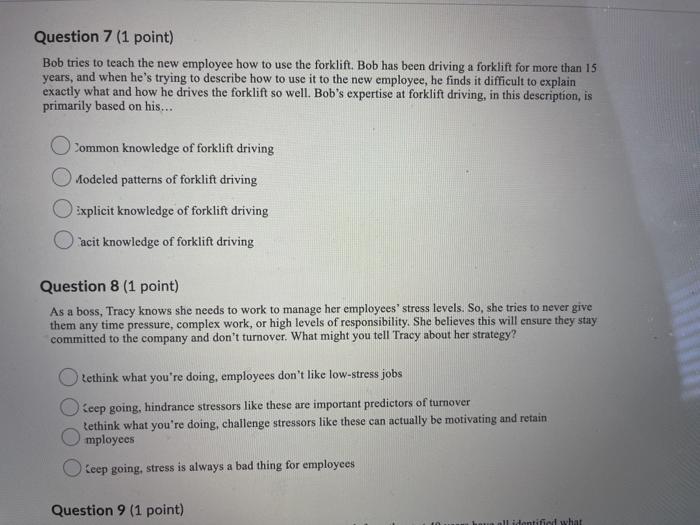
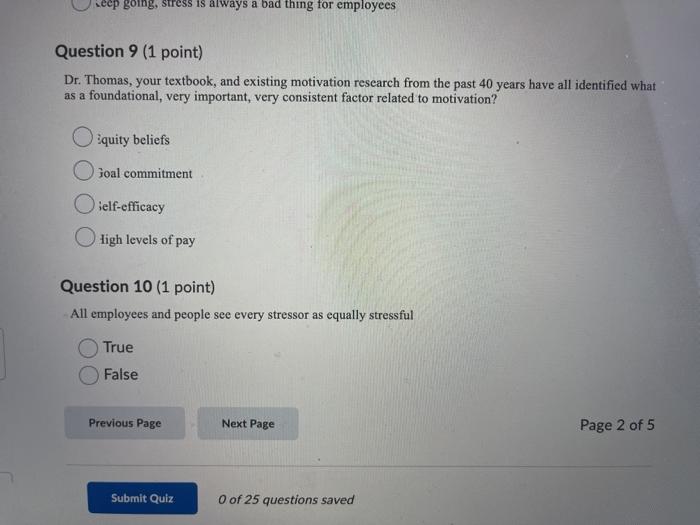
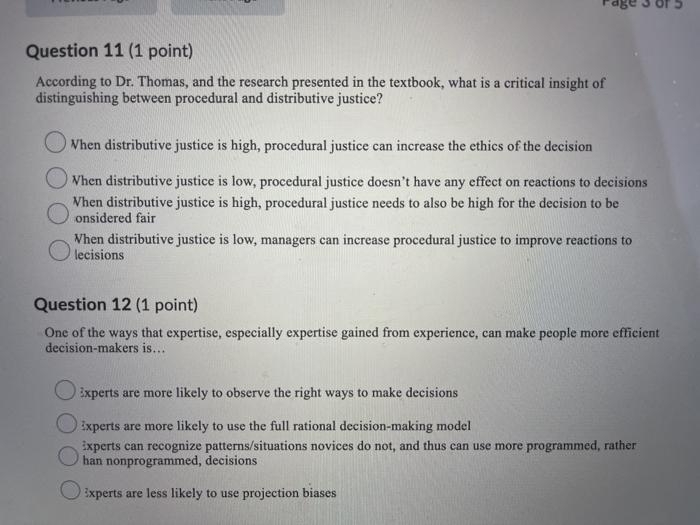
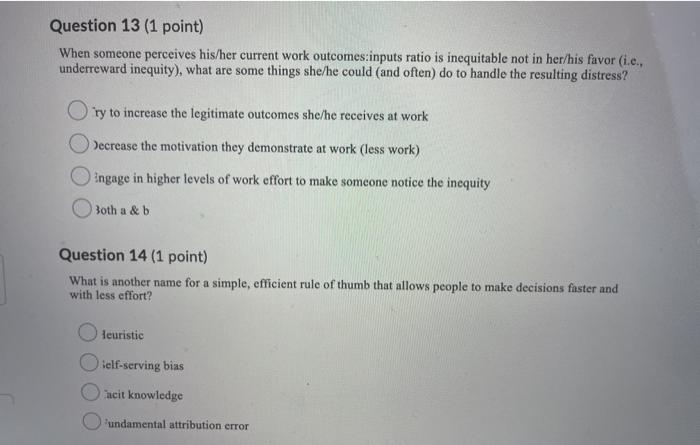
Question 7 (1 point) Bob tries to teach the new employee how to use the forklift. Bob has been driving a forklift for more than 15 years, and when he's trying to describe how to use it to the new employee, he finds it difficult to explain exactly what and how he drives the forklift so well. Bob's expertise at forklift driving, in this description, is primarily based on his... Common knowledge of forklift driving Modeled patterns of forklift driving explicit knowledge of forklift driving acit knowledge of forklift driving Question 8 (1 point) As a boss, Tracy knows she needs to work to manage her employees' stress levels. So, she tries to never give them any time pressure, complex work, or high levels of responsibility. She believes this will ensure they stay committed to the company and don't turnover. What might you tell Tracy about her strategy? lethink what you're doing, employees don't like low-stress jobs cep going, hindrance stressors like these are important predictors of turnover lethink what you're doing, challenge stressors like these can actually be motivating and retain mployees teep going, stress is always a bad thing for employees Question 9 (1 point) all identified what Leep going, stress is always a bad thing for employees Question 9 (1 point) Dr. Thomas, your textbook, and existing motivation research from the past 40 years have all identified what as a foundational, very important, very consistent factor related to motivation? Equity beliefs joal commitment self-efficacy ligh levels of pay Question 10 (1 point) All employees and people see every stressor as equally stressful True False Previous Page Next Page Page 2 of 5 Submit Quiz O of 25 questions saved Question 11 (1 point) According to Dr. Thomas, and the research presented in the textbook, what is a critical insight of distinguishing between procedural and distributive justice? When distributive justice is high, procedural justice can increase the ethics of the decision When distributive justice is low, procedural justice doesn't have any effect on reactions to decisions When distributive justice is high, procedural justice needs to also be high for the decision to be onsidered fair When distributive justice is low, managers can increase procedural justice to improve reactions to lecisions Question 12 (1 point) One of the ways that expertise, especially expertise gained from experience, can make people more efficient decision-makers is... experts are more likely to observe the right ways to make decisions Experts are more likely to use the full rational decision-making model experts can recognize patterns/situations novices do not, and thus can use more programmed, rather han nonprogrammed, decisions experts are less likely to use projection biases Question 13 (1 point) When someone perceives his/her current work outcomes:inputs ratio is inequitable not in her/his favor (i.e., underreward inequity), what are some things she/he could (and often) do to handle the resulting distress? O ry to increase the legitimate outcomes she/he receives at work Decrease the motivation they demonstrate at work (less work) Ingage in higher levels of work effort to make someone notice the inequity Both a &b Question 14 (1 point) What is another name for a simple, efficient rule of thumb that allows people to make decisions faster and with less effort? leuristic ielf-serving bias acit knowledge fundamental attribution error
Step by Step Solution
There are 3 Steps involved in it
1 Expert Approved Answer
Step: 1 Unlock

Question Has Been Solved by an Expert!
Get step-by-step solutions from verified subject matter experts
Step: 2 Unlock
Step: 3 Unlock