Question: please answer 11 & 12 Samsung vs. Apple: Inside The Brutal War For Smartphone Dominance 1 We need more creativity! Dale Sohn, the CEO of
please answer 11 & 12
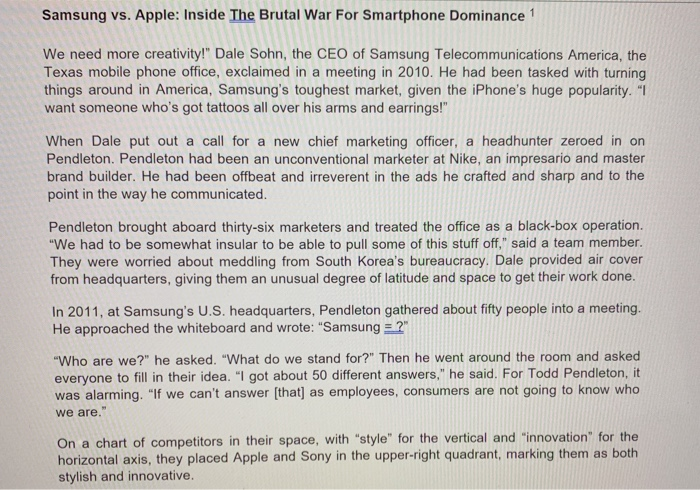
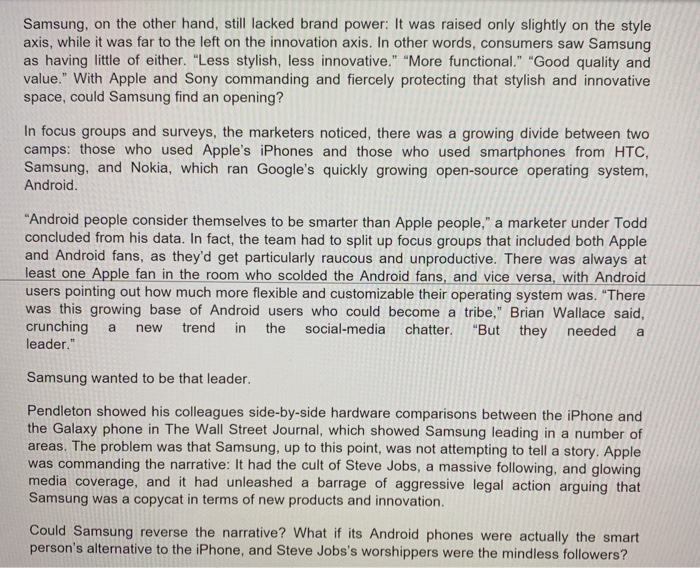
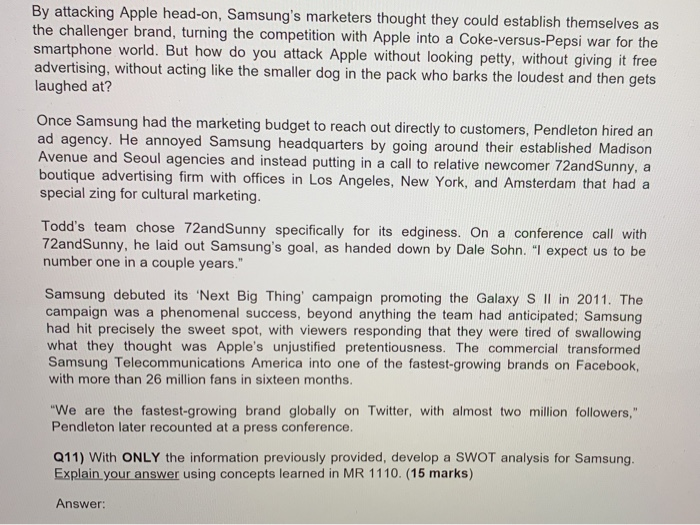
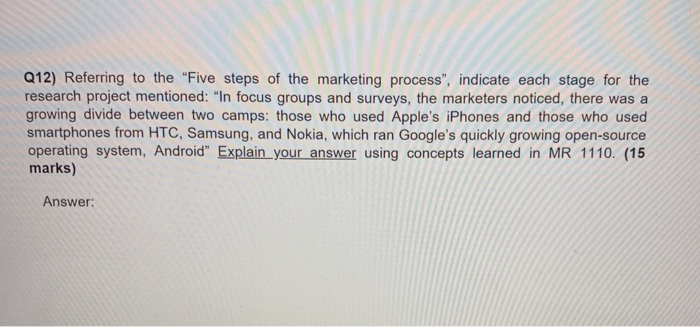
Samsung vs. Apple: Inside The Brutal War For Smartphone Dominance 1 We need more creativity!" Dale Sohn, the CEO of Samsung Telecommunications America, the Texas mobile phone office, exclaimed in a meeting in 2010. He had been tasked with turning things around in America, Samsung's toughest market, given the iPhone's huge popularity." want someone who's got tattoos all over his arms and earrings!" When Dale put out a call for a new chief marketing officer, a headhunter zeroed in on Pendleton. Pendleton had been an unconventional marketer at Nike, an impresario and master brand builder. He had been offbeat and irreverent in the ads he crafted and sharp and to the point in the way he communicated. Pendleton brought aboard thirty-six marketers and treated the office as a black-box operation. "We had to be somewhat insular to be able to pull some of this stuff off," said a team member. They were worried about meddling from South Korea's bureaucracy. Dale provided air cover from headquarters, giving them an unusual degree of latitude and space to get their work done. In 2011, at Samsung's U.S. headquarters, Pendleton gathered about fifty people into a meeting. He approached the whiteboard and wrote: "Samsung = ?" "Who are we?" he asked, "What do we stand for?" Then he went around the room and asked everyone to fill in their idea. "I got about 50 different answers," he said. For Todd Pendleton, it was alarming. "If we can't answer [that] as employees, consumers are not going to know who we are. On a chart of competitors in their space, with "style" for the vertical and innovation for the horizontal axis, they placed Apple and Sony in the upper-right quadrant, marking them as both stylish and innovative. Samsung, on the other hand, still lacked brand power: It was raised only slightly on the style axis, while it was far to the left on the innovation axis. In other words, consumers saw Samsung as having little of either. "Less stylish, less innovative." "More functional." "Good quality and value." With Apple and Sony commanding and fiercely protecting that stylish and innovative space, could Samsung find an opening? In focus groups and surveys, the marketers noticed, there was a growing divide between two camps: those who used Apple's iPhones and those who used smartphones from HTC, Samsung, and Nokia, which ran Google's quickly growing open-source operating system, Android "Android people consider themselves to be smarter than Apple people," a marketer under Todd concluded from his data. In fact, the team had to split up focus groups that included both Apple and Android fans, as they'd get particularly raucous and unproductive. There was always at least one Apple fan in the room who scolded the Android fans, and vice versa, with Android users pointing out how much more flexible and customizable their operating system was. "There was this growing base of Android users who could become a tribe," Brian Wallace said, crunching trend in the social-media chatter "But they needed leader." a new Samsung wanted to be that leader. Pendleton showed his colleagues side-by-side hardware comparisons between the iPhone and the Galaxy phone in The Wall Street Journal, which showed Samsung leading in a number of areas. The problem was that Samsung, up to this point, was not attempting to tell a story. Apple was commanding the narrative: It had the cult of Steve Jobs, a massive following, and glowing media coverage, and it had unleashed a barrage of aggressive legal action arguing that Samsung was a copycat in terms of new products and innovation. Could Samsung reverse the narrative? What if its Android phones were actually the smart person's alternative to the iPhone, and Steve Jobs's worshippers were the mindless followers? By attacking Apple head-on, Samsung's marketers thought they could establish themselves as the challenger brand, turning the competition with Apple into a Coke-versus-Pepsi war for the smartphone world. But how do you attack Apple without looking petty, without giving it free advertising, without acting like the smaller dog in the pack who barks the loudest and then gets laughed at? Once Samsung had the marketing budget to reach out directly to customers, Pendleton hired an ad agency. He annoyed Samsung headquarters by going around their established Madison Avenue and Seoul agencies and instead putting in a call to relative newcomer 72and Sunny, a boutique advertising firm with offices in Los Angeles, New York, and Amsterdam that had a special zing for cultural marketing. Todd's team chose 72and Sunny specifically for its edginess. On a conference call with 72and Sunny, he laid out Samsung's goal, as handed down by Dale Sohn. "I expect us to be number one in a couple years." Samsung debuted its 'Next Big Thing campaign promoting the Galaxy S II in 2011. The campaign was a phenomenal success, beyond anything the team had anticipated; Samsung had hit precisely the sweet spot, with viewers responding that they were tired of swallowing what they thought was Apple's unjustified pretentiousness. The commercial transformed Samsung Telecommunications America into one of the fastest-growing brands on Facebook, with more than 26 million fans in sixteen months. "We are the fastest-growing brand globally on Twitter, with almost two million followers," Pendleton later recounted at a press conference. Q11) With ONLY the information previously provided, develop a SWOT analysis for Samsung. Explain your answer using concepts learned in MR 1110. (15 marks) Answer: Q12) Referring to the "Five steps of the marketing process", indicate each stage for the research project mentioned: "In focus groups and surveys, the marketers noticed, there was a growing divide between two camps: those who used Apple's iPhones and those who used smartphones from HTC, Samsung, and Nokia, which ran Google's quickly growing open-source operating system, Android" Explain your answer using concepts learned in MR 1110. (15 marks)









 Study Help