Question: please answer 3 case study questions INTERACTIVE SESSION ORGANIZATI ORGANIZATIONS Al Technamica I mean job loss the hines did not reed them from of repetitive
please answer 3 case study questions 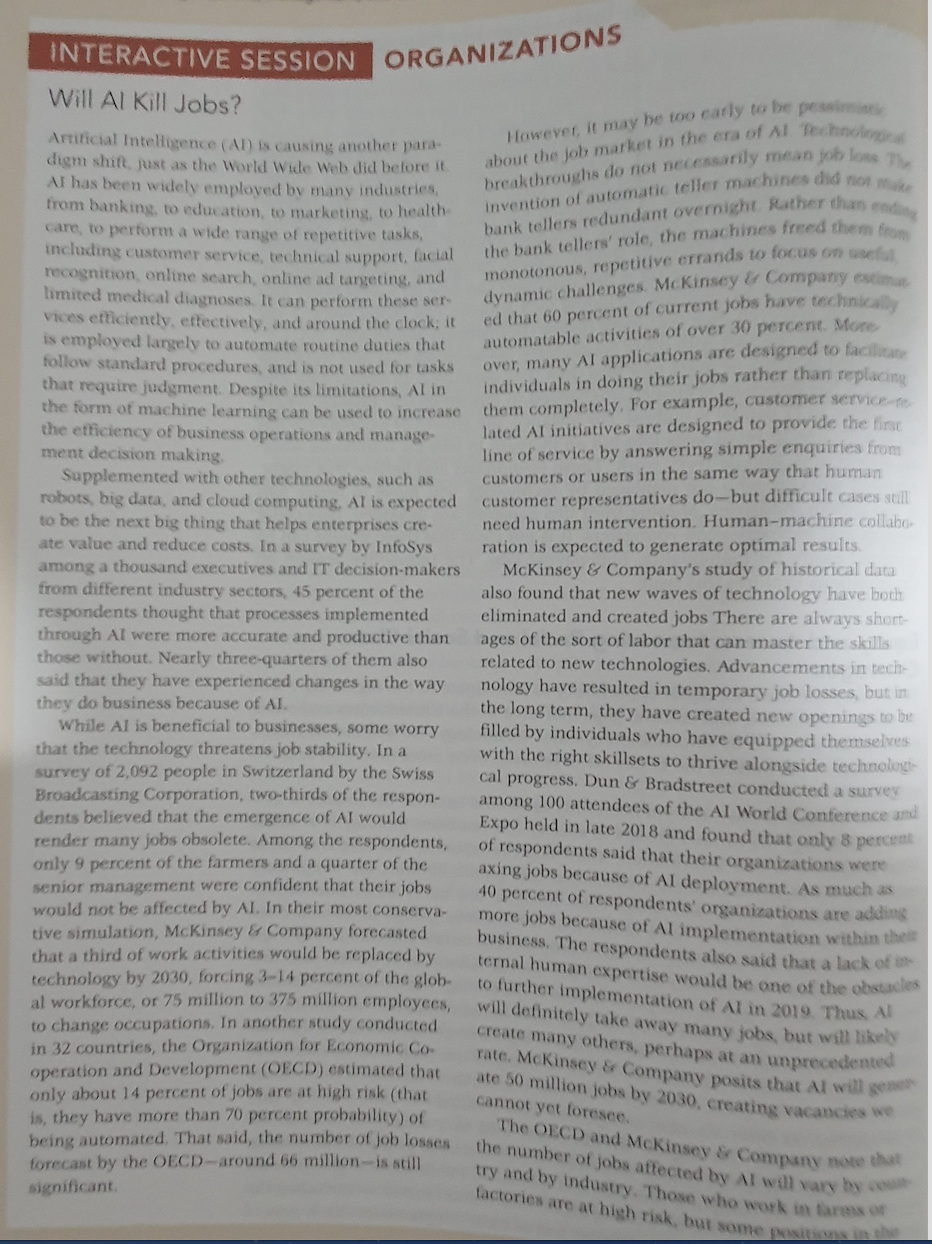
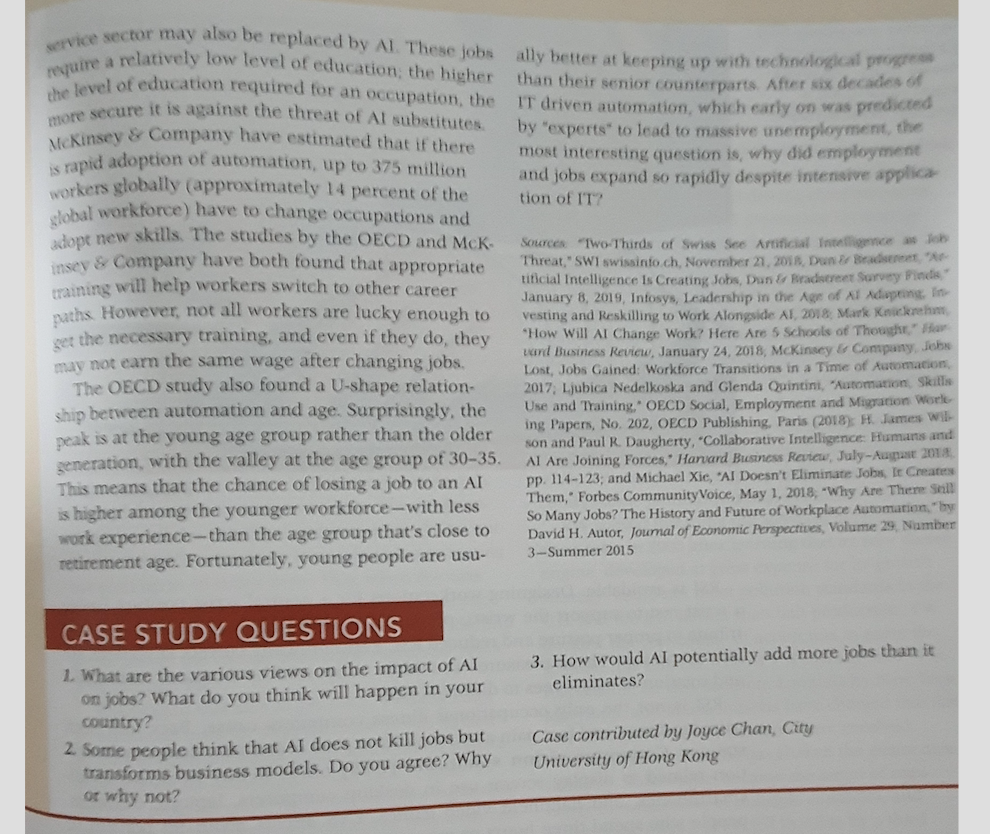
INTERACTIVE SESSION ORGANIZATI ORGANIZATIONS Al Technamica I mean job loss the hines did not reed them from of repetitive tasks, cal support, facial can perform these ser- Will Al Kill Jobs? Artificial Intelligence CAD is causing another part However, it may be 100 ratly to be pes digm shift rust as the World Wide Web did before it about the job market in the era of Al Tech Al has been widely employed by many industries breakthroughs do not necessarily mean from banking to education to marketing to health invention of automatic teller machines dhid care, to perform a wide range of repetitive tasks, bank tellers redundant overnight Rather than including customer service, technical support, facial the bank tellers' role, the machines freed the recognition online search online ad targeting, and monotonous, repetitive errands to focus on Company limited medical diagnoses. It can perform these ser dynamic challenges McKinsey vices etticiently, effectively, and around the clock it 60 percent of current jobs have technical is employed largely to automate routine duties automatable activities of over 30 percent. More follow standard procedures, and is not used for tasks dures, and is not used for tasks over, mar over, many Al applications are designed to face that require judgment. Despite its limitations, Alin agment. Despite its limitations. Al in individuals in doing their jobs rather than replacing the form of machine learning can be used to increase machine learning can be used to increase them completely. For example, customer service the efficiency of business operations and manage- lated Al initiatives are designed to provide the first ment decision making. line of service by answering simple enquiries from Supplemented with other technologies, such as customers or users in the same way that human robots, big data, and cloud computing. Al is expected customer representatives do--but difficult cases still to be the next big thing that helps enterprises cre need human intervention. Human-machine collabo ate value and reduce costs. In a survey by InfoSys ration is expected to generate optimal results among a thousand executives and IT decision-makers McKinsey & Company's study of historical data from different industry sectors, 45 percent of the also found that new waves of technology have both respondents thought that processes implemented eliminated and created jobs There are always short- through Al were more accurate and productive than ages of the sort of labor that can master the skills those without. Nearly three-quarters of them also related to new technologies. Advancements in tech said that they have experienced changes in the way! nology have resulted in temporary job losses, but in they do business because of Al. the long term, they have created new openings to be While Al is beneficial to businesses, some worry filled by individuals who have equipped themselves that the technology threatens job stability. In a with the right skillsets to thrive alongside technolo survey of 2,092 people in Switzerland by the Swiss cal progress. Dun & Bradstreet conducted a survey Broadcasting Corporation, two-thirds of the respon- among 100 attendees of the Al World Conference dents believed that the emergence of AI would Expo held in late 2018 and found that only 8 perce render many jobs obsolete. Among the respondents, of respondents said that their organizations were only 9 percent of the farmers and a quarter of the axing jobs because of Al deployment. As much as senior management were confident that their jobs 40 percent of respondents' organizations are ad would not be affected by Al. In their most conserva more jobs because of Al implementation with tive simulation, McKinsey & Company forecasted that a third of work activities would be replaced by technology by 2030, forcing 3-14 percent of the glob. al workforce, or 75 million to 375 million employees, to change occupations. In another study conducted in 32 countries, the Organization for Economic Co. operation and Development (OECD) estimated that only about 14 percent of jobs are at high risk (that is, they have more than 70 percent probability) of being automated. That said, the number of job losses forecast by the OECD-around 66 million is still significant ! business. The respondents also said that a lack o temal human expertise would be one of the obs to further implementation of Al in 2019. Thus will definitely take away many jobs but will be create many others, perhaps at an unpreceden Tate McKinsey & Company posits that Al w ate 50 million jobs by 2030. creating vacances cannot yet foresce. The OECD and McKinsey & Company the number of jobs affected by Al will vary by try and by industry. Those who work in tres factories are at high risk but some sector may also be replaced by Al. These jobs ally better at keeping up with the service sector may require a relativ better at keeping up with technological proces in their senior counterparts. After six decades of IT driven automation, which early on was predicted by "experts" to lead to massive unemployment, the most interesting question is, why did employment and jobs expand so rapidly despite intensive applica tion of IT? McKinsey & Com is rapid adoption he level of education required for moccupation, the secure it is against the threat of At substitutes nsey & Company have estimated that if there tutes id adoption of automation, up to 375 million es globally (approximately 14 percent of the hal workforce) have to change occupations and pt new skills. The studies by the OECD and McK Company have both found that appropriate training will help workers switch to other career paths. However, not all workers are lucky enough to ut the necessary training, and even if they do, they may not carn the same wage after changing jobs. The OECD study also found a U-shape relation- ship between automation and age. Surprisingly, the peak is at the young age group rather than the older generation, with the valley at the age group of 30-35. This means that the chance of losing a job to an AI is higher among the younger workforce-with less work experience-than the age group that's close to retirement age. Fortunately, young people are usu- Sources Two-Thirds of Swiss See Artificial Inte n ce Job Threat," SWI swissinfo.ch. November 21, 2011, Dun Bad A tificial Intelligence is Creating Jobs, Dun Bradstreer Survey Finds January 8, 2019, Infosys, Leadership in the Age of Al Adoptions in Vesting and Reskilling to Work Alongside Al 2018 Mark Kocke "How Will Al Change Work? Here Are 5 Schools of Tho r and Business Review, January 24, 2018, McKinsey & Company Jobs Lost, Jobs Gained: Workforce Transitions in a Time of Automation 2017, Ljubica Nedelkoska and Glenda Quintini, "Automation Skills Use and Training. OECD Social, Employment and Migration Worte ing Papers, No. 202, OECD Publishing. Paris (2018) H. James Will son and Paul R. Daugherty, "Collaborative Intelligence: Humans and Al Are Joining Forces, Harvard Business Review, July-Aust 2012 pp. 114-123, and Michael Xic, "Al Doesn't Eliminate Jobs, It Crates Them,' Forbes Community Voice, May 1, 2018, "Why Are There Sell So Many Jobs? The History and Future of Workplace Automation by David H. Autor, Journal of Economic Perspectives, Volume 29. Number 3-Summer 2015 CASE STUDY QUESTIONS 3. How would Al potentially add more jobs than it eliminates? 1. What are the various views on the impact of AI on jobs? What do you think will happen in your country? 2. Some people think that Al does not kill jobs but transforms business models. Do you agree? Why or why not? Case contributed by Joyce Chan, City University of Hong Kong









 Study Help