







Question: please answer all for a thumbs up Some hydrolases function with more specificity than others. In lecture, three examples of hydrolases were given when discussing
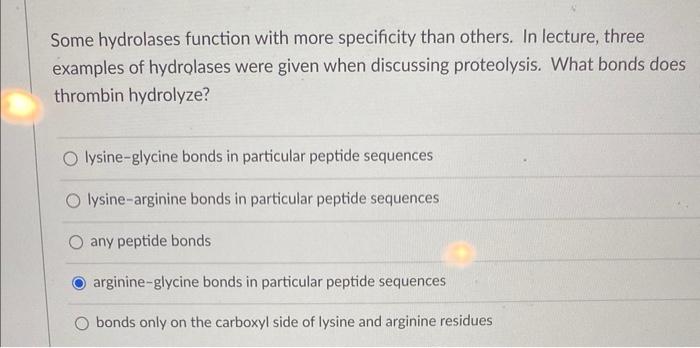
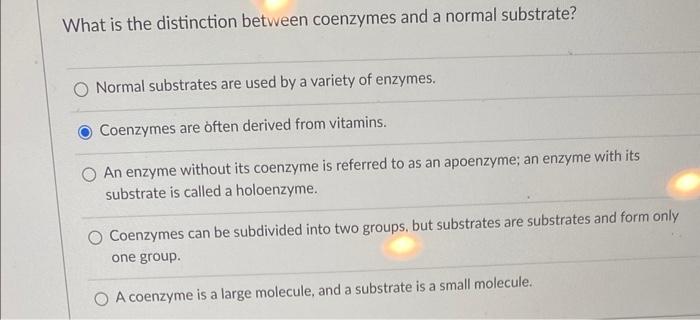
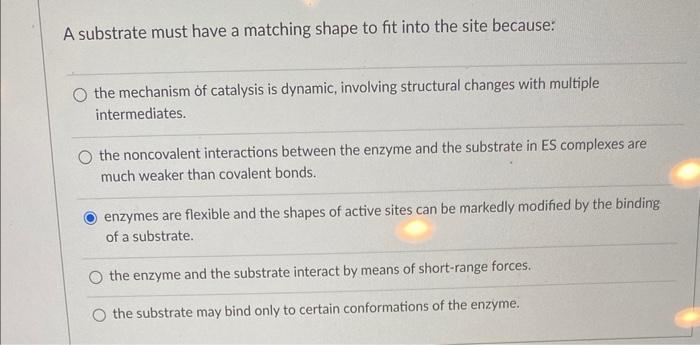
Some hydrolases function with more specificity than others. In lecture, three examples of hydrolases were given when discussing proteolysis. What bonds does thrombin hydrolyze? lysine-glycine bonds in particular peptide sequences lysine-arginine bonds in particular peptide sequences any peptide bonds arginine-glycine bonds in particular peptide sequences bonds only on the carboxyl side of lysine and arginine residues What is the distinction between coenzymes and a normal substrate? Normal substrates are used by a variety of enzymes. Coenzymes are often derived from vitamins. An enzyme without its coenzyme is referred to as an apoenzyme; an enzyme with its substrate is called a holoenzyme. Coenzymes can be subdivided into two groups, but substrates are substrates and form only one group. A coenzyme is a large molecule, and a substrate is a small molecule. A substrate must have a matching shape to fit into the site because: the mechanism of catalysis is dynamic, involving structural changes with multiple intermediates. the noncovalent interactions between the enzyme and the substrate in ES complexes are much weaker than covalent bonds. enzymes are flexible and the shapes of active sites can be markedly modified by the binding of a substrate. the enzyme and the substrate interact by means of short-range forces. the substrate may bind only to certain conformations of the enzyme
Step by Step Solution
There are 3 Steps involved in it

Get step-by-step solutions from verified subject matter experts
 Study Help