







Question: Please answer all the questions 1. How did you select particular projects from the feedback report? 2. What are some of the weaknesses of this
Please answer all the questions
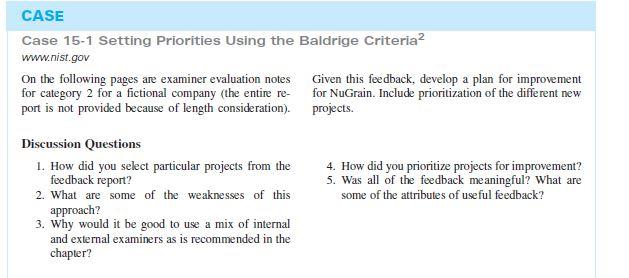
1. How did you select particular projects from the feedback report?
2. What are some of the weaknesses of this approach?
3. Why would it be good to use a mix of internal and external examiners as is recommended in the chapter?
4. How did you prioritize projects for improvement?
5. Was all of the feedback meaningful? What are some of the attributes of useful feedback?
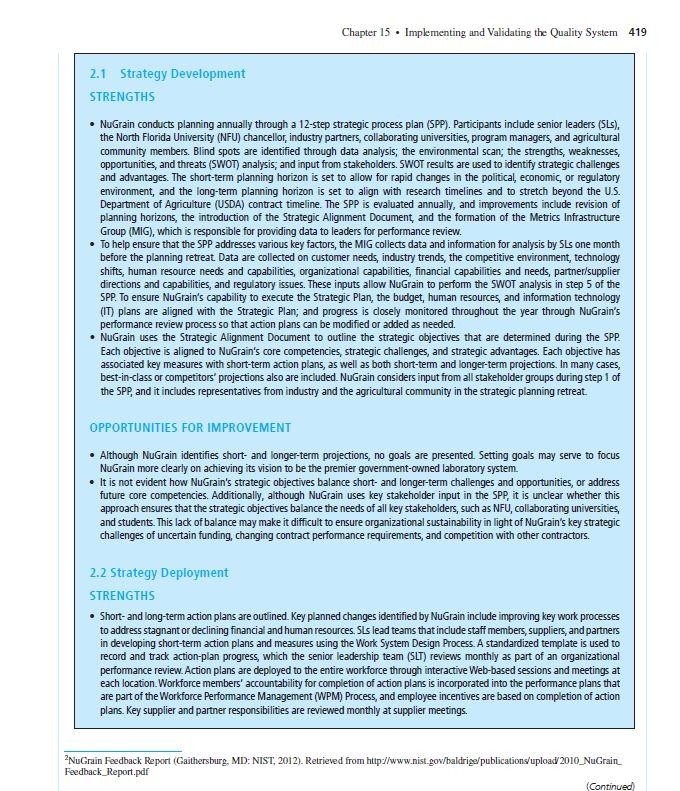
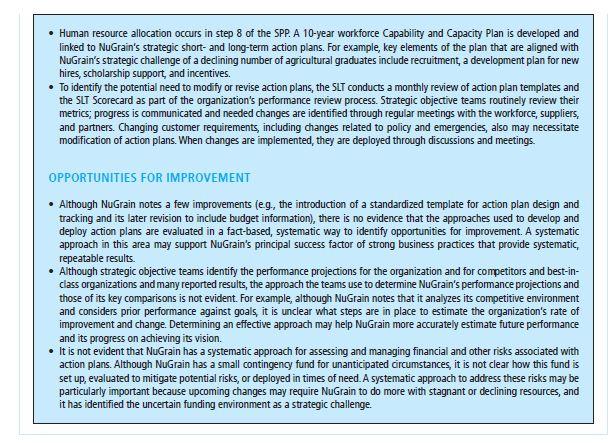
Chapter 15 Implementing and Validating the Quality System 419 . 2.1 Strategy Development STRENGTHS NuGrain conducts planning annually through a 12-step strategic process plan (SPP). Participants include senior leaders (SL), the North Florida University (NFU) chancellor, industry partners, collaborating universities, program managers, and agricultural community members. Blind spots are identified through data analysis; the environmental scan; the strengths, weaknesses, opportunities, and threats (SWOT) analysis, and input from stakeholders. SWOT results are used to identify strategic challenges and advantages. The short-term planning horizon is set to allow for rapid changes in the political, economic or regulatory environment, and the long-term planning horizon is set to align with research timelines and to stretch beyond the U.S. Department of Agriculture (USDA) contract timeline. The SPP is evaluated annually, and improvements include revision of planning horizons, the introduction of the Strategic Alignment Document, and the formation of the Metrics Infrastructure Group (MIG), which is responsible for providing data to leaders performance review To help ensure that the SPP addresses various key factors, the MIG collects data and information for analysis by SLs one month before the planning retreat Data are collected on customer needs, industry trends, the competitive environment, technology shifts, human resource needs and capabilities, organizational capabilities, financial capabilities and needs, partner/supplier directions and capabilities, and regulatory issues. These inputs allow NuGrain to perform the SWOT analysis in step 5 of the SPP. To ensure NuGrain's capability to execute the Strategic Plan, the budget, human resources, and information technology (IT) plans are aligned with the Strategic Plan; and progress is closely monitored throughout the year through NuGrain's performance review process so that action plans can be modified or added as needed. NuGrain uses the Strategic Alignment Document to outline the strategic objectives that are determined during the SPP. Each objective is aligned to NuGrain's core competencies, strategic challenges, and strategic advantages. Each objective has associated key measures with short-term action plans, as well as both short-term and longer-term projections. In many cases, best-in-class or competitors' projections also are included. NuGrain considers input from all stakeholder groups during step 1 of the SPP, and it includes representatives from industry and the agricultural community in the strategic planning retreat OPPORTUNITIES FOR IMPROVEMENT Although NuGrain identifies short- and longer-term projections, no goals are presented Setting goals may serve to focus NuGrain more clearly on achieving its vision to be the premier government-owned laboratory system. It is not evident how NuGrain's strategic objectives balance short- and longer-term challenges and opportunities, or address future core competencies. Additionally, although NuGrain uses key stakeholder input in the SPP, it is unclear whether this approach ensures that the strategic objectives balance the needs of all key stakeholders, such as NFU, collaborating universities, and students. This lack of balance may make it difficult to ensure organizational sustainability in light of NuGrain's key strategic challenges of uncertain funding, changing contract performance requirements, and competition with other contractors. 2.2 Strategy Deployment STRENGTHS Short and long-term action plans are outlined. Key planned changes identified by NuGrain include improving key work processes to address stagnant or declining financial and human resources. SLs lead teams that include staff members, suppliers and partners in developing short-term action plans and measures using the Work System Design Process. A standardized template is used to record and track action-plan progress, which the senior leadership team (SLT) reviews monthly as part of an organizational performance review. Action plans are deployed to the entire workforce through interactive Web-based sessions and meetings at each location. Workforce members' accountability for completion of action plans is incorporated into the performance plans that are part of the Workforce Performance Management (WPM) Process, and employee incentives are based on completion of action plans. Key supplier and partner responsibilities are reviewed monthly at supplier meetings. NuGrain Feedback Report (Gaithersburg, MD: NIST, 2012). Retrieved from http://www.nist.gov/baldrige/publications/upload 2010_NuGrain Feedback_Report.pdf (Continued) Human resource allocation occurs in step 8 of the SPP. A 10-year workforce Capability and Capacity Plan is developed and linked to NuGrain's strategic short- and long-term action plans. For example, key elements of the plan that are aligned with NuGrain's strategic challenge of a declining number of agricultural graduates include recruitment, a development plan for new hires, scholarship support and incentives. To identify the potential need to modify or revise action plans, the SLT conducts a monthly review of action plan templates and the SLT Scorecard as part of the organization's performance review process. Strategic objective teams routinely review their metrics; progress is communicated and needed changes are identified through regular meetings with the workforce , suppliers, and partners. Changing customer requirements, including changes related to policy and emergencies, also may necessitate modification of action plans . When changes are implemented, they are deployed through discussions and meetings. OPPORTUNITIES FOR IMPROVEMENT Although NuGrain notes a few improvements (eg, the introduction of a standardized template for action plan design and tracking and its later revision to include budget information), there is no evidence that the approaches used to develop and deploy action plans are evaluated in a fact-based, systematic way to identify opportunities for improvement. A systematic approach in this area may support NuGrain's principal success factor of strong business practices that provide systematic, repeatable results. Although strategic objective teams identify the performance projections for the organization and for competitors and best-in- class organizations and many reported results, the approach the teams use to determine NuGrain's performance projections and those of its key comparisons is not evident. For example, although NuGrain notes that it analyzes its competitive environment and considers prior performance against goals, it is unclear what steps are in place to estimate the organization's rate of improvement and change. Determining an effective approach may help NuGrain more accurately estimate future performance and its progress on achieving its vision. It is not evident that NuGrain has a systematic approach for assessing and managing financial and other risks associated with action plans. Although NuGrain has a small contingency fund for unanticipated circumstances, it is not clear how this fund is set up, evaluated to mitigate potential risks, or deployed in times of need. A systematic approach to address these risks may be particularly important because upcoming changes may require NuGrain to do more with stagnant or declining resources, and it has identified the uncertain funding environment as a strategic challenge CASE Case 15-1 Setting Priorities Using the Baldrige Criteria www.nist.gov On the following pages are examiner evaluation notes Given this feedback, develop a plan for improvement for category 2 for a fictional company (the entire re- for NuGrain. Include prioritization of the different new port is not provided because of length consideration) projects. Discussion Questions 1. How did you select particular projects from the feedback report? 2. What are some of the weaknesses of this approach? 3. Why would it be good to use a mix of internal and external examiners as is recommended in the chapter? 4. How did you prioritize projects for improvement? 5. Was all of the feedback meaningful? What are some of the attributes of useful feedbackStep by Step Solution
There are 3 Steps involved in it
1 Expert Approved Answer
Step: 1 Unlock

Question Has Been Solved by an Expert!
Get step-by-step solutions from verified subject matter experts
Step: 2 Unlock
Step: 3 Unlock
 Study Help