



Question: Please answer all the questions and show the steps In 2009, the Government of Canada introduced Tax-Free Savings Accounts (TFSAs). The rules for TFSAs allowed
Please answer all the questions and show the steps
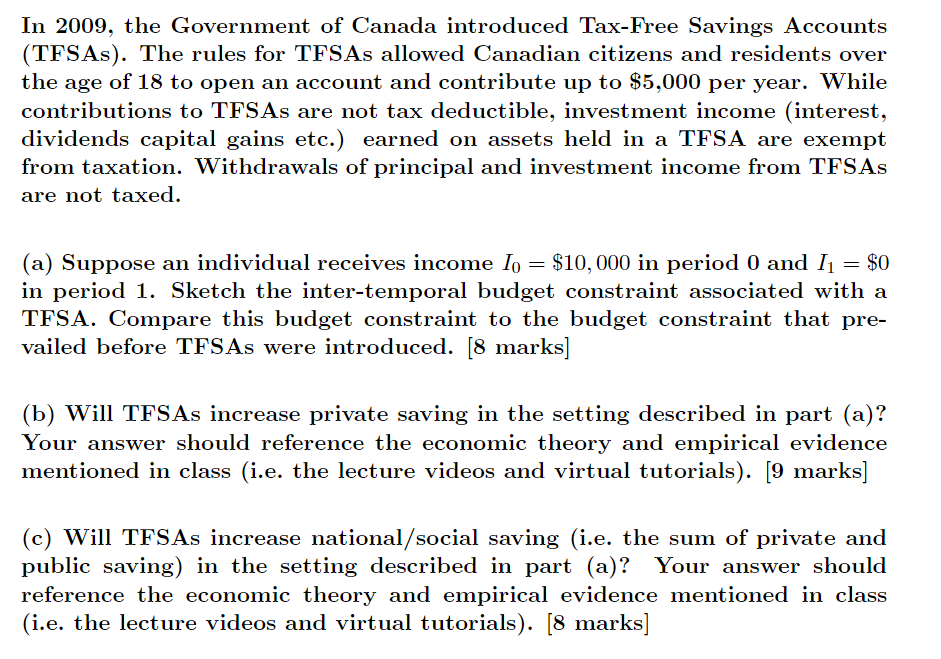
In 2009, the Government of Canada introduced Tax-Free Savings Accounts (TFSAs). The rules for TFSAs allowed Canadian citizens and residents over the age of 18 to open an account and contribute up to $5,000 per year. While contributions to TFSAs are not tax deductible, investment income (interest, dividends capital gains etc.) earned on assets held in a TFSA are exempt from taxation. Withdrawals of principal and investment income from TFSAs are not taxed. (a) Suppose an individual receives income lo = $10,000 in period 0 and I1 = $0 in period 1. Sketch the inter-temporal budget constraint associated with a TFSA. Compare this budget constraint to the budget constraint that pre- vailed before TFSAs were introduced. [8 marks] (b) Will TFSAs increase private saving in the setting described in part (a)? Your answer should reference the economic theory and empirical evidence mentioned in class (i.e. the lecture videos and virtual tutorials). [9 marks] (c) Will TFSAs increase national/social saving (i.e. the sum of private and public saving) in the setting described in part (a)? Your answer should reference the economic theory and empirical evidence mentioned in class (i.e. the lecture videos and virtual tutorials). [8 marks] In 2009, the Government of Canada introduced Tax-Free Savings Accounts (TFSAs). The rules for TFSAs allowed Canadian citizens and residents over the age of 18 to open an account and contribute up to $5,000 per year. While contributions to TFSAs are not tax deductible, investment income (interest, dividends capital gains etc.) earned on assets held in a TFSA are exempt from taxation. Withdrawals of principal and investment income from TFSAs are not taxed. (a) Suppose an individual receives income lo = $10,000 in period 0 and I1 = $0 in period 1. Sketch the inter-temporal budget constraint associated with a TFSA. Compare this budget constraint to the budget constraint that pre- vailed before TFSAs were introduced. [8 marks] (b) Will TFSAs increase private saving in the setting described in part (a)? Your answer should reference the economic theory and empirical evidence mentioned in class (i.e. the lecture videos and virtual tutorials). [9 marks] (c) Will TFSAs increase national/social saving (i.e. the sum of private and public saving) in the setting described in part (a)? Your answer should reference the economic theory and empirical evidence mentioned in class (i.e. the lecture videos and virtual tutorials). [8 marks]
Step by Step Solution
There are 3 Steps involved in it

Get step-by-step solutions from verified subject matter experts