







Question: please answer all the questions. Questions for Data Analysis and Results Part A. Mixing Solvents 1. When you have two liquids that do not dissolve
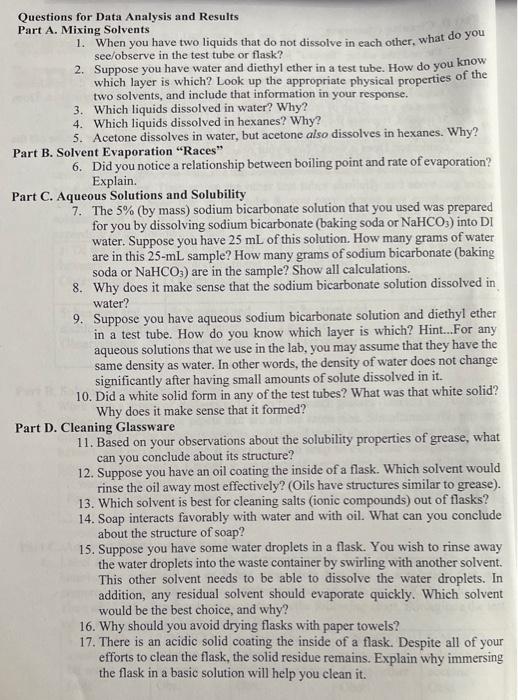
Questions for Data Analysis and Results Part A. Mixing Solvents 1. When you have two liquids that do not dissolve in each other, what do you see/observe in the test tube or flask? 2. Suppose you have water and diethyl ether in a test tube. How do you know which layer is which? Look up the appropriate physical properties of the two solvents, and include that information in your response. 3. Which liquids dissolved in water? Why? 4. Which liquids dissolved in hexanes? Why? 5. Acetone dissolves in water, but acetone also dissolves in hexanes. Why? Part B. Solvent Evaporation "Races" 6. Did you notice a relationship between boiling point and rate of evaporation? Explain. Part C. Aqueous Solutions and Solubility 7. The 5% (by mass) sodium bicarbonate solution that you used was prepared for you by dissolving sodium bicarbonate (baking soda or NaHCO3 ) into DI water. Suppose you have 25mL of this solution. How many grams of water are in this 25-mL sample? How many grams of sodium bicarbonate (baking soda or NaHCO3 ) are in the sample? Show all calculations. 8. Why does it make sense that the sodium bicarbonate solution dissolved in water? 9. Suppose you have aqueous sodium bicarbonate solution and diethyl ether in a test tube. How do you know which layer is which? Hint... For any aqueous solutions that we use in the lab, you may assume that they have the same density as water. In other words, the density of water does not change significantly after having small amounts of solute dissolved in it. 10. Did a white solid form in any of the test tubes? What was that white solid? Why does it make sense that it formed? Part D. Cleaning Glassware 11. Based on your observations about the solubility properties of grease, what can you conclude about its structure? 12. Suppose you have an oil coating the inside of a flask. Which solvent would rinse the oil away most effectively? (Oils have structures similar to grease). 13. Which solvent is best for cleaning salts (ionic compounds) out of flasks? 14. Soap interacts favorably with water and with oil. What can you conclude about the structure of soap? 15. Suppose you have some water droplets in a flask. You wish to rinse away the water droplets into the waste container by swirling with another solvent. This other solvent needs to be able to dissolve the water droplets. In addition, any residual solvent should evaporate quickly. Which solvent would be the best choice, and why? 16. Why should you avoid drying flasks with paper towels? 17. There is an acidic solid coating the inside of a flask. Despite all of your efforts to clean the flask, the solid residue remains. Explain why immersing the flask in a basic solution will help you clean it
Step by Step Solution
There are 3 Steps involved in it

Get step-by-step solutions from verified subject matter experts
 Study Help