Question: please answer all the questions since it is one case study, not three questions. Nokia has made a remarkable transformation over the period of two
please answer all the questions since it is one case study, not three questions.
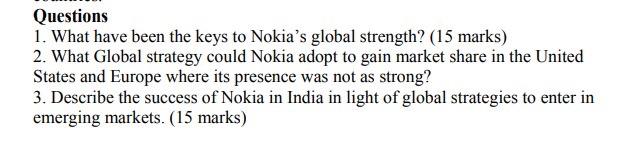
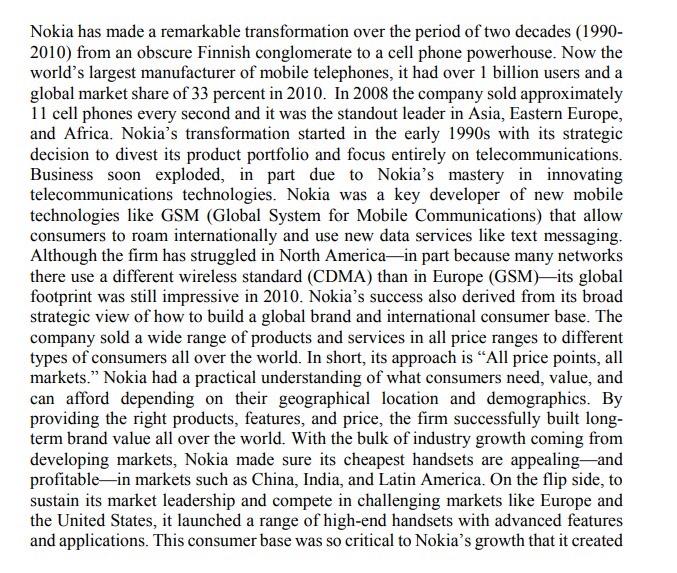
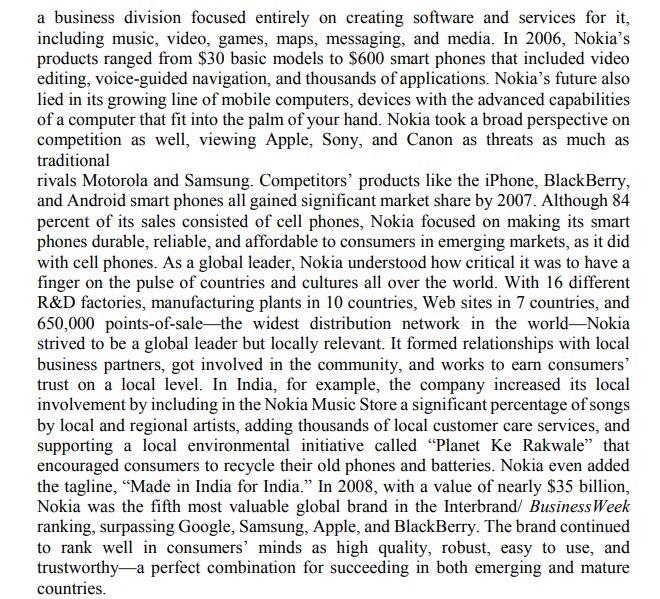
Nokia has made a remarkable transformation over the period of two decades (1990- 2010) from an obscure Finnish conglomerate to a cell phone powerhouse. Now the world's largest manufacturer of mobile telephones, it had over 1 billion users and a global market share of 33 percent in 2010. In 2008 the company sold approximately 11 cell phones every second and it was the standout leader in Asia, Eastern Europe, and Africa. Nokia's transformation started in the early 1990s with its strategic decision to divest its product portfolio and focus entirely on telecommunications. Business soon exploded, in part due to Nokia's mastery in innovating telecommunications technologies. Nokia was a key developer of new mobile technologies like GSM (Global System for Mobile Communications) that allow consumers to roam internationally and use new data services like text messaging. Although the firm has struggled in North Americain part because many networks there use a different wireless standard (CDMA) than in Europe (GSM)its global footprint was still impressive in 2010. Nokia's success also derived from its broad strategic view of how to build a global brand and international consumer base. The company sold a wide range of products and services in all price ranges to different types of consumers all over the world. In short, its approach is All price points, all markets." Nokia had a practical understanding of what consumers need, value, and can afford depending on their geographical location and demographics. By providing the right products, features, and price, the firm successfully built long- term brand value all over the world. With the bulk of industry growth coming from developing markets, Nokia made sure its cheapest handsets are appealing and profitable in markets such as China, India, and Latin America. On the flip side, to sustain its market leadership and compete in challenging markets like Europe and the United States, it launched a range of high-end handsets with advanced features and applications. This consumer base was so critical to Nokia's growth that it created a business division focused entirely on creating software and services for it, including music, video, games, maps, messaging, and media. In 2006, Nokia's products ranged from $30 basic models to $600 smart phones that included video editing, voice-guided navigation, and thousands of applications. Nokia's future also lied in its growing line of mobile computers, devices with the advanced capabilities of a computer that fit into the palm of your hand. Nokia took a broad perspective on competition as well, viewing Apple, Sony, and Canon as threats as much as traditional rivals Motorola and Samsung. Competitors' products like the iPhone, BlackBerry, and Android smart phones all gained significant market share by 2007. Although 84 percent of its sales consisted of cell phones, Nokia focused on making its smart phones durable, reliable, and affordable to consumers in emerging markets, as it did with cell phones. As a global leader, Nokia understood how critical it was to have a finger on the pulse of countries and cultures all over the world. With 16 different R&D factories, manufacturing plants in 10 countries, Web sites in 7 countries, and 650,000 points-of-salethe widest distribution network in the worldNokia strived to be a global leader but locally relevant. It formed relationships with local business partners, got involved in the community, and works to earn consumers' trust on a local level. In India, for example, the company increased its local involvement by including in the Nokia Music Store a significant percentage of songs by local and regional artists, adding thousands of local customer care services, and supporting a local environmental initiative called Planet Ke Rakwale that encouraged consumers to recycle their old phones and batteries. Nokia even added the tagline, "Made in India for India. In 2008, with a value of nearly $35 billion, Nokia was the fifth most valuable global brand in the Interbrand Business Week ranking, surpassing Google, Samsung, Apple, and BlackBerry. The brand continued to rank well in consumers' minds as high quality, robust, easy to use, and trustworthy-a perfect combination for succeeding in both emerging and mature countries. Questions 1. What have been the keys to Nokia's global strength? (15 marks) 2. What Global strategy could Nokia adopt to gain market share in the United States and Europe where its presence was not as strong? 3. Describe the success of Nokia in India in light of global strategies to enter in emerging markets. (15 marks)









 Study Help