Question: Please answer all these questions for my customer service class, Situation 1 One of your good, and regular, customers has placed an order for a
Please answer all these questions for my customer service class,
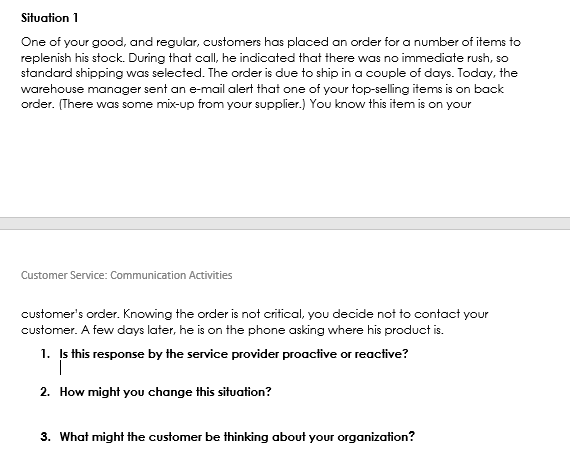
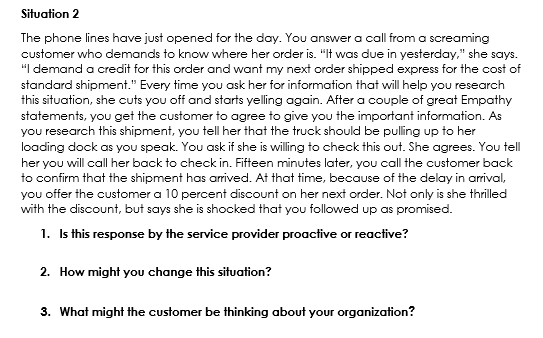
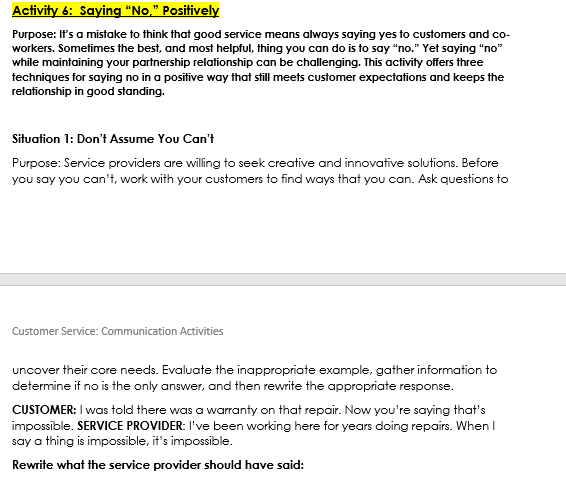
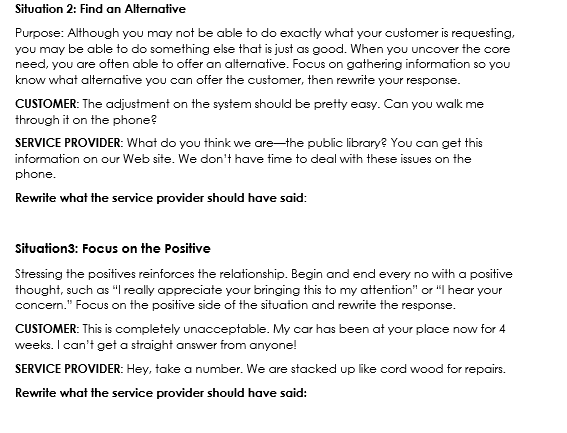
Situation 1 One of your good, and regular, customers has placed an order for a number of items to replenish his stock. During that call, he indicated that there was no immediate rush, so standard shipping was selected. The order is due to ship in a couple of days. Today, the warehouse manager sent an e-mail alert that one of your top-selling items is on back order. (There was some mix-up from your supplier.) You know this item is on your Customer Service: Communication Activities customer's order. Knowing the order is not critical, you decide not to contact your customer. A few days later, he is on the phone asking where his product is. 1. Is this response by the service provider proactive or reactive? 2. How might you change this situation? 3. What might the customer be thinking about your organization? Situation 2 The phone lines have just opened for the day. You answer a call from a screaming customer who demands to know where her order is. "It was due in yesterday," she says. "I demand a credit for this order and want my next order shipped express for the cost of standard shipment." Every time you ask her for information that will help you research this situation, she cuts you off and starts yelling again. After a couple of great Empathy statements, you get the customer to agree to give you the important information. As you research this shipment, you tell her that the truck should be pulling up to her loading dock as you speak. You ask if she is willing to check this out. She agrees. You tell her you will call her back to check in. Fifteen minutes later, you call the customer back to confirm that the shipment has arrived. At that time, because of the delay in arrival, you offer the customer a 10 percent discount on her next order. Not only is she thrilled with the discount, but says she is shocked that you followed up as promised. 1. Is this response by the service provider proactive or reactive? 2. How might you change this situation? 3. What might the customer be thinking about your organization? Activity 6: Saying "No," Positively Purpose: It's a mistake to think that good service means always saying yes to customers and co- workers. Sometimes the best, and most helpful, thing you can do is to say no." Yet saying "no" while maintaining your partnership relationship can be challenging. This activity offers three techniques for saying no in a positive way that still meets customer expectations and keeps the relationship in good standing. Situation 1: Don't Assume You Can't Purpose: Service providers are willing to seek creative and innovative solutions. Before you say you can't work with your customers to find ways that you can. Ask questions to Customer Service: Communication Activities uncover their core needs. Evaluate the inappropriate example, gather information to determine if no is the only answer, and then rewrite the appropriate response. CUSTOMER: I was told there was a warranty on that repair. Now you're saying that's impossible. SERVICE PROVIDER: I've been working here for years doing repairs. When I say a thing is impossible, it's impossible. Rewrite what the service provider should have said: Situation 2: Find an Alternative Purpose: Although you may not be able to do exactly what your customer is requesting, you may be able to do something else that is just as good. When you uncover the core need, you are often able to offer an alternative. Focus on gathering information so you know what alternative you can offer the customer, then rewrite your response. CUSTOMER: The adjustment on the system should be pretty easy. Can you walk me through it on the phone? SERVICE PROVIDER: What do you think we arethe public library? You can get this information on our Web site. We don't have time to deal with these issues on the phone. Rewrite what the service provider should have said: Situation3: Focus on the Positive Stressing the positives reinforces the relationship. Begin and end every no with a positive thought, such as "I really appreciate your bringing this to my attention" or "I hear your concern." Focus on the positive side of the situation and rewrite the response. CUSTOMER: This is completely unacceptable. My car has been at your place now for 4 weeks. I can't get a straight answer from anyone! SERVICE PROVIDER: Hey, take a number. We are stacked up like cord wood for repairs. Rewrite what the service provider should have said




