Question: Please answer ASAP. Thank you. What factors have enabled the company to deliver strong performance in the past? What are some of the important issues
Please answer ASAP. Thank you.
- What factors have enabled the company to deliver strong performance in the past?
- What are some of the important issues confronting this company and what external developments and internal actions might have caused these issues?
- If you were taking over as CEO of the company at the end of case, what courses of action would you pursue to address these issues? Explain how you would implement these, how they would address each issue, and what potential risks may exist.
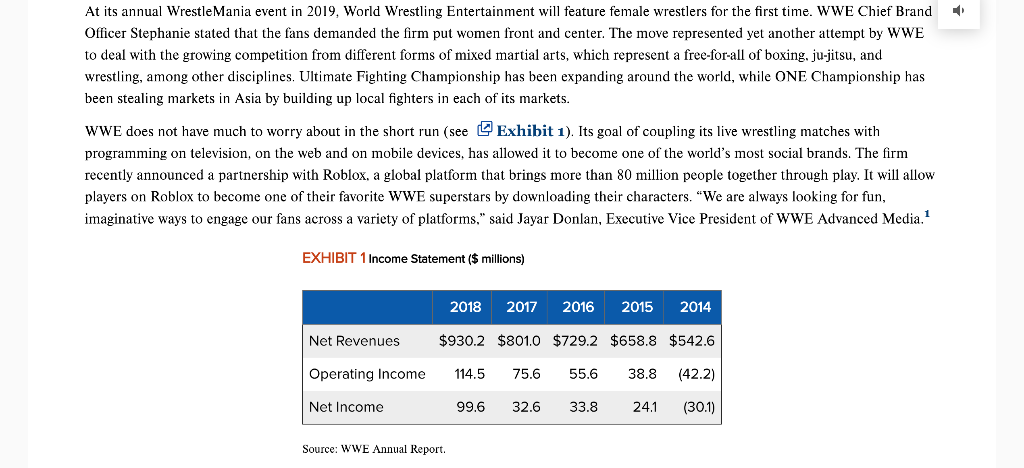
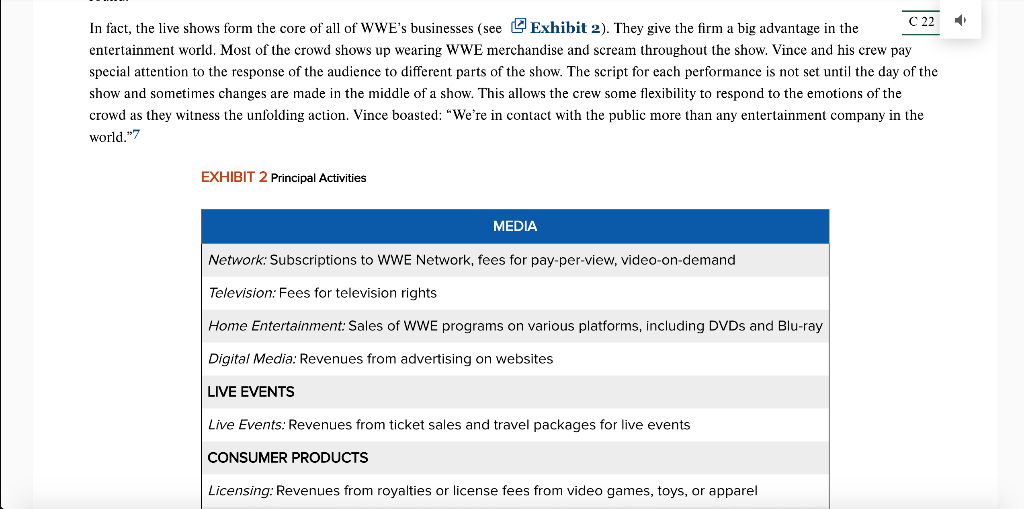
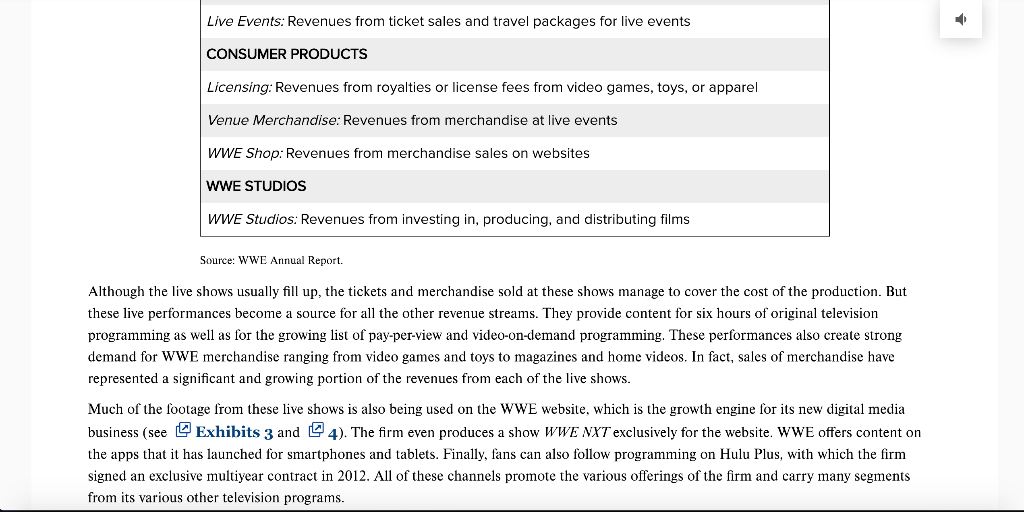
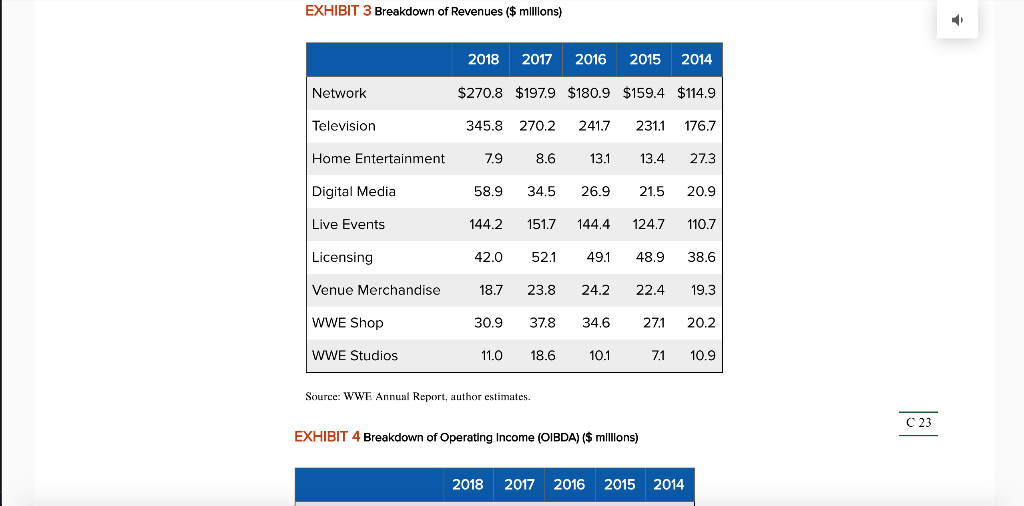
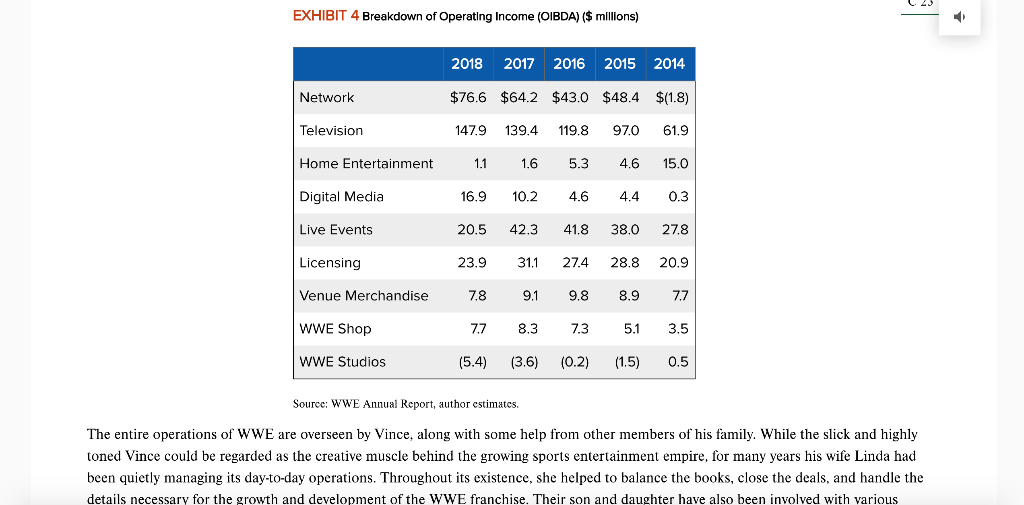
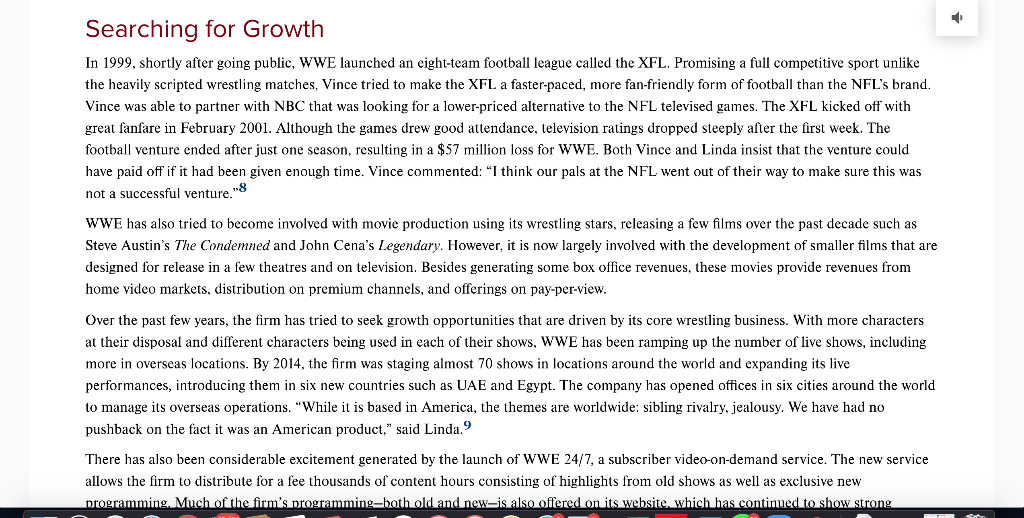
C At its annual WrestleMania event in 2019, World Wrestling Entertainment will feature female wrestlers for the first time. WWE Chief Brand Officer Stephanie stated that the fans demanded the firm put women front and center. The move represented yet another attempt by WWE to deal with the growing competition from different forms of mixed martial arts, which represent a free-for-all of boxing, ju-jitsu, and wrestling, among other disciplines. Ultimate Fighting Championship has been expanding around the world, while ONE Championship has been stealing markets in Asia by building up local fighters in each of its markets. WWE does not have much to worry about in the short run (see Exhibit 1). Its goal of coupling its live wrestling matches with programming on television, on the web and on mobile devices, has allowed it to become one of the world's most social brands. The firm recently announced a partnership with Roblox, a global platform that brings more than 80 million people together through play. It will allow players on Roblox to become one of their favorite WWE superstars by downloading their characters. "We are always looking for fun, imaginative ways to engage our fans across a variety of platforms," said Jayar Donlan, Executive Vice President of WWE Advanced Media." EXHIBIT 1 Income Statement ($ millions) 2018 2017 2016 2015 2014 Net Revenues $930.2 $801,0 $729.2 $658.8 $542.6 Operating Income 114.5 75.6 55.6 38.8 (42.2) Net Income 99.6 32.6 33.8 24.1 (30.1) Source: WWE Annual Report. D All of these achievements clearly indicate that WWE has moved out of a slump that it had endured between 2001 and 2005. During the 1990s, Vince McMahon had used a potent mix of shaved, pierced, and pumped-up muscled hunks; buxom, scantily-clad, and sometimes cosmetically enhanced beauties; and body-bashing clashes of good versus evil to build an empire that claimed over 35 million fans. Furthermore, the vast majority of these fans were males between the ages of 12 and 34, representing the demographic segment that makes most advertisers drool. Just when looked like everything was going well, WWE hit a rough patch. Its attempt to move beyond wrestling to other sports and entertainment was not successful. It failed with its launch of a football league during 2001, which folded after just one season. WWE has not done much better with its foray into movies that would use some of its wrestlers. The firm was also struggling with its efforts to build new wrestling stars and to introduce new characters into its shows. Some of its most valuable younger viewers were also turning to new reality- based shows on television such as Survivor, Fear Factor, and Jackass. Since 2005, however, WWE has been turning pro wrestling into a perpetual road show that makes millions of fans pass through turnstiles in a growing number of locations around the globe. Its flagship television programs, Raw and Smackdown! are broadcast in over 30 languages in 150 countries reaching 36 million viewers around the world. WWE has also been signing pacts with dozens of licensees-including one with toymaker Mattel-to sell DVDs, video games, toys, and trading cards. Developing a Wrestling Empire Most of the success of the WWE can be attributed to the persistent efforts of Vince McMahon. He was a self-described juvenile delinquent who went to military school as a teenager to avoid being sent to a reformatory institution. Around 1970, Vince joined his father's wrestling company that operated in Northeastern cities such as New York, Philadelphia, and Washington, DC. He did on-air commentary, developed scripts, and otherwise moted wrestling matches. Vince bought the wrestling firm from his father in 1982, eventually renaming it World Wrestling Federation. At that time, wrestling was managed by regional fiefdoms where everyone avoided encroaching on anyone else's territory. Vince began to change all that by paying local television stations around the country to broadcast his matches. His aggressive pursuit of audiences across the country gradually squeezed out most of the other rivals. "I banked on the fact that they were behind the times, and they were," said Vince.2 C 21 Soon after, Vince broke another taboo by admitting to the public that wrestling matches were scripted. Although he had made this admission in order to avoid the scrutiny of state athletic commissions, wrestling fans appreciated the honesty. The WWF began to draw in more fans through the elaborate story lines and the captivating characters of its wrestling matches. The firm turned wrestlers such as Hulk Hogan and Andre the Giant into mainstream icons of pop culture. By the late 1980s, the WWF's Raw is War had become a top-rated show on cable and the firm had also begun to offer pay-per-view shows. Vince faced his most formidable competition after 1988, when Ted Turner brought out World Championship Wrestling, one of the few major rivals that was still operating. He spent millions luring away WWF stars such as Hulk Hogan and Macho Man Randy Savage. He used these stars to launch a show on his own TNT channel to go up against WWF's major show, Raw is War. Although Turner's new show caused a temporary dip in the ratings for WWF's shows, Vince fought back with pumped-up scripts, mouthy muscle-men, and lyca-clad women. "Ted Turner decided to come after me and all of my talent," growled Vince, "and now he's where he should be.....3 In 2001, Vince was finally able to acquire WCW from Turner's parent firm AOL Time Warner for a bargain price of $5 million. Because of the manner in which he eliminated most of his rivals, Vince has earned a reputation for being as aggressive and ambitious as any character in the ring. Paul MacArthur, publisher of the industry newsletter Wrestling Perspective, praised his accomplishments: "McMahon understands the wrestling business better than anyone else. He's considered by most in the business to be brilliant."4 In 2002, WWF was also hit by a ruling by a British court that their original WWF acronym belonged to the World Wildlife Fund. The firm had to undergo a major branding transition, changing its well-known name and triple logo from WWF to WWE. Although the change in name has been costly, it is not clear that this will hurt the firm in the long run. Their product is really the entertainment. It's the stars. It's In 2002, WWF was also hit by a ruling by a British court that their original WWF acronym belonged to the World Wildlife Fund. The firm had to undergo a major branding transition, changing its well-known name and triple logo from WWF to WWE. Although the change in name has been costly, it is not clear that this will hurt the firm in the long run. Their product is really the entertainment. It's the stars. It's the bodies," said Larry McNaughton, managing director and principal of CoreBrand, a branding consultancy.5 Vince's wife Linda stated that the new name might actually be beneficial for the firm. "Our new name puts the emphasis on the 'E' for entertainment," she commented. 6 Creating a Script for Success Since taking over the firm, Vince began to change the entire focus of the wrestling shows. He looked to television soap operas for enhancing the entertainment value of his live events. Vince reduced the amount of actual wrestling and replaced it with wacky yet somewhat compelling story lines. He began to develop interesting characters and create compelling story lines by employing techniques that were quite similar to those being used by many successful television shows. There was great deal of reliance on the "good versus evil" or the settling the score" themes in the development of the plots for his wrestling matches. The plots and subplots ended up providing viewers with a mix of romance, sex, sports, comedy, and violence against a backdrop of pyrotechnics. Over time, the scripts for the matches became tighter, with increasingly intricate story lines, plots, and dialogue. The details of every match were worked out well in advance, leaving the wrestlers themselves to decide only the manner in which they would dispatch their opponents to the mat. Vince's use of characters was well thought out and he began to refer to his wrestlers as "athletic performers" who were selected on the basis of their acting ability in addition to their physical stamina. Vince also ensured that his firm owned the rights to the characters that were played by his wrestlers. This would allow him to continue to exploit the characters that he developed for his television shows, even after the wrestler who played that character had left his firm. By now, Vince holds the rights to many characters that have become familiar to audiences around the world. LD By the late 1990s Vince had two weekly shows on television. Besides the original flagship program on the USA cable channel, WWE had added a Smackdown! show on the UPN broadcast channel. He developed a continuous story line using the same characters so that his audience would be driven to both the shows. But the acquisition of the WCW resulted in a significant increase in the number of wrestling stars under contract. Trying to incorporate almost 150 characters into the story lines for WWE's shows proved to be a challenging task. At the same time, the move of Raw to Spike TV channel resulted in a loss of viewers. In October 2005, WWE signed a new agreement with NBC that moved Raw back to its USA channel. Its other show, Smackdown, is now carried by the Syfy channel, and has been climbing in the charts. Its newest show, Total Divas, has recently been launched on the E! Network. All of these programs have done well in ratings, particularly for male viewers because of the growth in popularity of a new breed of characters such as John Cena, Chris Benoit, Rey Mysterio, and Triple H. The visibility of these characters has also been enhanced through profiles on the WWE website and mobile apps. Managing a Road Show A typical workweek for the WWE can be grueling for the McMahons, for the talent and for the crew. The organization is now putting on almost 330 live shows a year requiring everyone to be on the road most days of the week. The touring crew includes over 200 crew members, including stage hands. All of WWE's live events, including those that are used for its two longstanding weekly shows Raw and Smackdown! as well as the newer ones, are held in different cities. Consequently, the crew is always packing up a dozen 18-wheelers and driving hundreds of miles to get from one performance to the other. Since there are no repeats of any WWE shows, the live performances must be held year round. In fact, the live shows form the core of all of WWE's businesses (see Exhibit 2). They give the firm a big advantage in the C22 entertainment world. Most of the crowd shows up wearing WWE merchandise and scream throughout the show. Vince and his crew pay In fact, the live shows form the core of all of WWE's businesses (see Exhibit 2). They give the firm a big advantage in the C 22 entertainment world. Most of the crowd shows up wearing WWE merchandise and scream throughout the show. Vince and his crew pay special attention to the response of the audience to different parts of the show. The script for each performance is not set until the day of the show and sometimes changes are made in the middle of a show. This allows the crew some flexibility to respond to the emotions of the crowd as they witness the unfolding action. Vince boasted: "We're in contact with the public more than any entertainment company in the world."7 EXHIBIT 2 Principal Activities MEDIA Network: Subscriptions to WWE Network, fees for pay-per-view, video-on-demand Television: Fees for television rights Home Entertainment: Sales of WWE programs on various platforms, including DVDs and Blu-ray Digital Media: Revenues from advertising on websites LIVE EVENTS Live Events: Revenues from ticket sales and travel packages for live events CONSUMER PRODUCTS Licensing: Revenues from royalties or license fees from video games, toys, or apparel Live Events: Revenues from ticket sales and travel packages for live events CONSUMER PRODUCTS Licensing: Revenues from royalties or license fees from video games, toys, or apparel Venue Merchandise: Revenues from merchandise at live events WWE Shop: Revenues from merchandise sales on websites WWE STUDIOS WWE Studios: Revenues from investing in, producing, and distributing films Source: WWE Annual Report. Although the live shows usually fill up, the tickets and merchandise sold at these shows manage to cover the cost of the production. But these live performances become a source for all the other revenue streams. They provide content for six hours of original television programming as well as for the growing list of pay-per-view and video-on-demand programming. These performances also create strong demand for WWE merchandise ranging from video games and toys to magazines and home videos. In fact, sales of merchandise have represented a significant and growing portion of the revenues from each of the live shows. Much of the footage from these live shows is also being used on the WWE website, which is the growth engine for its new digital media business (see Exhibits 3 and 4). The firm even produces a show WWE NXT exclusively for the website. WWE offers content on the apps that it has launched for smartphones and tablets. Finally, fans can also follow programming on Hulu Plus, with which the firm signed an exclusive multiyear contract in 2012. All of these channels promote the various offerings of the firm and carry many segments from its various other television programs. EXHIBIT 3 Breakdown of Revenues ($ millions) 2018 2017 2016 2015 2014 Network $270.8 $197.9 $180.9 $159.4 $114.9 Television 345.8 270.2 241.7 231.1 176.7 Home Entertainment 7.9 8.6 13.1 13.4 27.3 Digital Media 58.9 34.5 26.9 21.5 20.9 Live Events 144.2 151.7 144.4 124.7 110.7 Licensing 42.0 52.1 49.1 48.9 38.6 Venue Merchandise 18.7 23.8 24.2 22.4 19.3 WWE Shop 30.9 37.8 34.6 27.1 20.2 WWE Studios 11.0 18.6 10.1 7.1 10.9 Source: WWE Annual Report, author estimates. C23 EXHIBIT 4 Breakdown of Operating Income (OIBDA) ($ millions) 2018 2017 2016 2015 2014 EXHIBIT 4 Breakdown of Operating Income (OIBDA) ($ millions) 2018 2017 2016 2015 2014 Network $76.6 $64.2 $43.0 $48.4 $(1.8) Television 147.9 139.4 119.8 97.0 61.9 Home Entertainment 1.1 1.6 5.3 4.6 15.0 Digital Media 16.9 10.2 4.6 4.4 0.3 Live Events 20.5 42.3 41.8 38.0 27.8 Licensing 23.9 31.1 27.4 28.8 20.9 Venue Merchandise 7,8 9.1 9.8 8.9 7.7 WWE Shop 7.7 8.3 7.3 5.1 3.5 WWE Studios (5.4) (3.6) (0.2) (1.5) 0.5 Source: WWE Annual Report, author estimates. The entire operations of WWE are overseen by Vince, along with some help from other members of his family. While the slick and highly toned Vince could be regarded as the creative muscle behind the growing sports entertainment empire, for many years his wife Linda had been quietly managing its day-to-day operations. Throughout its existence, she helped to balance the books, close the deals, and handle the details necessary for the growth and development of the WWE franchise. Their son and daughter have also been involved with various Searching for Growth In 1999, shortly after going public, WWE launched an eight-team football league called the XFL. Promising a full competitive sport unlike the heavily scripted wrestling matches, Vince tried to make the XFL a faster-paced, more fan-friendly form of football than the NFL's brand. Vince was able to partner with NBC that was looking for a lower-priced alternative to the NFL televised games. The XFL kicked off with great fanfare in February 2001. Although the games drew good attendance, television ratings dropped steeply after the first week. The football venture ended after just one season, resulting in a $57 million loss for WWE. Both Vince and Linda insist that the venture could have paid off if it had been given enough time. Vince commented: I think our pals at the NFL went out of their way to make sure this was not a successful venture."8 WWE has also tried to become involved with movie production using its wrestling stars, releasing a few films over the past decade such as Steve Austin's The Condemned and John Cena's Legendary. However, it is now largely involved with the development of smaller films that are designed for release in a few theatres and on television. Besides generating some box office revenues, these movies provide revenues from home video markets, distribution on premium channels, and offerings on pay-per-view. Over the past few years, the firm has tried to seek growth opportunities that are driven by its core wrestling business. With more characters at their disposal and different characters being used in each of their shows, WWE has been ramping up the number of live shows, including more in overseas locations. By 2014, the firm was staging almost 70 shows in locations around the world and expanding its live performances, introducing them in six new countries such as UAE and Egypt. The company has opened offices in six cities around the world to manage its overseas operations. "While it is based in America, the themes are worldwide: sibling rivalry, jealousy. We have had no pushback on the fact it was an American product," said Linda.9 There has also been considerable excitement generated by the launch of WWE 24/7, a subscriber video-on-demand service. The new service allows the firm to distribute for a fee thousands of content hours consisting of highlights from old shows as well as exclusive new programming. Much of the firm's programming=both old and new=is also offered on its website, which has continued to show strong There has also been considerable excitement generated by the launch of WWE 24/7, a subscriber video-on-demand service. The new service allows the firm to distribute for a fee thousands of content hours consisting of highlights from old shows as well as exclusive new programming. Much of the firm's programming-both old and new-is also offered on its website, which has continued to show strong growth. By allowing audiences to watch WWE programming whenever they may want to, these new forms of distribution have allowed the firm to reach out to new audiences. The new push for streaming on mobiles and through Hulu has provided even more opportunities for WWE to expand into digital media. The firm believes that offering their programming on smartphones and tablets will lead to a significant growth in revenues, in part from additional sales of their merchandise. Our fans have proven that they want to consume WWE content day and night and now, through our new mobile app, they can stay completely connected to the action wherever they are," said Jason Hoch, WWE's recently appointed Senior Vice-President of Digital Operations. 10 C 24 Reclaiming the Championship? Although WWE may find it challenging to keep building on its already formidable fan base, there is no question that it continues to generate a lot of excitement. Most of this excitement is driven by the live shows in which they fill up the arenas. They have the most excited fans that have come through our doors," said the director of sales and marketing at one of the arenas that holds WWE matches. They make signs, dress up, and cheer constantly."11 The interest in the live matches is most evident each year with the frenzy that is created by WrestleMania, the annual pop culture extravaganza that has become an almost weeklong celebration of everything wrestling. No wrestler becomes a true star until their performance is featured at WrestleMania and any true fan must make the pilgrimage at least once in their life. WWE has begun to expand its audience by toning down its sex and violence during recent years to make their shows more family friendly. They no longer use fake prop blood and have toned down the use of abusive language in order to get a rating of TV-PG for their television programming. The use of new media like the launch of shows through streaming video is also expected to bring in younger viewers. "I think star until their performance is featured at WrestleMania and any true fan must make the pilgrimage at least once in their life. WWE has begun to expand its audience by toning down its sex and violence during recent years to make their shows more family friendly. They no longer use fake prop blood and have toned down the use of abusive language in order to get a rating of TV-PG for their television programming. The use of new media like the launch of shows through streaming video is also expected to bring in younger viewers. I think any good entertainment product has to change with the times," said McMahon. "You have to have your fingers on the pulse of the marketplace."12 McMahon is aware of the growing threat of mixed martial arts that started in Japan and Brazil and is spreading to more locations. Because of its similarity to wrestling, this new combat sport is likely to pull away some of WWE's fans. However, everyone at WWE is convinced that these real sports cannot match the drama and passion of the storylines and characters used to draw audiences to their matches. As Dana White, president of Ultimate Fighting Championship, has said: "People have been trying to count the WWE out for years. They are a powerhouse."13 There are some questions about the future of WWE after McMahon. The wrestling-based firm has relied on McMahon, now over 70, who single-handedly built his wrestling empire from his father's small regional business. Although it has branched out into other activities, the bulk of WWE's revenues and profits are tied to wrestling. Stephanie McMahon dismisses any possible doubts about the future of WWE. All of our lines of business are more akin to Disney," she said. "We are a media property, with live shows, consumer products, television programs, and feature films. We have all the different aspects."14 Those who understand don't need an explanation. Those who need an explanation will never understand. -Marty, a 19-year-old wrestling addict quoted in Fortune, October 6, 2000









 Study Help