







Question: Please answer b,c, d, and e. Thanks in advance! 2. (30 points) Metal carbides are formed in steel by heat treating large slabs of steel.
 Please answer b,c, d, and e. Thanks in advance!
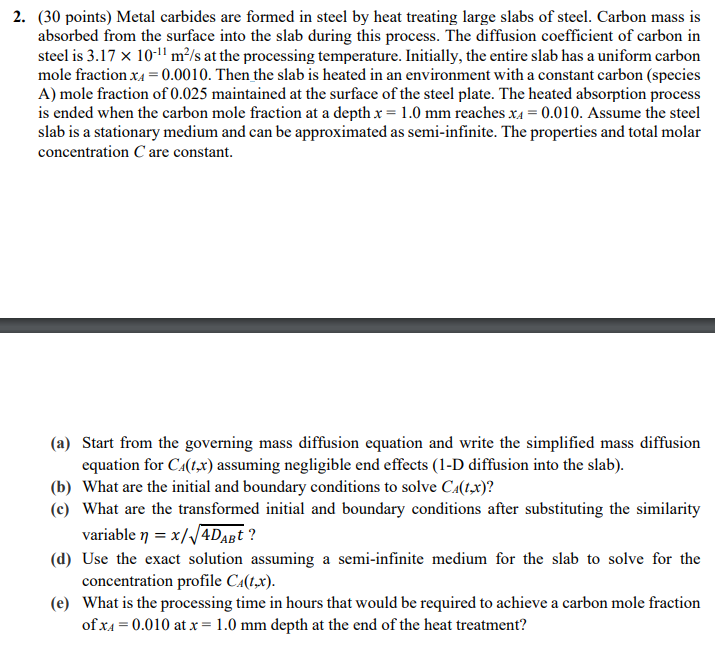
2. (30 points) Metal carbides are formed in steel by heat treating large slabs of steel. Carbon mass is absorbed from the surface into the slab during this process. The diffusion coefficient of carbon in steel is 3.17 x 10⁻¹¹ m/s at the processing temperature. Initially, the entire slab has a uniform carbon mole fraction xa=0.0010. Then the slab is heated in an environment with a constant carbon (species A) mole fraction of 0.025 maintained at the surface of the steel plate. The heated absorption process is ended when the carbon mole fraction at a depth x = 1.0 mm reaches xa = 0.010. Assume the steel slab is a stationary medium and can be approximated as semi-infinite. The properties and total molar concentration Care constant. (a) Start from the governing mass diffusion equation and write the simplified mass diffusion equation for Ca(tx) assuming negligible end effects (1-D diffusion into the slab). (b) What are the initial and boundary conditions to solve C-(tx)? (e) What are the transformed initial and boundary conditions after substituting the similarity variable n = x//4DABt ? (d) Use the exact solution assuming a semi-infinite medium for the slab to solve for the concentration profile Cl(t_x). (e) What is the processing time in hours that would be required to achieve a carbon mole fraction of xa = 0.010 at x = 1.0 mm depth at the end of the heat treatment
Step by Step Solution
There are 3 Steps involved in it

Get step-by-step solutions from verified subject matter experts
 Study Help