Question: PLEASE ANSWER BOTH THE QUESTION FROM THE CASE STUDY GIVEN BELOW KITASOO AQUA FARMS LTD. AND KITASOO SEAFOODS LTD.LEVERAGING LOCAL RESOURCES Larry Greba told the
PLEASE ANSWER BOTH THE QUESTION FROM THE CASE STUDY GIVEN BELOW
KITASOO AQUA FARMS LTD. AND KITASOO SEAFOODS LTD.LEVERAGING LOCAL RESOURCES
Larry Greba told the Conference Board that decades of government allocation policies have limited other local fishing opportunities. The Kitasoo have had access to less than 5 percent of the rich non-salmon fish stocks in their 6,000-square-kilometre traditional territory, even though they are the only permanent residents..
Read the KITASOO AQUA FARMS Case Study and answer the following.
1. "By the early 1990s, the local salmon fisheries were not viable from a small business perspective". How did the Kitasoo solve this business problem? Explain how Kitasoo expanded total market demand while increasing its current share. Substantiate your response.
2. If Kitasoo wanted to expand its product line, what are some new products you would recommend for the company? Should it use the same brand name for those products? Substantiate your response.
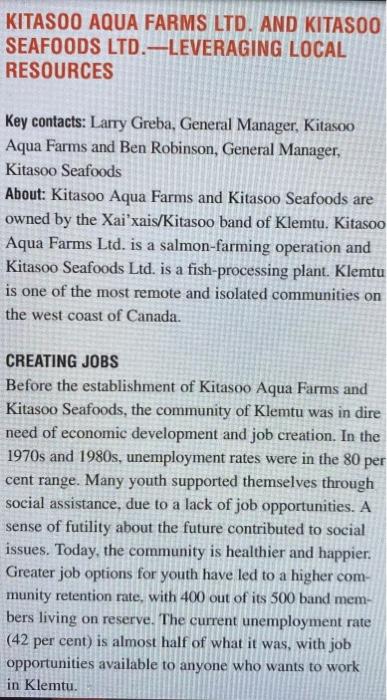
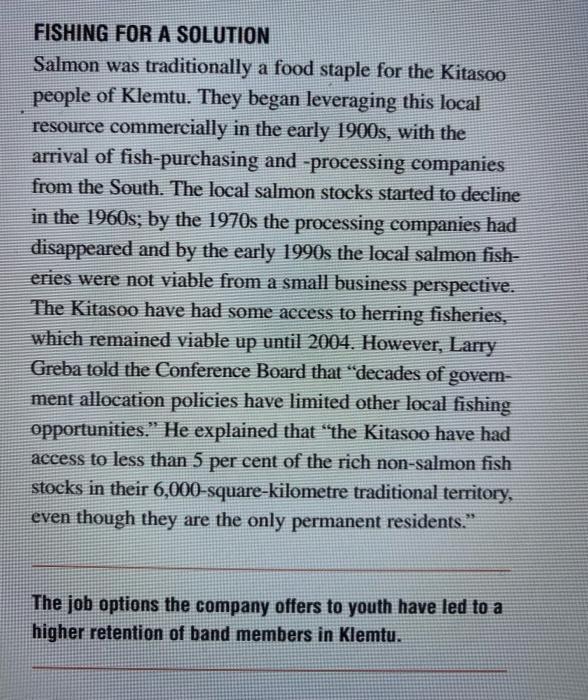
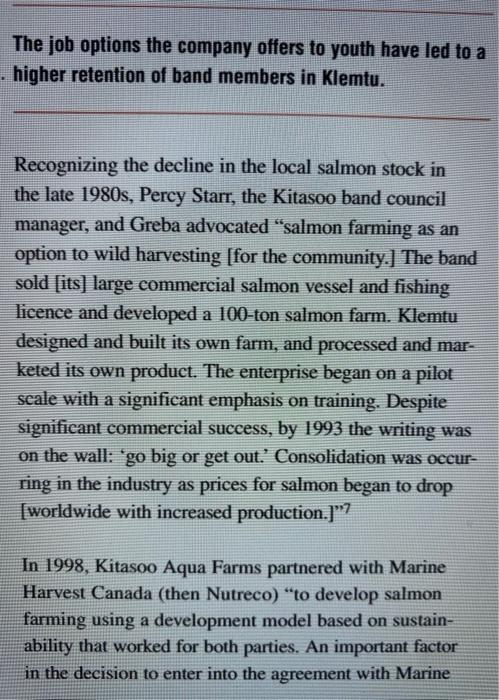
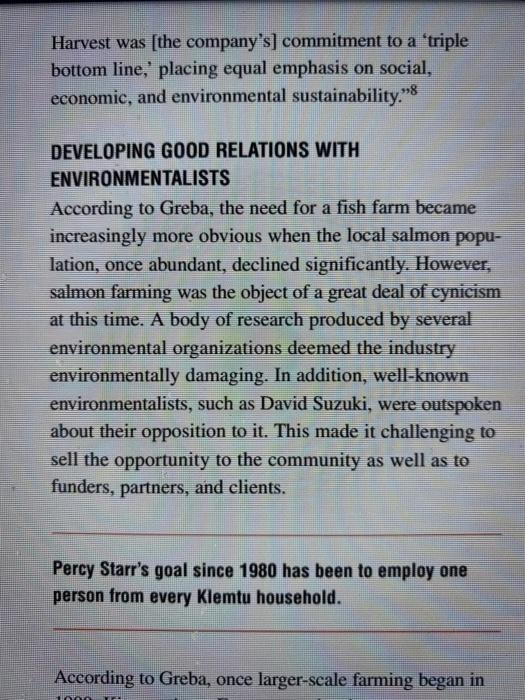
KITASOO AQUA FARMS LTD. AND KITASOO SEAFOODS LTD.-LEVERAGING LOCAL RESOURCES Key contacts: Larry Greba, General Manager, Kitasoo Aqua Farms and Ben Robinson, General Manager, Kitasoo Seafoods About: Kitasoo Aqua Farms and Kitasoo Seafoods are owned by the Xai xais/Kitasoo band of Klemtu. Kitasoo Aqua Farms Ltd. is a salmon-farming operation and Kitasoo Seafoods Ltd. is a fish-processing plant. Klemtu is one of the most remote and isolated communities on the west coast of Canada. CREATING JOBS Before the establishment of Kitasoo Aqua Farms and Kitasoo Seafoods, the community of Klemtu was in dire need of economic development and job creation. In the 1970s and 1980s, unemployment rates were in the 80 per cent range. Many youth supported themselves through social assistance, due to a lack of job opportunities. A sense of futility about the future contributed to social issues. Today, the community is healthier and happier. Greater job options for youth have led to a higher com- munity retention rate, with 400 out of its 500 band mem- bers living on reserve. The current unemployment rate (42 per cent) is almost half of what it was, with job opportunities available to anyone who wants to work in Klemtu. FISHING FOR A SOLUTION Salmon was traditionally a food staple for the Kitasoo people of Klemtu. They began leveraging this local resource commercially in the early 1900s, with the arrival of fish-purchasing and -processing companies from the South. The local salmon stocks started to decline in the 1960s; by the 1970s the processing companies had disappeared and by the early 1990s the local salmon fish- eries were not viable from a small business perspective. The Kitasoo have had some access to herring fisheries, which remained viable up until 2004. However, Larry Greba told the Conference Board that decades of govem- ment allocation policies have limited other local fishing opportunities." He explained that "the Kitasoo have had access to less than 5 per cent of the rich non-salmon fish stocks in their 6,000-square-kilometre traditional territory, even though they are the only permanent residents." The job options the company offers to youth have led to a higher retention of band members in Klemtu. The job options the company offers to youth have led to a . higher retention of band members in Klemtu. Recognizing the decline in the local salmon stock in the late 1980s, Percy Starr, the Kitasoo band council manager, and Greba advocated "salmon farming as an option to wild harvesting (for the community.] The band sold [its] large commercial salmon vessel and fishing licence and developed a 100-ton salmon farm. Klemtu designed and built its own farm, and processed and mar- keted its own product. The enterprise began on a pilot scale with a significant emphasis on training. Despite significant commercial success, by 1993 the writing was on the wall: go big or get out.' Consolidation was occur- ring in the industry as prices for salmon began to drop [worldwide with increased production.)"? In 1998, Kitasoo Aqua Farms partnered with Marine Harvest Canada (then Nutreco) to develop salmon farming using a development model based on sustain- ability that worked for both parties. An important factor in the decision to enter into the agreement with Marine Harvest was [the company's) commitment to a 'triple bottom line,' placing equal emphasis on social, economic, and environmental sustainability.8 DEVELOPING GOOD RELATIONS WITH ENVIRONMENTALISTS According to Greba, the need for a fish farm became increasingly more obvious when the local salmon popu- lation, once abundant, declined significantly. However, salmon farming was the object of a great deal of cynicism at this time. A body of research produced by several environmental organizations deemed the industry environmentally damaging. In addition, well-known environmentalists, such as David Suzuki, were outspoken about their opposition to it. This made it challenging to sell the opportunity to the community as well as to funders, partners, and clients. Percy Starr's goal since 1980 has been to employ one person from every Klemtu household. According to Greba, once larger-scale farming began in FO Percy Starr's goal since 1980 has been to employ one person from every Klemtu household. According to Greba, once larger-scale farming began in 1999, Kitasoo Aqua Farms turned to its own commun- ity marine research organization, the Kitasoo Fisheries Program, to research environmental issues that were of concern to the community and the aquaculture critics. The Kitasoo Fisheries Program, in turn, began collaborating with some of the salmon farm research groups, mostly in academic institutions. It also partnered with environ- mentalists and developed a good rapport. This helped the company to ally with its biggest critics and build a good reputation with customers. According to Greba, After 11 years of larger-scale farming with Marine Harvest Canada, Kitasoo is systematically proving the industry is viable and environmentally sustainable." REALIZING SUCCESS Today, Klemtu community members are happier and healthier and have one of the biggest retention rates of all coastal bands (525 in band list and over 425 in Klemtu). Manager, Kitasoo Seafoods, said this is largely due to the greater number of job opportun- ities created by businesses such as Kitasoo Aqua Farms and Kitasoo Seafoods in the community. They employ approximately 60 people, who are paid about $2,500 monthly. This has inspired others to work. Today, almost 60 per cent of community members are employed. And they have more diverse job opportunities. In addition to the many other service-level jobs with the band office, store, school, and public works, they can work for the seafood plant, the salmon farm, the harvest and trans- port vessel, or newly developed businesses in tourism and forestry. CHALLENGES Kitasoo Aqua Farms and Kitasoo Seafoods face their fair share of challenges. According to Greba, constant expansion and upgrading to maintain government permits at the farmed salmon-processing plant require large annual capital injections to support the ongoing operations and employment. Kitasoo has a diversity of profitable busi- nesses in the community that have been created and managed by the Kitasoo Development Corporation, which support the call for capital. Transportation of goods, services, and people is another major challenge for Kitasoo. Most farmed salmon is sent down to the Pacific seaboard, but the provincial ferry system does not stop by Klemtu often enough to support normal business trade. Kitasoo has worked with its partners to be innovative and uses private barging services to support the local processing. Despite these challenges, Kitasoo sustains itself with self-determination and ingenuity. THE WAY FORWARD Percy Starr's goal since 1980 has been to employ one person from every Klemtu household. This goal has now been surpassed and almost doubled. It is build- ing infrastructure for tourism, and hopes to profit from accommodation as well. In the short term, Kitasoo Development Corporation is focusing on developing its hotelSpirit Bear Lodge. Currently, the lodge generates $200,000 in revenue. In 2001. it put together packaged four- and seven-day bear-viewing tours under the business Spirit Bear Adventures. Greba told the Conference Board that clients come from around the world, especially the United Kingdom. Kitasoo believes that this significant business opportunity will add to the continued diversity of jobs and opportunities available to the Kitasoo/ Xaixais people









 Study Help