Question: Please answer case question #1. It does not have to be that long and perfect. thank you! MANAGEMENT AT WORK Let's say you're a businessperson
Please answer case question #1. It does not have to be that long and perfect.
thank you!
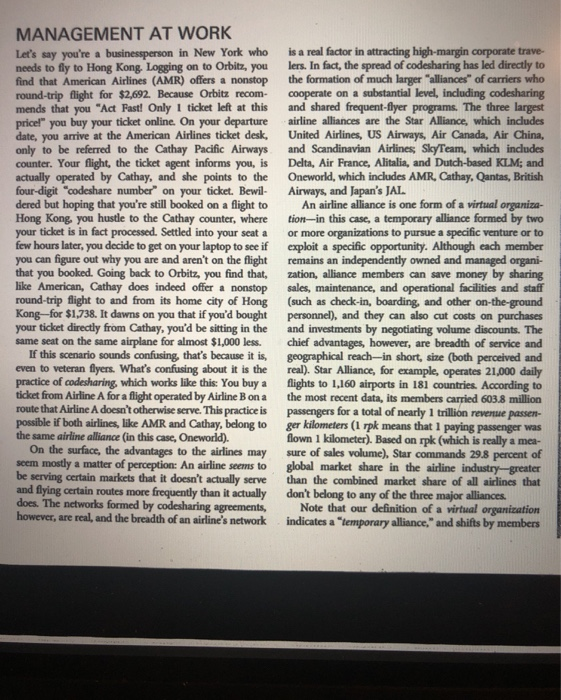
MANAGEMENT AT WORK Let's say you're a businessperson in New York who is a real factor in attracting high-margin corporate trave needs to fly to Hong Kong. Logging on to Orbitz, you lers. In fact, the spread of codesharing has led directly to find that American Airlines (AMR) offers a nonstop the formation of much larger "alliances" of carriers who round-trip flight for $2,692 Because Orbitz recom cooperate on a substantial level, including codesharing mends that you "Act Fast! Only I ticket left at this and shared frequent-flyer programs. The three largest pricel" you buy your ticket online. On your departure airline alliances are the Star Alliance, which includes date, you arrive at the American Airlines ticket desk, United Airlines, US Airways, Air Canada, Air China, only to be referred to the Cathay Pacific Airways and Scandinavian Airlines, SkyTeam, which includes counter. Your flight, the ticket agent informs you, is Delta, Air France, Alitalia, and Dutch-based KLM; and actually operated by Cathay, and she points to the Oneworld, which includes AMR, Cathay. Qantas, British four-digit codeshare number on your ticket. Bewil Airways, and Japan's JAL dered but hoping that you're still booked on a flight to An airline alliance is one form of a virtual organiza- Hong Kong, you hustle to the Cathay counter, where tion-in this case, a temporary alliance formed by two your ticket in fact processed. Settled into your seat a or more organizations to pursue a specific venture or to few hours later, you decide to get on your laptop to see if exploit a specific opportunity. Although each member you can figure out why you are and aren't on the flight remains an independently owned and managed organi- that you booked. Going back to Orbitz, you find that, zation, alliance members can save money by sharing like American, Cathay does indeed offer a nonstop sales, maintenance, and operational facilities and staff round-trip flight to and from its home city of Hong (such as check-in, boarding, and other on-the-ground Kong--for $1,738. It dawns on you that if you'd bought personnel), and they can also cut costs on purchases your ticket directly from Cathay, you'd be sitting in the and investments by negotiating volume discounts. The same seat on the same airplane for almost $1,000 less. chief advantages, however, are breadth of service and If this scenario sounds confusing that's because it is, geographical reach-in short, size (both perceived and even to veteran flyers. What's confusing about it is the real). Star Alliance, for example, operates 21,000 daily practice of codesharing, which works like this: You buy a flights to 1,160 airports in 181 countries. According to ticket from Airline A for a flight operated by Airline Bona the most recent data, its members carried 603.8 million route that Airline A doesn't otherwise serve. This practice is passengers for a total of nearly 1 trillion revenue passen- possible if both airlines, like AMR and Cathay, belong to ger kilometers (1 rpk means that I paying passenger was the same airline alliance (in this case, Oneworld). flown 1 kilometer). Based on rpk (which is really a mea- On the surface, the advantages to the airlines may sure of sales volume). Star commands 29.8 percent of seem mostly a matter of perception: An airline seems to global market share in the airline industry-greater be serving certain markets that it doesn't actually serve than the combined market share of all airlines that and flying certain routes more frequently than it actually don't belong to any of the three major alliances does. The networks formed by codesharing agreements, Note that our definition of a virtual organization however, are real, and the breadth of an airline's network indicates a temporary alliance," and shifts by members of airline alliances are not unheard of. In January 2009, for example, a few months after merger talks had bro- ken down with United Airlines, Continental Airlines, a member of SkyTeam since 2004, announced that it was joining United in the Star Alliance. According to one analyst, the move, which took effect in October 2009, "was obviously a precursor to a full-blown merger," and, sure enough, Continental and United merged in May 2010 under a parent company called United Con- tinental Holdings. The new airline remains a member of the Star Alliance. The Continental-United merger was particularly bad news for both AMR, a member of Oneworld and the country's largest stand-alone airline, and US Air- ways Group, a member of SkyTeam and the fifth- largest U.S. carrier. With the merger of Continental and United, says Vaughn Cordle, chief analyst at Air- line Forecasts, specialist in industry investment research, "the odds of ... bankruptcy for US Airways and American increase because it will be too difficult, if not impossible for them to remain viable as stand- alone businesses....(Without a new strategic direction and significant changes in the industry's structure." Cordle predicts, AMR and US Airways will continue on the slow ... path to failure." Cordle recommends consolidation, and many ana- lysts say that AMR management had begun considering its options even before the Continental-United merger. The best strategy, adds George Van Hom, an analyst at the research firm IBISWorld, needn't be a merger but could involve some kind of looser alliance. Who is the likely partner if AMR decides to consolidate! John Kasarda, an aviation expert at the University of North Carolina's Kenan-Flagler Business School, thinks that an AMR-US Airways merger isn't out of the question: "It would be more out of necessity," he admits, but both airlines have been asleep at the switch and can expect their respective shareholders to demand some kind of action. A merger, however, would require US Airways to leave the Star Alliance, and US Airways says that we highly value our membership in Star and maintain that it's the strongest alliance." In any case, observers agree that AMR needs to make some kind of strategic move. Once the world's largest airline, it's now number three, behind the new Continental-United and Delta Airlines. Among U.S. airlines, AMR has the lowest margins and highest costs, and it's also the only U.S. airline that lost money in 2010. IBISWorld's Van Horn points out, however, that AMR has considerable experience at the kind of deal making in question: American, he reminds potential investors,"helped originate the whole idea of alliances and partnerships. If somebody should be good at it, you could make the argument they should be." Case Questions 1. Take a situational view of organization design: What roles have technology and environment played in the development of alliances and virtual organizations in the airline industry? In what ways does the corporate-level strategy of joining an alli- ance affect an airline's organizational functions? 2. In what ways might the divisional (M-form) designs of most airlines lend themselves to the requirements of alliance membership! In what ways might they be compatible with the organi- zational needs of the alliances themselves? 3. According to one industry analyst, "in a scale business... size does matter." What does he mean by a scale business? Why is the airline industry a scale business"? Once you've thought about these two questions, how would you describe the specific opportunity which, as virtual organizations, airline alliances are designed to exploit? 4. Have you ever been on a flight that involved a codesharing arrangement? Did you notice then- or do you realize now-that there were advantages to the practice of codesharing! Based on what you know about airline travel, list a few of the possible advantages of codesharing for passengers. Case References "Orbitz: Flights," Orbite.com, May 3, 2010, www.orbitz .com, on July 18, 2012, David Grossman, "The Anomalies of Code Share, USA Today, June 23, 2006, www.usatoday.com, on July 18, 2012, Star Alliance, "Star Alliance Statistics." July 2010, www staralliance.com, on July 18, 2012; Ben Mutxabaugh, *Continental: SkyTeam Membership Ends Oct. 24." USA Today, January 30, 2009, http//travel.usatoday .com, on July 18, 2012, Andrew Clark, United and Continental Merge to Create World's Biggest Air- line, The Guardian, September 17, 2010, www guardian.co.uk, on July 18, 2012, Susanna Ray. "AMR May Seck Alliances as Mergers Erase Lead in Size," Bloomberg Business week, May 3, 2010, www.businessweek.com, on July 18, 2012, and Robert Herbst, Airlines Will Report Big Profits for 2010," Seeking Alpha, January 17, 2011, http//see- kingalpha.com, on July 18, 2012









 Study Help