Question: Please! Please! Please! Answer the question ASAP. I will like from 4 different ids. Thank You CASE 6 JOHN PAUL II: CEO OF THE WORLD'S
Please! Please! Please! Answer the question ASAP. I will like from 4 different ids.
Thank You
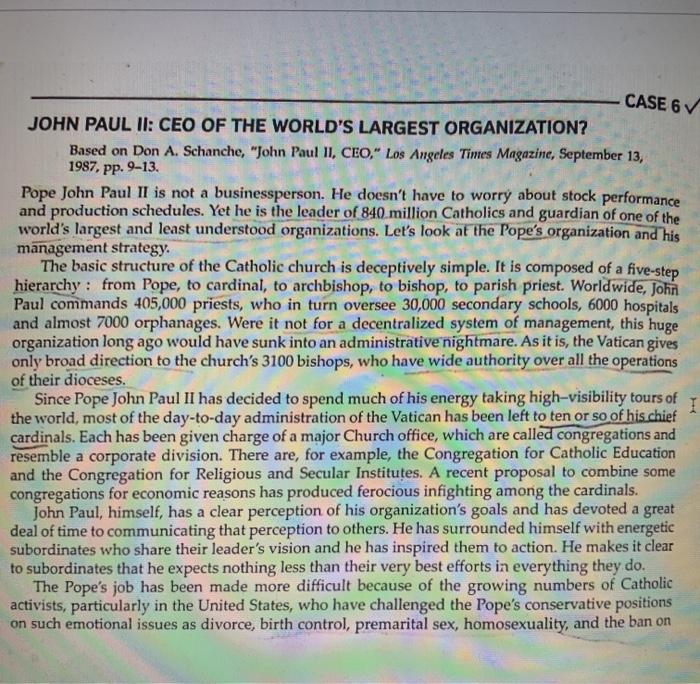
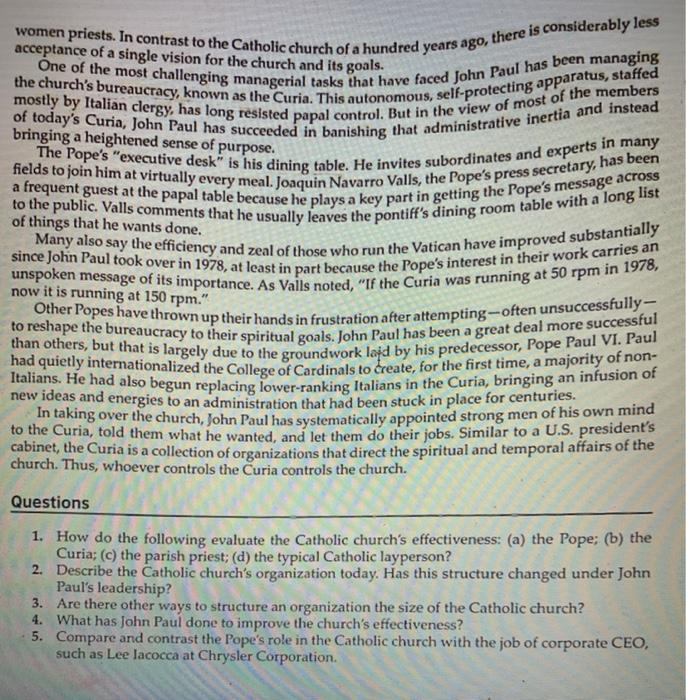
CASE 6 JOHN PAUL II: CEO OF THE WORLD'S LARGEST ORGANIZATION? Based on Don A. Schanche, "John Paul II, CEO," Los Angeles Times Magazine, September 13, 1987, pp. 9-13. Pope John Paul II is not a businessperson. He doesn't have to worry about stock performance and production schedules. Yet he is the leader of 840 million Catholics and guardian of one of the world's largest and least understood organizations. Let's look at the Pope's organization and his management strategy. The basic structure of the Catholic church is deceptively simple. It is composed of a five-step hierarchy : from Pope, to cardinal, to archbishop, to bishop, to parish priest. Worldwide, John Paul commands 405,000 priests, who in turn oversee 30,000 secondary schools, 6000 hospitals and almost 7000 orphanages. Were it not for a decentralized system of management, this huge organization long ago would have sunk into an administrative nightmare. As it is, the Vatican gives only broad direction to the church's 3100 bishops, who have wide authority over all the operations of their dioceses. Since Pope John Paul II has decided to spend much of his energy taking high-visibility tours of the world, most of the day-to-day administration of the Vatican has been left to ten or so of his chief cardinals. Each has been given charge of a major Church office, which are called congregations and resemble a corporate division. There are, for example, the Congregation for Catholic Education and the Congregation for Religious and Secular Institutes. A recent proposal to combine some congregations for economic reasons has produced ferocious infighting among the cardinals. John Paul, himself, has a clear perception of his organization's goals and has devoted a great deal of time to communicating that perception to others. He has surrounded himself with energetic subordinates who share their leader's vision and he has inspired them to action. He makes it clear to subordinates that he expects nothing less than their very best efforts in everything they do. The Pope's job has been made more difficult because of the growing numbers of Catholic activists, particularly in the United States, who have challenged the Pope's conservative positions on such emotional issues as divorce, birth control, premarital sex, homosexuality, and the ban on bringing a heightened sense of purpose. experts women priests. In contrast to the Catholic church of a hundred years ago, there is considerably less a single vision for and the church's bureaucracy, known as the Curia. This autonomous, self-protecting apparatus, staffed One of the most challenging managerial tasks that have faced John Paul has been managing mostly by Italian clergy, has long resisted papal control. But in the view of most of the members of today's Curia, John Paul has succeeded in banishing that administrative inertia and instead in many The Pope's "executive desk" is his dining table. He invites subordinates and fields to join him at virtually every meal. Joaquin Navarro Valls, the Pope's press secretary, has been a frequent guest at the papal table because he plays a key part in getting the Pope's message across of things that he wants . to the public. Valls comments that he usually leaves the pontiff's dining room table with a long list since John Paul took over in 1978, at least in part because the Pope's interest in their work carries an Many also say the efficiency and zeal of those who run the Vatican have improved substantially unspoken message of its importance. As Valls noted, "If the Curia was running at 50 rpm in 1978, now it is running at 150 rpm." Other Popes have thrown up their hands in frustration after attempting-often unsuccessfully- than others, but that is largely due to the groundwork laid by his predecessor, Pope Paul VI. Paul to reshape the bureaucracy to their spiritual goals. John Paul has been a great deal more successful Italians. He had also begun replacing lower-ranking Italians in the Curia, bringing an infusion of new ideas and energies to an administration that had been stuck in place for centuries. In taking over the church, John Paul has systematically appointed strong men of his own mind to the Curia, told them what he wanted, and let them do their jobs. Similar to a U.S. president's cabinet, the Curia is a collection of organizations that direct the spiritual and temporal affairs of the church. Thus, whoever controls the Curia controls the church. Questions 1. How do the following evaluate the Catholic church's effectiveness: (a) the Pope; (b) the Curia; (c) the parish priest; (d) the typical Catholic layperson? 2. Describe the Catholic church's organization today. Has this structure changed under John Paul's leadership? 3. Are there other ways to structure an organization the size of the Catholic church? 4. What has John Paul done to improve the church's effectiveness? 5. Compare and contrast the Pope's role in the Catholic church with the job of corporate CEO, such as Lee Iacocca at Chrysler Corporation. CASE 6 JOHN PAUL II: CEO OF THE WORLD'S LARGEST ORGANIZATION? Based on Don A. Schanche, "John Paul II, CEO," Los Angeles Times Magazine, September 13, 1987, pp. 9-13. Pope John Paul II is not a businessperson. He doesn't have to worry about stock performance and production schedules. Yet he is the leader of 840 million Catholics and guardian of one of the world's largest and least understood organizations. Let's look at the Pope's organization and his management strategy. The basic structure of the Catholic church is deceptively simple. It is composed of a five-step hierarchy : from Pope, to cardinal, to archbishop, to bishop, to parish priest. Worldwide, John Paul commands 405,000 priests, who in turn oversee 30,000 secondary schools, 6000 hospitals and almost 7000 orphanages. Were it not for a decentralized system of management, this huge organization long ago would have sunk into an administrative nightmare. As it is, the Vatican gives only broad direction to the church's 3100 bishops, who have wide authority over all the operations of their dioceses. Since Pope John Paul II has decided to spend much of his energy taking high-visibility tours of the world, most of the day-to-day administration of the Vatican has been left to ten or so of his chief cardinals. Each has been given charge of a major Church office, which are called congregations and resemble a corporate division. There are, for example, the Congregation for Catholic Education and the Congregation for Religious and Secular Institutes. A recent proposal to combine some congregations for economic reasons has produced ferocious infighting among the cardinals. John Paul, himself, has a clear perception of his organization's goals and has devoted a great deal of time to communicating that perception to others. He has surrounded himself with energetic subordinates who share their leader's vision and he has inspired them to action. He makes it clear to subordinates that he expects nothing less than their very best efforts in everything they do. The Pope's job has been made more difficult because of the growing numbers of Catholic activists, particularly in the United States, who have challenged the Pope's conservative positions on such emotional issues as divorce, birth control, premarital sex, homosexuality, and the ban on bringing a heightened sense of purpose. experts women priests. In contrast to the Catholic church of a hundred years ago, there is considerably less a single vision for and the church's bureaucracy, known as the Curia. This autonomous, self-protecting apparatus, staffed One of the most challenging managerial tasks that have faced John Paul has been managing mostly by Italian clergy, has long resisted papal control. But in the view of most of the members of today's Curia, John Paul has succeeded in banishing that administrative inertia and instead in many The Pope's "executive desk" is his dining table. He invites subordinates and fields to join him at virtually every meal. Joaquin Navarro Valls, the Pope's press secretary, has been a frequent guest at the papal table because he plays a key part in getting the Pope's message across of things that he wants . to the public. Valls comments that he usually leaves the pontiff's dining room table with a long list since John Paul took over in 1978, at least in part because the Pope's interest in their work carries an Many also say the efficiency and zeal of those who run the Vatican have improved substantially unspoken message of its importance. As Valls noted, "If the Curia was running at 50 rpm in 1978, now it is running at 150 rpm." Other Popes have thrown up their hands in frustration after attempting-often unsuccessfully- than others, but that is largely due to the groundwork laid by his predecessor, Pope Paul VI. Paul to reshape the bureaucracy to their spiritual goals. John Paul has been a great deal more successful Italians. He had also begun replacing lower-ranking Italians in the Curia, bringing an infusion of new ideas and energies to an administration that had been stuck in place for centuries. In taking over the church, John Paul has systematically appointed strong men of his own mind to the Curia, told them what he wanted, and let them do their jobs. Similar to a U.S. president's cabinet, the Curia is a collection of organizations that direct the spiritual and temporal affairs of the church. Thus, whoever controls the Curia controls the church. Questions 1. How do the following evaluate the Catholic church's effectiveness: (a) the Pope; (b) the Curia; (c) the parish priest; (d) the typical Catholic layperson? 2. Describe the Catholic church's organization today. Has this structure changed under John Paul's leadership? 3. Are there other ways to structure an organization the size of the Catholic church? 4. What has John Paul done to improve the church's effectiveness? 5. Compare and contrast the Pope's role in the Catholic church with the job of corporate CEO, such as Lee Iacocca at Chrysler Corporation









 Study Help