







Question: PLEASE ANSWER FOR QUESTION 3 NOT QUESTION 2 Substances A and B have retention times of 6.40 and 7.20min, respectively, on 15.0cm liquid chromatography (LC)
PLEASE ANSWER FOR QUESTION 3 NOT QUESTION 2
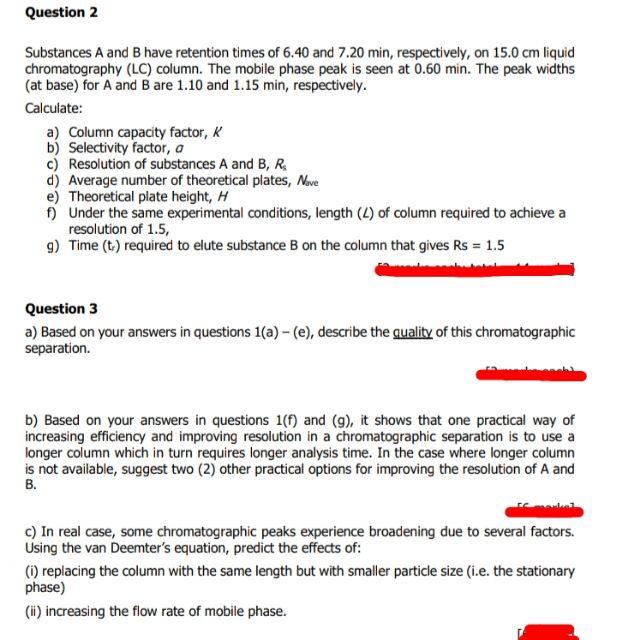
Substances A and B have retention times of 6.40 and 7.20min, respectively, on 15.0cm liquid chromatography (LC) column. The mobile phase peak is seen at 0.60min. The peak widths (at base) for A and B are 1.10 and 1.15min, respectively. Calculate: a) Column capacity factor, k b) Selectivity factor, a c) Resolution of substances A and B,Rs d) Average number of theoretical plates, Nsve e) Theoretical plate height, H f) Under the same experimental conditions, length ( L ) of column required to achieve a resolution of 1.5, g) Time (t ) required to elute substance B on the column that gives Rs=1.5 Question 3 a) Based on your answers in questions 1(a) - (e), describe the quality of this chromatographic separation. b) Based on your answers in questions 1(f) and (g), it shows that one practical way of increasing efficiency and improving resolution in a chromatographic separation is to use a longer column which in turn requires longer analysis time. In the case where longer column is not available, suggest two (2) other practical options for improving the resolution of A and B. c) In real case, some chromatographic peaks experience broadening due to several factors. Using the van Deemter's equation, predict the effects of: (i) replacing the column with the same length but with smaller particle size (i.e. the stationary phase) (ii) increasing the flow rate of mobile phase. Substances A and B have retention times of 6.40 and 7.20min, respectively, on 15.0cm liquid chromatography (LC) column. The mobile phase peak is seen at 0.60min. The peak widths (at base) for A and B are 1.10 and 1.15min, respectively. Calculate: a) Column capacity factor, k b) Selectivity factor, a c) Resolution of substances A and B,Rs d) Average number of theoretical plates, Nsve e) Theoretical plate height, H f) Under the same experimental conditions, length ( L ) of column required to achieve a resolution of 1.5, g) Time (t ) required to elute substance B on the column that gives Rs=1.5 Question 3 a) Based on your answers in questions 1(a) - (e), describe the quality of this chromatographic separation. b) Based on your answers in questions 1(f) and (g), it shows that one practical way of increasing efficiency and improving resolution in a chromatographic separation is to use a longer column which in turn requires longer analysis time. In the case where longer column is not available, suggest two (2) other practical options for improving the resolution of A and B. c) In real case, some chromatographic peaks experience broadening due to several factors. Using the van Deemter's equation, predict the effects of: (i) replacing the column with the same length but with smaller particle size (i.e. the stationary phase) (ii) increasing the flow rate of mobile phase
Step by Step Solution
There are 3 Steps involved in it

Get step-by-step solutions from verified subject matter experts
 Study Help