



Question: Please answer h, i, j, k. (a to g are available on course hero. ) STATS 110/201 Homework 1 esserian Sevan Krikor Gulesserian This file
Please answer h, i, j, k. (a to g are available on course hero. )
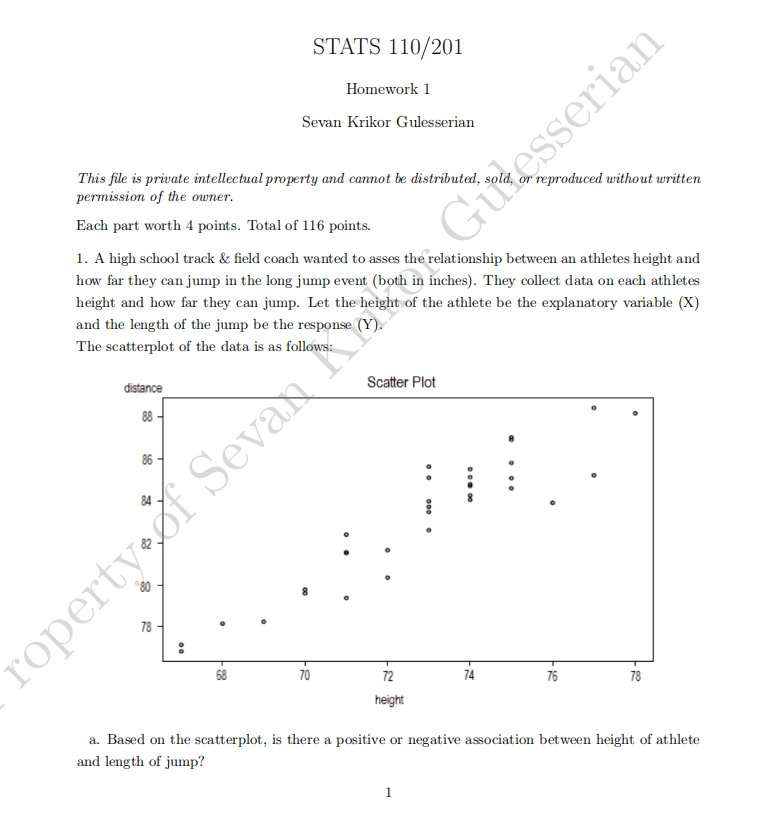
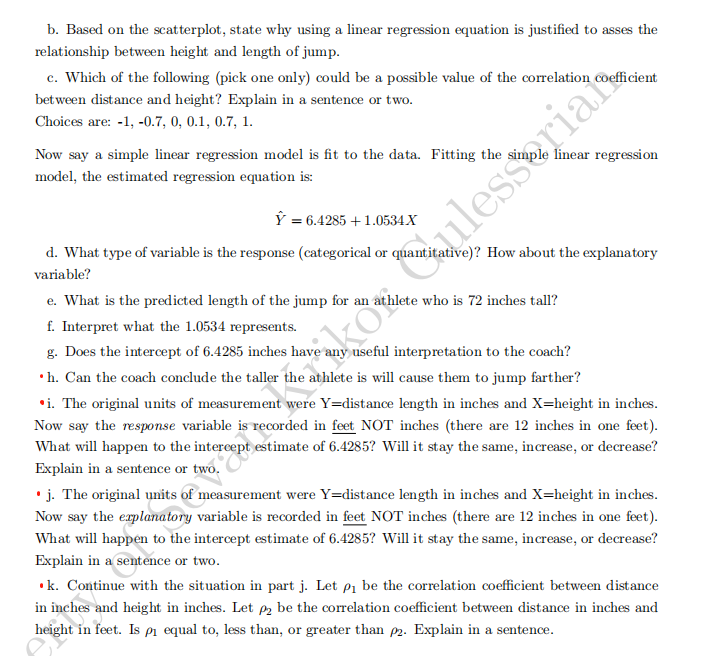
STATS 110/201 Homework 1 esserian Sevan Krikor Gulesserian This file is private intellectual property and cannot be distributed, sold, or reproduced without written permission of the owner. Each part worth 4 points. Total of 116 points. G 1. A high school track & field coach wanted to asses the relationship between an athletes height and how far they can jump in the long jump event (both in inches). They collect data on each athletes height and how far they can jump. Let the height of the athlete be the explanatory variable (X) and the length of the jump be the response (Y). The scatterplot of the data is as follows: distance Scatter Plot 00 0 0 roperty.of Sevan 16 - 68 70 72 74 76 78 height a. Based on the scatterplot, is there a positive or negative association between height of athlete and length of jump?b. Based on the scatterplot, state why using a linear regression equation is justified to asses the relationship between height and length of jump. c. Which of the following (pick one only) could be a possible value of the correlation coefficient between distance and height? Explain in a sentence or two. Choices are: -1, -0.7, 0, 0.1, 0.7, 1. cia Now say a simple linear regression model is fit to the data. Fitting the simple linear regression model, the estimated regression equation is: Y = 6.4285 + 1.0534X d. What type of variable is the response (categorical or quantitative)? How about the explanatory variable? e. What is the predicted length of the jump for an athlete who is 72 inches tall? f. Interpret what the 1.0534 represents. g. Does the intercept of 6.4285 inches have any useful interpretation to the coach? . h. Can the coach conclude the taller the athlete is will cause them to jump farther? .i. The original units of measurement were Y=distance length in inches and X=height in inches. Now say the response variable is recorded in feet NOT inches (there are 12 inches in one feet). What will happen to the intercept estimate of 6.4285? Will it stay the same, increase, or decrease? Explain in a sentence or two. . j. The original units of measurement were Y=distance length in inches and X=height in inches. Now say the explanatory variable is recorded in feet NOT inches (there are 12 inches in one feet). What will happen to the intercept estimate of 6.4285? Will it stay the same, increase, or decrease? Explain in a sentence or two. . k. Continue with the situation in part j. Let p, be the correlation coefficient between distance in inches and height in inches. Let p2 be the correlation coefficient between distance in inches and height in feet. Is pi equal to, less than, or greater than p2. Explain in a sentence
Step by Step Solution
There are 3 Steps involved in it

Get step-by-step solutions from verified subject matter experts