Question: please answer me activity 11 from the above reading lesson please answer me in less than 10 mintues . Can a Computer Think? by Kevin
please answer me activity 11 from the above reading lesson
please answer me in less than 10 mintues .
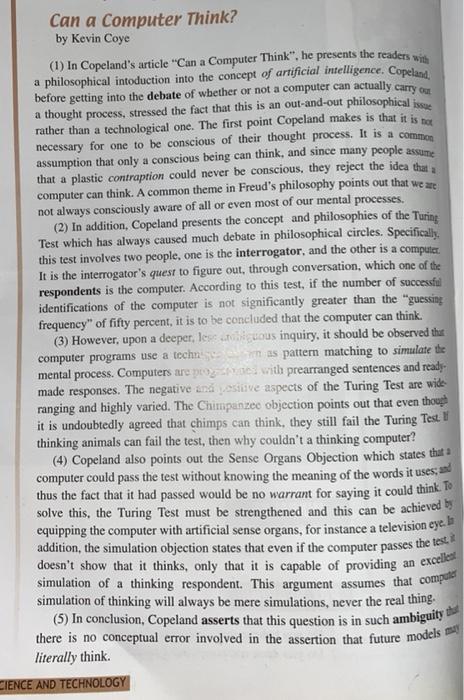
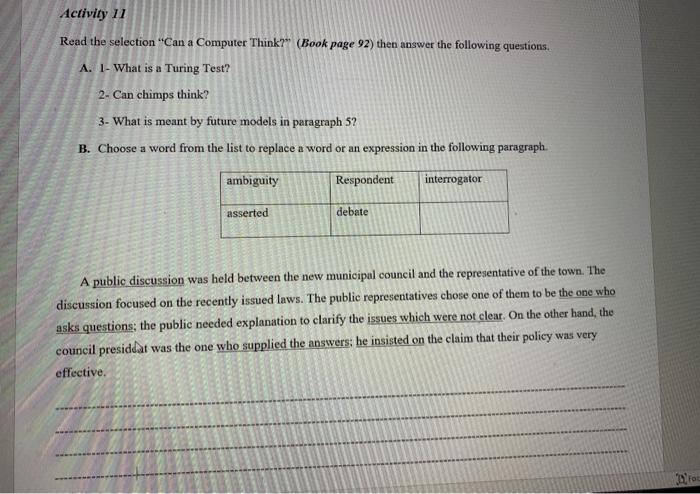
Can a Computer Think? by Kevin Coye a philosophical intoduction into the concept of artificial intelligence. Copeland, (1) In Copeland's article "Can a Computer Think", he presents the readers wij before getting into the debate of whether or not a computer can actually carry on a thought process, stressed the fact that this is an out-and-out philosophical issue rather than a technological one. The first point Copeland makes is that it is the necessary for one to be conscious of their thought process. It is a common assumption that only a conscious being can think, and since many people assume that a plastic contraption could never be conscious, they reject the idea that computer can think. A common theme in Freud's philosophy points out that we are not always consciously aware of all or even most of our mental processes. (2) In addition, Copeland presents the concept and philosophies of the Turing Test which has always caused much debate in philosophical circles. Specifically this test involves two people, one is the interrogator, and the other is a computer It is the interrogator's quest to figure out, through conversation, which one of the respondents is the computer. According to this test, if the number of successful identifications of the computer is not significantly greater than the "guessing frequency of fifty percent, it is to be concluded that the computer can think. (3) However, upon a deeper, lescuous inquiry, it should be observed that computer programs use a techn Es pattern matching to simulate the mental process. Computers are prezos with prearranged sentences and ready- made responses. The negative ancsive aspects of the Turing Test are wide ranging and highly varied. The Chimpanzeo objection points out that even though it is undoubtedly agreed that chimps can think, they still fail the Turing Tese. thinking animals can fail the test, then why couldn't a thinking computer? (4) Copeland also points out the Sense Organs Objection which states that a computer could pass the test without knowing the meaning of the words it uses, and thus the fact that it had passed would be no warrant for saying it could think. To solve this, the Turing Test must be strengthened and this can be achieved equipping the computer with artificial sense organs, for instance a television eye. La addition, the simulation objection states that even if the computer passes the test doesn't show that it thinks, only that it is capable of providing an excellent simulation of a thinking respondent. This argument assumes that computo simulation of thinking will always be mere simulations, never the real thing. (5) In conclusion, Copeland asserts that this question is in such ambiguity there is no conceptual error involved in the assertion that future models literally think. CIENCE AND TECHNOLOGY Activity 11 Read the selection "Can a Computer Think? (Book page 92) then answer the following questions A. 1- What is a Turing Test? 2- Can chimps think? 3- What is meant by future models in paragraph 52 B. Choose a word from the list to replace a word or an expression in the following paragraph. ambiguity Respondent interrogator asserted debate A public discussion was held between the new municipal council and the representative of the town. The discussion focused on the recently issued laws. The public representatives chose one of them to be the one who asks questions; the public needed explanation to clarify the issues which were not clear. On the other hand, the council presiddat was the one who supplied the answers: he insisted on the claim that their policy was very effective









 Study Help