



Question: please answer part 2: a,b I want you to make sure that you have learned the basic math used in establishing the existence of Nash
 please answer part 2: a,b
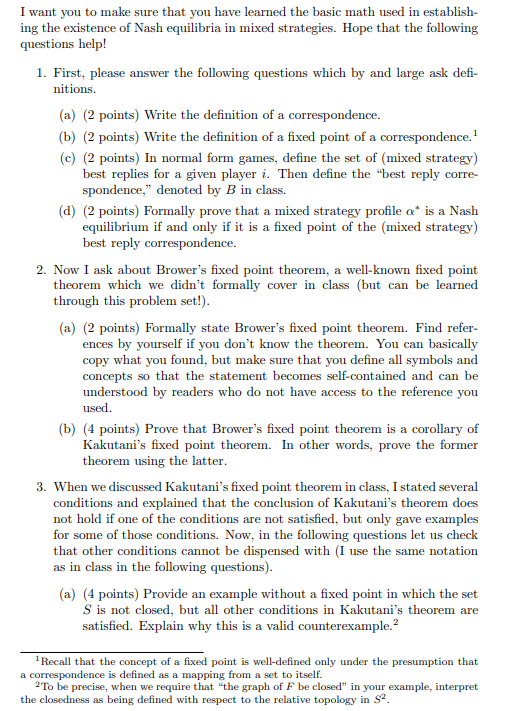
I want you to make sure that you have learned the basic math used in establishing the existence of Nash equilibria in mixed strategies. Hope that the following questions help! 1. First, please answer the following questions which by and large ask definitions. (a) (2 points) Write the definition of a correspondence. (b) (2 points) Write the definition of a fixed point of a correspondence. 1 (c) (2 points) In normal form games, define the set of (mixed strategy) best replies for a given player i. Then define the "best reply correspondence," denoted by B in class. (d) (2 points) Formally prove that a mixed strategy profile is a Nash equilibrium if and only if it is a fixed point of the (mixed strategy) best reply correspondence. 2. Now I ask about Brower's fixed point theorem, a well-known fixed point theorem which we didn't formally cover in class (but can be learned through this problem set!). (a) (2 points) Formally state Brower's fixed point theorem. Find references by yourself if you don't know the theorem. You can basically copy what you found, but make sure that you define all symbols and concepts so that the statement becomes self-contained and can be understood by readers who do not have access to the reference you used. (b) (4 points) Prove that Brower's fixed point theorem is a corollary of Kakutani's fixed point theorem. In other words, prove the former theorem using the latter. 3. When we discussed Kakutani's fixed point theorem in class, I stated several conditions and explained that the conclusion of Kakutani's theorem does not hold if one of the conditions are not satisfied, but only gave examples for some of those conditions. Now, in the following questions let us check that other conditions cannot be dispensed with (I use the same notation as in class in the following questions). (a) (4 points) Provide an example without a fixed point in which the set S is not closed, but all other conditions in Kakutani's theorem are satisfied. Explain why this is a valid counterexample. 2 1 Recall that the concept of a fixed point is well-defined only under the presumption that a correspondence is defined as a mapping from a set to itself. 2 To be precise, when we require that "the graph of F be closed" in your example, interpret the closedness as being defined with respect to the relative topology in S2. I want you to make sure that you have learned the basic math used in establishing the existence of Nash equilibria in mixed strategies. Hope that the following questions help! 1. First, please answer the following questions which by and large ask definitions. (a) (2 points) Write the definition of a correspondence. (b) (2 points) Write the definition of a fixed point of a correspondence. 1 (c) (2 points) In normal form games, define the set of (mixed strategy) best replies for a given player i. Then define the "best reply correspondence," denoted by B in class. (d) (2 points) Formally prove that a mixed strategy profile is a Nash equilibrium if and only if it is a fixed point of the (mixed strategy) best reply correspondence. 2. Now I ask about Brower's fixed point theorem, a well-known fixed point theorem which we didn't formally cover in class (but can be learned through this problem set!). (a) (2 points) Formally state Brower's fixed point theorem. Find references by yourself if you don't know the theorem. You can basically copy what you found, but make sure that you define all symbols and concepts so that the statement becomes self-contained and can be understood by readers who do not have access to the reference you used. (b) (4 points) Prove that Brower's fixed point theorem is a corollary of Kakutani's fixed point theorem. In other words, prove the former theorem using the latter. 3. When we discussed Kakutani's fixed point theorem in class, I stated several conditions and explained that the conclusion of Kakutani's theorem does not hold if one of the conditions are not satisfied, but only gave examples for some of those conditions. Now, in the following questions let us check that other conditions cannot be dispensed with (I use the same notation as in class in the following questions). (a) (4 points) Provide an example without a fixed point in which the set S is not closed, but all other conditions in Kakutani's theorem are satisfied. Explain why this is a valid counterexample. 2 1 Recall that the concept of a fixed point is well-defined only under the presumption that a correspondence is defined as a mapping from a set to itself. 2 To be precise, when we require that "the graph of F be closed" in your example, interpret the closedness as being defined with respect to the relative topology in S2
Step by Step Solution
There are 3 Steps involved in it

Get step-by-step solutions from verified subject matter experts