







Question: Please answer parts A through C. I am having a lot of trouble with chemistry I am having a hard time understanding everything. Please show
Please answer parts A through C. I am having a lot of trouble with chemistry I am having a hard time understanding everything. Please show work if possible. Thank You!!!!
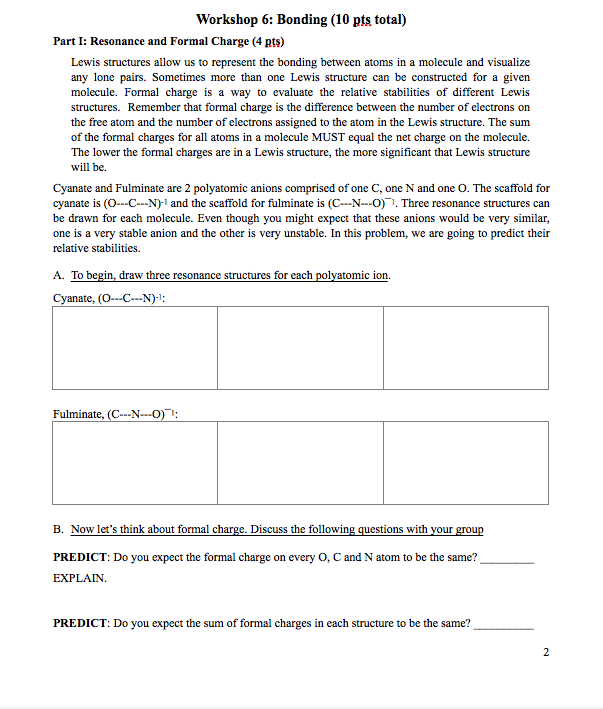
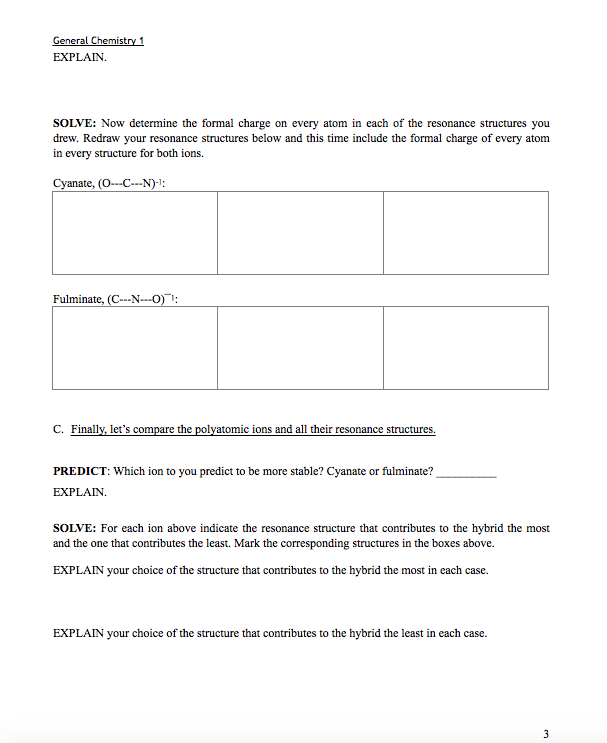
Workshop 6: Bonding (10 pts total) Part I: Resonance and Formal Charge (4 pts) Lewis structures allow us to represent the bonding between atoms in a molecule and visualize any lone pairs. Sometimes more than one Lewis structure can be constructed for a given molecule. Formal charge is a way to evaluate the relative stabilities of different Lewis structures. Remember that formal charge is the difference between the number of electrons on the free atom and the number of electrons assigned to the atom in the Lewis structure. The sum of the formal charges for all atoms in a molecule MUST equal the net charge on the molecule. The lower the formal charges are in a Lewis structure, the more significant that Lewis structure will be. Cyanate and Fulminate are 2 polyatomic anions comprised of one C, one N and one O. The scaffold for cyanate is (O---C---N).I and the scaffold for fulminate is (C---N---O) 1. Three resonance structures can be drawn for each molecule. Even though you might expect that these anions would be very similar, one is a very stable anion and the other is very unstable. In this problem, we are going to predict their relative stabilities. A. To begin, draw three resonance structures for each polyatomic ion. Cyanate, (0---C---N)-1: Fulminate, (C---N-O) 1; B. Now let's think about formal charge. Discuss the following questions with your group PREDICT: Do you expect the formal charge on every O, C and N atom to be the same? EXPLAIN. PREDICT: Do you expect the sum of formal charges in each structure to be the same? 2General Chemistry 1 EXPLAIN. SOLVE: Now determine the formal charge on every atom in each of the resonance structures you drew. Redraw your resonance structures below and this time include the formal charge of every atom in every structure for both ions. Cyanate, (0---C---N)-1: Fulminate, (C---N-O) 1; C. Finally, let's compare the polyatomic ions and all their resonance structures. PREDICT: Which ion to you predict to be more stable? Cyanate or fulminate? EXPLAIN. SOLVE: For each ion above indicate the resonance structure that contributes to the hybrid the most and the one that contributes the least. Mark the corresponding structures in the boxes above. EXPLAIN your choice of the structure that contributes to the hybrid the most in each case. EXPLAIN your choice of the structure that contributes to the hybrid the least in each case. 3
Step by Step Solution
There are 3 Steps involved in it

Get step-by-step solutions from verified subject matter experts
 Study Help