







Question: please answer peer response #2 with the above information provided. (please explain it so i can understand better) I am a business owner of boba
 please answer peer response #2 with the above information provided. (please explain it so i can understand better)
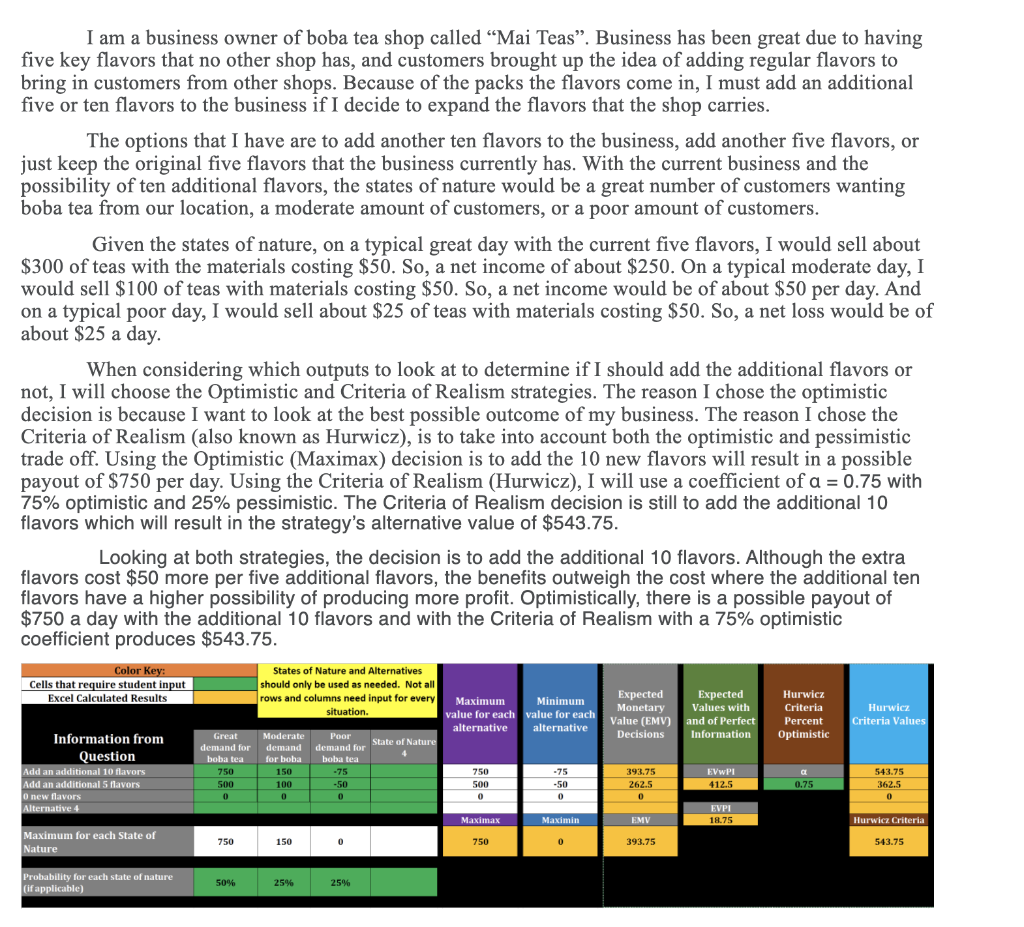
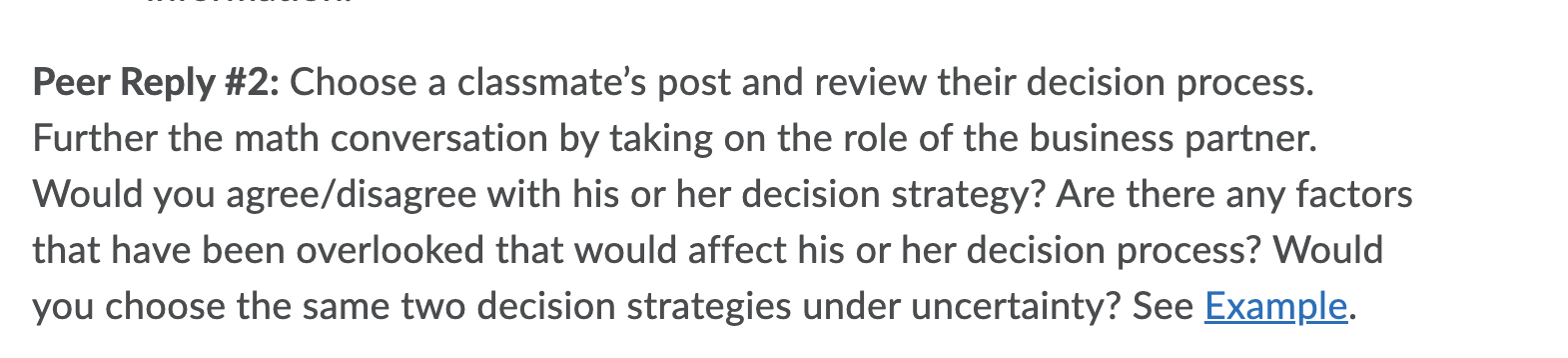
I am a business owner of boba tea shop called Mai Teas. Business has been great due to having five key flavors that no other shop has, and customers brought up the idea of adding regular flavors to bring in customers from other shops. Because of the packs the flavors come in, I must add an additional five or ten flavors to the business if I decide to expand the flavors that the shop carries. The options that I have are to add another ten flavors to the business, add another five flavors, or just keep the original five flavors that the business currently has. With the current business and the possibility of ten additional flavors, the states of nature would be a great number of customers wanting boba tea from our location, a moderate amount of customers, or a poor amount of customers. Given the states of nature, on a typical great day with the current five flavors, I would sell about $300 of teas with the materials costing $50. So, a net income of about $250. On a typical moderate day, I would sell $100 of teas with materials costing $50. So, a net income would be of about $50 per day. And on a typical poor day, I would sell about $25 of teas with materials costing $50. So, a net loss would be of about $25 a day. When considering which outputs to look at to determine if I should add the additional flavors or not, I will choose the Optimistic and Criteria of Realism strategies. The reason I chose the optimistic decision is because I want to look at the best possible outcome of my business. The reason I chose the Criteria of Realism (also known as Hurwicz), is to take into account both the optimistic and pessimistic trade off. Using the Optimistic (Maximax) decision is to add the 10 new flavors will result in a possible payout of $750 per day. Using the Criteria of Realism (Hurwicz), I will use a coefficient of a = 0.75 with 75% optimistic and 25% pessimistic. The Criteria of Realism decision is still to add the additional 10 flavors which will result in the strategy's alternative value of $543.75. Looking at both strategies, the decision is to add the additional 10 flavors. Although the extra flavors cost $50 more per five additional flavors, the benefits outweigh the cost where the additional ten flavors have a higher possibility of producing more profit. Optimistically, there is a possible payout of $750 a day with the additional 10 flavors and with the Criteria of Realism with a 75% optimistic coefficient produces $543.75. Color Key: Cells that require student input Excel Calculated Results States of Nature and Alternatives should only be used as needed. Not all rows and columns need input for every situation Maximum Expected Minimum Expected Monetary Values with value for each value for each Value (EMV) and of Perfect alternative alternative Decisions Information Hurwicz Criteria Percent Optimistic Hurwicz Criteria Values Information from Question Add an additional 10 flavors Add an additional 5 flavors o new flavors Alternative 4 Great demand for boba tea 750 Sod 0 Moderate Poor demand demand for State of Nature 4 for boba bobate 150 -75 100 -50 0 0 750 500 -75 -50 0 393.75 262.5 0 EVwPI 412.5 0.75 543.75 362.5 0 EVPI 18.75 Maxi 410 Maximin EMV Hurwicz Criteria Maximum for each State of Nature 750 150 0 750 O 393.75 543.75 Probability for each state of nature (if applicable) 50% 25% 25% Peer Reply #2: Choose a classmate's post and review their decision process. Further the math conversation by taking on the role of the business partner. Would you agree/disagree with his or her decision strategy? Are there any factors that have been overlooked that would affect his or her decision process? Would you choose the same two decision strategies under uncertainty? See Example. I am a business owner of boba tea shop called Mai Teas. Business has been great due to having five key flavors that no other shop has, and customers brought up the idea of adding regular flavors to bring in customers from other shops. Because of the packs the flavors come in, I must add an additional five or ten flavors to the business if I decide to expand the flavors that the shop carries. The options that I have are to add another ten flavors to the business, add another five flavors, or just keep the original five flavors that the business currently has. With the current business and the possibility of ten additional flavors, the states of nature would be a great number of customers wanting boba tea from our location, a moderate amount of customers, or a poor amount of customers. Given the states of nature, on a typical great day with the current five flavors, I would sell about $300 of teas with the materials costing $50. So, a net income of about $250. On a typical moderate day, I would sell $100 of teas with materials costing $50. So, a net income would be of about $50 per day. And on a typical poor day, I would sell about $25 of teas with materials costing $50. So, a net loss would be of about $25 a day. When considering which outputs to look at to determine if I should add the additional flavors or not, I will choose the Optimistic and Criteria of Realism strategies. The reason I chose the optimistic decision is because I want to look at the best possible outcome of my business. The reason I chose the Criteria of Realism (also known as Hurwicz), is to take into account both the optimistic and pessimistic trade off. Using the Optimistic (Maximax) decision is to add the 10 new flavors will result in a possible payout of $750 per day. Using the Criteria of Realism (Hurwicz), I will use a coefficient of a = 0.75 with 75% optimistic and 25% pessimistic. The Criteria of Realism decision is still to add the additional 10 flavors which will result in the strategy's alternative value of $543.75. Looking at both strategies, the decision is to add the additional 10 flavors. Although the extra flavors cost $50 more per five additional flavors, the benefits outweigh the cost where the additional ten flavors have a higher possibility of producing more profit. Optimistically, there is a possible payout of $750 a day with the additional 10 flavors and with the Criteria of Realism with a 75% optimistic coefficient produces $543.75. Color Key: Cells that require student input Excel Calculated Results States of Nature and Alternatives should only be used as needed. Not all rows and columns need input for every situation Maximum Expected Minimum Expected Monetary Values with value for each value for each Value (EMV) and of Perfect alternative alternative Decisions Information Hurwicz Criteria Percent Optimistic Hurwicz Criteria Values Information from Question Add an additional 10 flavors Add an additional 5 flavors o new flavors Alternative 4 Great demand for boba tea 750 Sod 0 Moderate Poor demand demand for State of Nature 4 for boba bobate 150 -75 100 -50 0 0 750 500 -75 -50 0 393.75 262.5 0 EVwPI 412.5 0.75 543.75 362.5 0 EVPI 18.75 Maxi 410 Maximin EMV Hurwicz Criteria Maximum for each State of Nature 750 150 0 750 O 393.75 543.75 Probability for each state of nature (if applicable) 50% 25% 25% Peer Reply #2: Choose a classmate's post and review their decision process. Further the math conversation by taking on the role of the business partner. Would you agree/disagree with his or her decision strategy? Are there any factors that have been overlooked that would affect his or her decision process? Would you choose the same two decision strategies under uncertainty? See Example
Step by Step Solution
There are 3 Steps involved in it

Get step-by-step solutions from verified subject matter experts
 Study Help