







Question: {{ Please answer Problem 3. (**Skip Problem 2.**) please show steps }} Problem 2: Construct a Timed Extended State Machine for the T-junction with five
{{ Please answer Problem 3. (**Skip Problem 2.**) please show steps }}
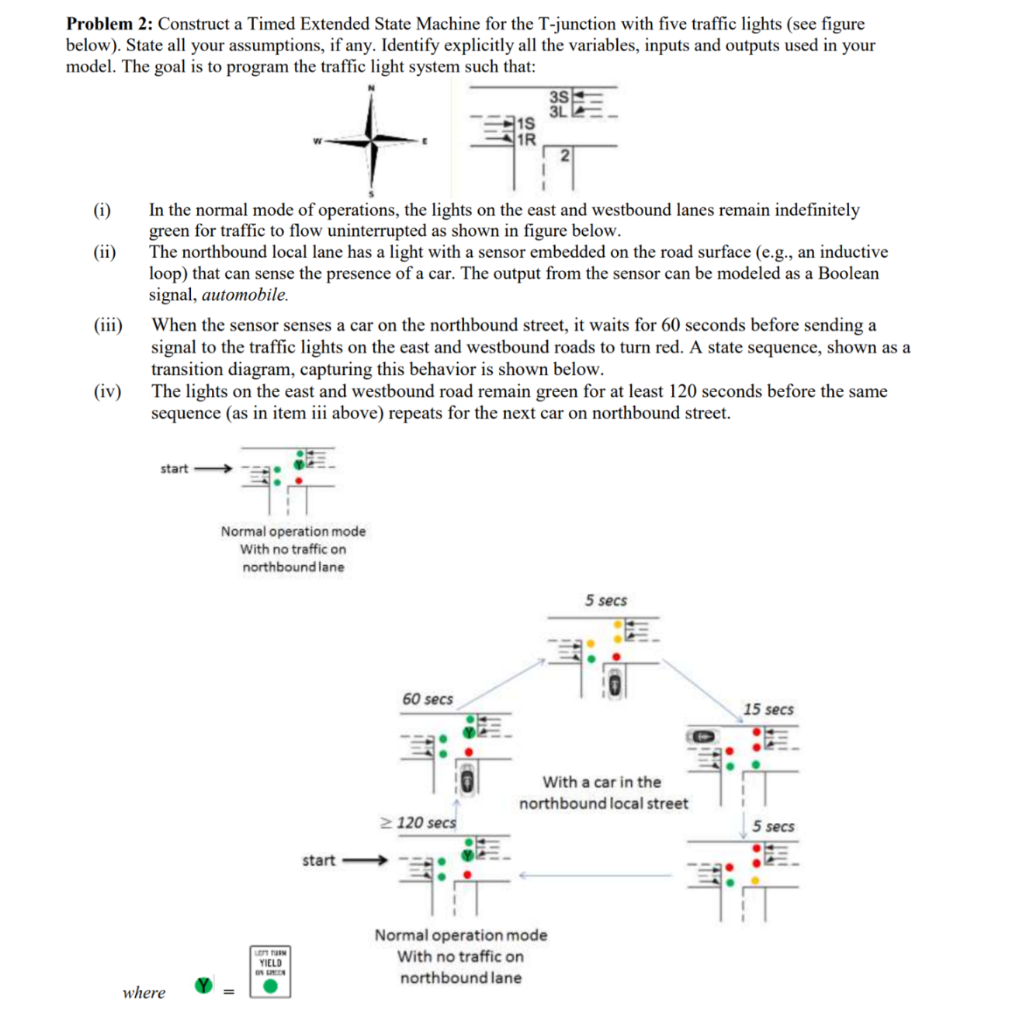
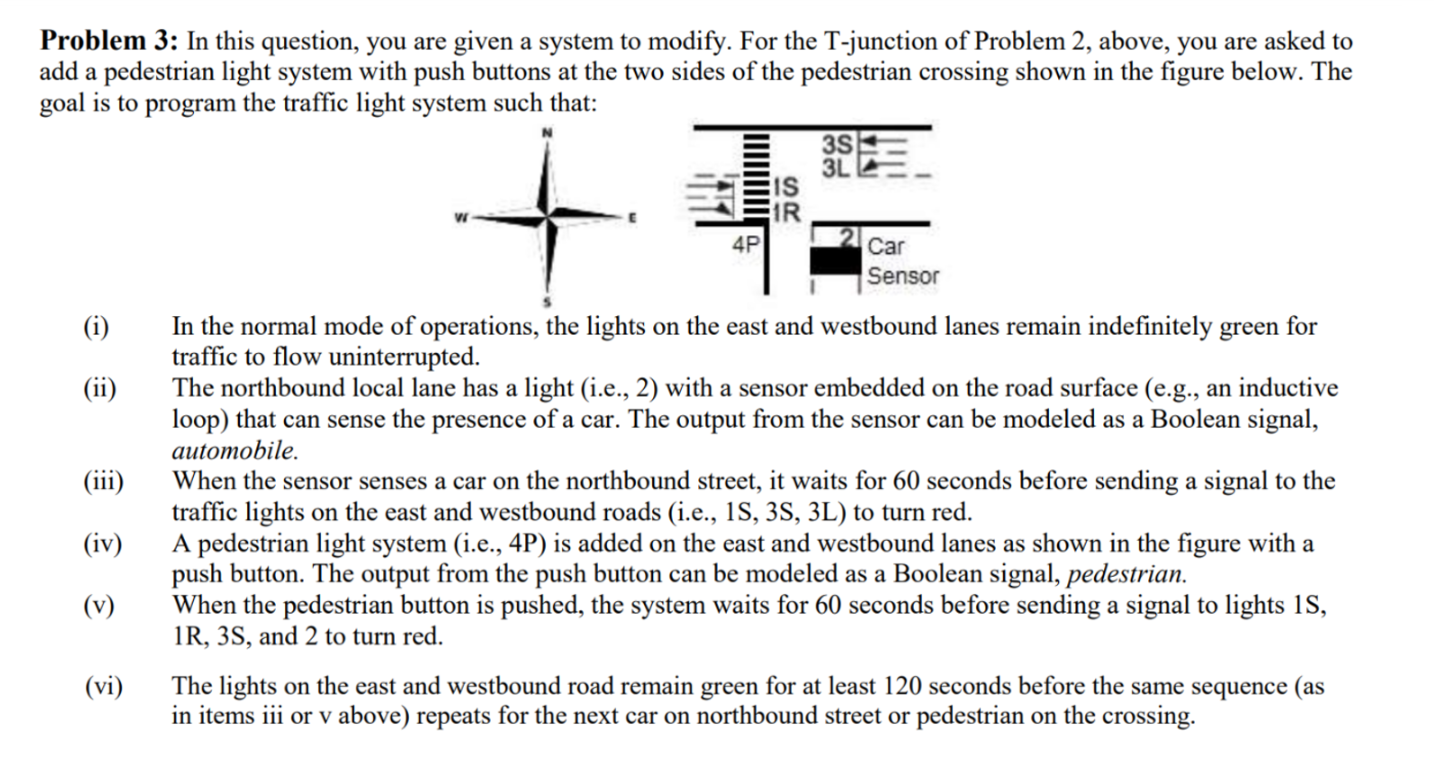
Problem 2: Construct a Timed Extended State Machine for the T-junction with five traffic lights (see figure below). State all your assumptions, if any. Identify explicitly all the variables, inputs and outputs used in your model. The goal is to program the traffic light system such that: (i) (ii) In the normal mode of operations, the lights on the east and westbound lanes remain indefinitely green for traffic to flow uninterrupted as shown in figure below. The northbound local lane has a light with a sensor embedded on the road surface (e.g., an inductive loop) that can sense the presence of a car. The output from the sensor can be modeled as a Boolean signal, automobile. When the sensor senses a car on the northbound street, it waits for 60 seconds before sending a signal to the traffic lights on the east and westbound roads to turn red. A state sequence, shown as a transition diagram, capturing this behavior is shown below. The lights on the east and westbound road remain green for at least 120 seconds before the same sequence (as in item iii above) repeats for the next car on northbound street. (iii) (iv) start- Normal operation mode With no traffic on northboundlane 5 secs 60 secs 15 secs With a car in the northbound local street 120 secs 5 secs start - - Normal operation mode With no traffic on northbound lane YIELD where Problem 3: In this question, you are given a system to modify. For the T-junction of Problem 2, above, you are asked to add a pedestrian light system with push buttons at the two sides of the pedestrian crossing shown in the figure below. The goal is to program the traffic light system such that: 2 car Sensor (i) (iii) In the normal mode of operations, the lights on the east and westbound lanes remain indefinitely green for traffic to flow uninterrupted. The northbound local lane has a light (i.e., 2) with a sensor embedded on the road surface (e.g., an inductive loop) that can sense the presence of a car. The output from the sensor can be modeled as a Boolean signal, automobile. When the sensor senses a car on the northbound street, it waits for 60 seconds before sending a signal to the traffic lights on the east and westbound roads (i.e., 1S, 3S, 3L) to turn red. A pedestrian light system (i.e., 4P) is added on the east and westbound lanes as shown in the figure with a push button. The output from the push button can be modeled as a Boolean signal, pedestrian. When the pedestrian button is pushed, the system waits for 60 seconds before sending a signal to lights 1S, 1R, 3S, and 2 to turn red. The lights on the east and westbound road remain green for at least 120 seconds before the same sequence (as in items iii or v above) repeats for the next car on northbound street or pedestrian on the crossing. (iv) (v) (vi) Problem 2: Construct a Timed Extended State Machine for the T-junction with five traffic lights (see figure below). State all your assumptions, if any. Identify explicitly all the variables, inputs and outputs used in your model. The goal is to program the traffic light system such that: (i) (ii) In the normal mode of operations, the lights on the east and westbound lanes remain indefinitely green for traffic to flow uninterrupted as shown in figure below. The northbound local lane has a light with a sensor embedded on the road surface (e.g., an inductive loop) that can sense the presence of a car. The output from the sensor can be modeled as a Boolean signal, automobile. When the sensor senses a car on the northbound street, it waits for 60 seconds before sending a signal to the traffic lights on the east and westbound roads to turn red. A state sequence, shown as a transition diagram, capturing this behavior is shown below. The lights on the east and westbound road remain green for at least 120 seconds before the same sequence (as in item iii above) repeats for the next car on northbound street. (iii) (iv) start- Normal operation mode With no traffic on northboundlane 5 secs 60 secs 15 secs With a car in the northbound local street 120 secs 5 secs start - - Normal operation mode With no traffic on northbound lane YIELD where Problem 3: In this question, you are given a system to modify. For the T-junction of Problem 2, above, you are asked to add a pedestrian light system with push buttons at the two sides of the pedestrian crossing shown in the figure below. The goal is to program the traffic light system such that: 2 car Sensor (i) (iii) In the normal mode of operations, the lights on the east and westbound lanes remain indefinitely green for traffic to flow uninterrupted. The northbound local lane has a light (i.e., 2) with a sensor embedded on the road surface (e.g., an inductive loop) that can sense the presence of a car. The output from the sensor can be modeled as a Boolean signal, automobile. When the sensor senses a car on the northbound street, it waits for 60 seconds before sending a signal to the traffic lights on the east and westbound roads (i.e., 1S, 3S, 3L) to turn red. A pedestrian light system (i.e., 4P) is added on the east and westbound lanes as shown in the figure with a push button. The output from the push button can be modeled as a Boolean signal, pedestrian. When the pedestrian button is pushed, the system waits for 60 seconds before sending a signal to lights 1S, 1R, 3S, and 2 to turn red. The lights on the east and westbound road remain green for at least 120 seconds before the same sequence (as in items iii or v above) repeats for the next car on northbound street or pedestrian on the crossing. (iv) (v) (vi)
Step by Step Solution
There are 3 Steps involved in it

Get step-by-step solutions from verified subject matter experts
 Study Help