







Question: Please answer Question 10.4 - What are the major forces that affected the Japanese yen over the years? What factors do you think are important
Please answer Question 10.4 -
What are the major forces that affected the Japanese yen over the years? What factors do you think are important to monitor as you try to forecast what will happen to the value of the yen in the future?
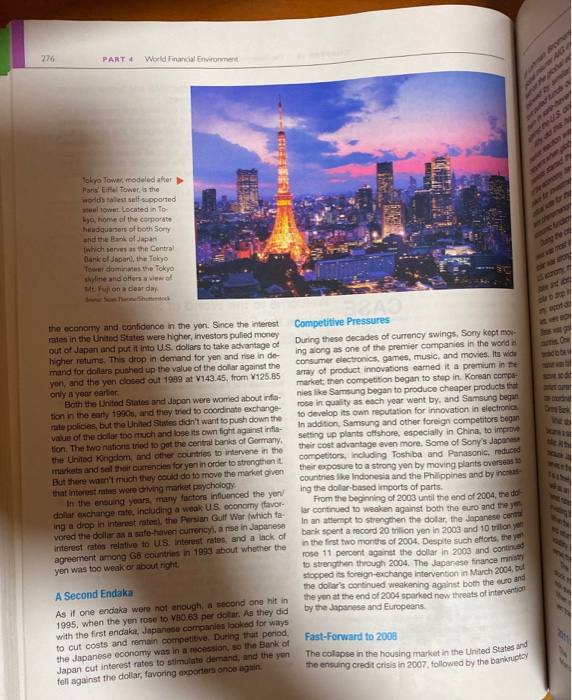
CASE Welcome to the World of Sony- Unless the Falling Yen Rises (or Falls) Again 35 For five consecutive years, the yen was falling against the U.S. dollar, which actually was a good deal. The reason is because Japanese foreign-exchange policies favored companies and stronger revenues and earnings from abroad were translated industries that the government wanted to succeed, especially into more yen. In addition, the weaker yen helped Sony in in export markets. With a cheap yen, it was easy for compa- export markets. However, in early 2016, the yen began to nies to expand exports rapidly. strengthen against the dollar from V123 in November 2015 to 120 at the end of 2015, to V112.4 on March 31, 2016, The First Endaka the close of Sony's fiscal year. Whereas Toyota disclosed in From its 1970 high, the yen steadily strengthened until 1985, August 2015 that the weaker yen was fueling profits, in when it really shot up in value. Due to economic problems the first quarter of 2016 it changed its tune and noted that the in the United States, the dollar began to fall during the latter stronger yen was going to hurt sales and profits. What will the part of 1985, and the yen ended the year at V200 per dollar future bring for Sony and other Japanese companies? (as the number of yen per dollar falls, the dollar gets weaker and the yen gets stronger). By the latter part of 1986, it The Past was trading at V150, a steep rise from its historical highs. The Japanese called this strengthening of the yen endaka, Before attacking the future, let's look at the past, especially which literally translates "high yen." Endaka resulted in seri- from the perspective of the Japanese yen. In the post-World ous problems for Japanese exporters and potential pain War Il years, the yen was extremely weak against the dollar, for the entire Japanese economy, which depended heavily trading at V357.65 in 1970. At that time, in 1946, the Tokyo on international trade. However, one advantage of endaka Tsushin Kogyo Corporation was founded, officially becom- was that imports were cheaper, and Japan relied heavily on ing known as Sony Corporation in 1958, the year its stock imports of virtually all commodities. Thus its input costs fell, even as it found its export prices rising. was first listed on the Tokyo Stock Exchange. It also became The strong yen was due primarily to a strong Japanese tho first Japanese company to list American Depositary Receipts (ADRs) on the New York Stock Exchange in 1961, economy, large trade surpluses, and the largest foreign-ex- finally listing its own shares in September 1970. change reserves in the world. In addition, Japan had low un- employment, low interest rates, and low inflation. But cracks In those early years of operation, Sony had the luxury began to show in its economy. A combination of a drop in the of operating in a currency that was not only weak against stock market, a rise in inflation, and a real estate bubble hurt the dollar, but also highly controlled by the government 276 PART 4 World Financial Environment Tokyo Tower, modeled after Paris Eiffel Tower, is the worlds tallest self-supported steel tower. Located in To: kyo, home of the corporate headquarters of both Sony and the Bank of Japan (which serves as the Central Bank of Japan, the Tokyo Tower dominates the Tokyo skyline and offers a view of Mt. Fup on a clear day teor the economy and confidence in the yen. Since the interest rates in the United States were higher, investors pulled money out of Japan and put it into U.S. dollars to take advantage of higher retums. This drop in demand for yon and rise in de mand for dollars pushed up the value of the dollar against the yon, and the yen closed out 1989 at V143.45, from V125.85 only a year earlier Both the United States and Japan were worried about info tion in the early 1990s, and they tried to coordinate exchange- rate policies, but the United States didn't want to push down the value of dollar too much and lose its own fight against infia- tion. The two nations tried to get the central banks of Germany, the United Kingdom, and other countries to intervene in the markets and sell their currencies for yen in order to strengthen it. But there wasn't much they could do to move the market given that interest rates were driving market psychology. In the ensuing years, many factors influenced the yen/ dollar exchange rate, including a weak U.S. economy favor ing a drop in interest rates), the Persian Gulf War (which fa- vored the dollar as a safe haven currency), a rise in Japanese interest rates relative to U.S. interest rates, and a lack of agreement among GB countries in 1993 about whether the yen was too weak or about night. Competitive Pressures During these decades of currency swings. Sony kept mov- ing along as one of the premier companies in the world in consumer electronics, games, music, and movies. Its wide array of product innovations camed it a premium in the market, then competition began to stop in Korean compa nies like Samsung began to produce cheaper products that Tote in quality as each year went by, and Samsung began to develop its own reputation for innovation in electronics In addition, Samsung and other foreign competitors began setting up plants offshore, especially in China, to improve their cost advantage even more. Some of Sony's Japanese competitors, including Toshiba and Panasonic, reduced their exposure to a strong yen by moving plants overseas to countries like Indonesia and the Philippines and by increas ing the dollar based imports of parts. From the beginning of 2003 until the end of 2004, the do tar continued to weaken against both the euro and the yon In an attempt to strengthen the dollar, the Japanese contra bark spent a record 20 trillion yen in 2003 and 10 trillion yon in the first two months of 2004. Despite such efforts, the yon robe 11 percent against the dollar in 2003 and continued to strengthen through 2004. The Japanese finance ministry stopped its foreign exchange intervention in March 2004, but the dollar's continued weakening against both the euro and the yon at the end of 2004 sparked new threats of intervention by the Japanese and Europeans. A Second Endaka As if one endaka were not enough, a second one hit in 1995, when the yen rose to V80.63 per dollar. As they did with the first endaka, Japanese companies looked for ways to cut costs and remain competitive. During that period, the Japanese economy was in a recession, so the Bank of Japan cut interest rates to stimulate demand, and the yon foll against the dollar, favoring exporters once again. Fast-Forward to 2008 The collapse in the housing market in the United States and the ensuing credit crisis in 2007, followed by the bankruptcy CHAPTER 10 The Determination of Exchange Rates of Lehman Brothers and the US government takeover of global insurer AIG in September 2008, had a devastating ef- fect on the global economy. The U.S. stock market crashed, overall human tragedy. In addition, there was a great deal followed by similar crashes around the world, and inves of uncertainty over damage to nuclear reactors and disrup tors pulled funds out of risky emerging markets and placed tion to the global supply chain. Consider that Japanese them in safe-haven assets. As a result, the euro dropped factores produce about 25 percent of the world's sem conductors and 40 percent of electronic components) against the U.S. dollar and the Japanese yen. Why did this happen? In the case of the US dollar, the Plants in affected areas were shut down due to property market reaction was a standard flight to safety - which often damage, power outages, and a transportation Infrastruc ture that ground to a halt happens when global events get scary-even though the U.S. What happened to the Japanese yen during this si? markets started the collapse. Political stability and the size Conventional wisdom would say that the yer ol against the of the economy tend to make the United States an attractive dollar, but it actually rose in value. After the que, there was place for investment. Thus, the fear factor seemed to be a a massive inflow of capital from the Japanese as they lo critical vote for the dollar during the crisis. This was a short dated investments made with cheap Japanese money which term phenomenon, however, and was eventually replaced by were invested in emerging markets where returns are high economic fundamentals (another example of carry trade. In addition, many Japanese During the crisis, the dollar vacilated depending on what companies brought money back to the country at the end of news was most important. When the crisis was the news, the the fiscal year (March 31), so the need for capital resulted in a dollar was strong. When the news favored a recovery of the tremendous inflow of it, causing the yen to rise in value. U.S. economy, money flowed into equity markets in the United States and abroad, seeking higher returns and causing the What Does All This Mean to Sony? dollar to drop in value. With the slowdown in the U.S. econ- Now we are in 2016 where the yon reversed years of weak onty, export-dominated countries, especially emerging mar- ness against the dollar and started an upward climb. In FY kets, were expected to suffer. Also, the credit crisis the United 2015, Sony generated 27.2 percent of its sales in Japan, States was going through was expected to expand to other 18.6 percent in the United States, 23.5 percent in Europe, countries. One interesting effect of the crisis was that the euro 12.8 percent in Asia/Pacific, 6.7 percent in China, and tended to be very sensitive to the U.S. stock market. When the 11.2 percent elsewhere. Thus, the company was well diver- market was falling, so was the euro. When the market began to sified geographically. Sony's production of electronics products was done 60 recover, so did the euro. The euro is obviously a strong and im- percent in-house and 40 percent outsourced. Of the in-house portant currency, but it lacks a strong central goverment that production, 35 percent was done in Japan, of which 75 per can coordinate a response to economic crisis. The European Central Bank can influence interest rates, but that's about all. cent was exported; 40 percent was manufactured in China, of which 75 percent was exported; 5 percent was manufactured What about the yen? Interestingly enough, the yen also in the United States and Europe for local consumptions and became a safe haven currency during the crisis, along with the the rest was manufactured in other parts of Asia, of which dollar. At the time, the yen was Asia's most important currency 65 percent was exported to the Americas, Japan, Europe, and China, and the rest was sold in local markets. What interesting about the location of sales and manufacturing is that are multiple kinds of exposure. For example, products manufactured in Japan and exported to other markets are al fected by the value of the yen: When the yen is weak, exports benefit. When the yen is strong, exports suffer One major effect of the strong yen and the global slow- down was the sharp drop in exports from Japan. In January 2009, for example, exports dropped 49 percent compared to a year earlier. As exporters found their sales falling, they cut orders from their suppliers, so there was a ripple effect in the Japanese economy, affecting both production and employ ment. These events caused a sharp contraction in Japan as GDP fell 12.1 percent in the fourth quarter of 2008 compared to a year earlier, and many experts felt that Japan was going because Japan had the second-highest foreign-exchange re- serves in the region and the world (just after China) and because It is a freely convertible currency with high market liquidity, as well as an important trading currency. Also, with Japanese in terest rates so low, many investors were borrowing in yen and Investing their proceeds abroad to get access to higher retums. When the crisis hit the money quickly left the emerging markets and returned to Japan, a practice called carry trade. Whenever volatility in currency markets goes up, investors unwind (re- verse) their trades; this gave strength to the yen. The markets also demonstrated that the yen and U.S. Stock market were inversely related. When markets are less nisk-averse, stocks gain in value and the yen drops in value. When markets are more risk-averse, stock prices fall and the yen trades higher through its worst recession since World War IL Dellation was 2011: The Year of Tragedy also affecting the Japanese economy again, and consumers were delaying purchases hoping that prices would continue The earthquake and tsunami that struck Japan on to fall, while companies were hesitant to invest more list March 11, 2011, were devastating in terms of lives lost and 278 PART 4 World Financial Environment possible that the opposite took place when the yen weak- deflation at home and a weak domestic economy through ened in the past few years? Now that the yen is getting stron- loose monetary, fiscal, and structural policies, For most of ger, will Japan repeat its experience of 2009? 2012, the yen had been trading below V80/US$, but by the The strong yen was also hurting Sony's financial state- end of 2012 it was trading at 85.96; by May 6, 2013, it was ments. As Sony translates U.S. dollar or euro financial at 99.10 and falling. At the end of the first quarter of 2013 statements into yen, net assets and earnings are worth Sony doubled its annual profit estimates due partly to the less in yen, dragging down Sony's consolidated results. falling yen. The only way to offset this drop is to sell more and improve If the strong yen made it difficult for exporters to sell profit margins, both of which are hard to do in a slow global abroad and weakened foreign earnings, the weak yen was economy. From a cash-flow point of view, Sony's operations just the opposite. Exporters like Sony, Toyota, and Panasonic abroad are remitting dividends back to Japan, but they are were ecstatic about the weaker yen (which had fallen by more worth less yen as the dollar and euro weaken against it. One than 20 percent since Abe took office) and the opportunity silver lining is that the purchasing power of the yen rises as it strengthens compared to other currencies, so everything to expand their sales abroad. The full extent of their abil Sony imports into Japan for its manufacturing is cheaper. ity to take advantage of the weaker yen still depended on The same would be true for anything manufactured outside economic recovery in the United States, Europe, and China, but at least the currency wasn't an additional weight on their Japan, thus reducing costs and hopefully increasing mar- gins. As long as Sony is invoicing its exports in dollars to competitive position customers worldwide, it needs to match the dollar revenues with dollar expenses through investing more in the United QUESTIONS States or in other countries in Asia, like Taiwan, where components are cheaper and where Sony can invoice its 10-3. Why do you think it is important for Sony to manufacture purchases in dollars. more products in the United States and Europe and to also buy more from suppliers in other countries in Asia? A Reversal of Fortunes-Abenomics Just when things 10-4. What are the major forces that affected the Japanese yen looked bleak due to the strong yen and weak demand over the years? What factors do you think are important to in Europe and China, Japan elected a new prime minis- monitor as you try to forecast what will happen to the value ter in November 2012, Shinzo Abe, who decided to fight of the yen in the future? CASE Welcome to the World of Sony- Unless the Falling Yen Rises (or Falls) Again 35 For five consecutive years, the yen was falling against the U.S. dollar, which actually was a good deal. The reason is because Japanese foreign-exchange policies favored companies and stronger revenues and earnings from abroad were translated industries that the government wanted to succeed, especially into more yen. In addition, the weaker yen helped Sony in in export markets. With a cheap yen, it was easy for compa- export markets. However, in early 2016, the yen began to nies to expand exports rapidly. strengthen against the dollar from V123 in November 2015 to 120 at the end of 2015, to V112.4 on March 31, 2016, The First Endaka the close of Sony's fiscal year. Whereas Toyota disclosed in From its 1970 high, the yen steadily strengthened until 1985, August 2015 that the weaker yen was fueling profits, in when it really shot up in value. Due to economic problems the first quarter of 2016 it changed its tune and noted that the in the United States, the dollar began to fall during the latter stronger yen was going to hurt sales and profits. What will the part of 1985, and the yen ended the year at V200 per dollar future bring for Sony and other Japanese companies? (as the number of yen per dollar falls, the dollar gets weaker and the yen gets stronger). By the latter part of 1986, it The Past was trading at V150, a steep rise from its historical highs. The Japanese called this strengthening of the yen endaka, Before attacking the future, let's look at the past, especially which literally translates "high yen." Endaka resulted in seri- from the perspective of the Japanese yen. In the post-World ous problems for Japanese exporters and potential pain War Il years, the yen was extremely weak against the dollar, for the entire Japanese economy, which depended heavily trading at V357.65 in 1970. At that time, in 1946, the Tokyo on international trade. However, one advantage of endaka Tsushin Kogyo Corporation was founded, officially becom- was that imports were cheaper, and Japan relied heavily on ing known as Sony Corporation in 1958, the year its stock imports of virtually all commodities. Thus its input costs fell, even as it found its export prices rising. was first listed on the Tokyo Stock Exchange. It also became The strong yen was due primarily to a strong Japanese tho first Japanese company to list American Depositary Receipts (ADRs) on the New York Stock Exchange in 1961, economy, large trade surpluses, and the largest foreign-ex- finally listing its own shares in September 1970. change reserves in the world. In addition, Japan had low un- employment, low interest rates, and low inflation. But cracks In those early years of operation, Sony had the luxury began to show in its economy. A combination of a drop in the of operating in a currency that was not only weak against stock market, a rise in inflation, and a real estate bubble hurt the dollar, but also highly controlled by the government 276 PART 4 World Financial Environment Tokyo Tower, modeled after Paris Eiffel Tower, is the worlds tallest self-supported steel tower. Located in To: kyo, home of the corporate headquarters of both Sony and the Bank of Japan (which serves as the Central Bank of Japan, the Tokyo Tower dominates the Tokyo skyline and offers a view of Mt. Fup on a clear day teor the economy and confidence in the yen. Since the interest rates in the United States were higher, investors pulled money out of Japan and put it into U.S. dollars to take advantage of higher retums. This drop in demand for yon and rise in de mand for dollars pushed up the value of the dollar against the yon, and the yen closed out 1989 at V143.45, from V125.85 only a year earlier Both the United States and Japan were worried about info tion in the early 1990s, and they tried to coordinate exchange- rate policies, but the United States didn't want to push down the value of dollar too much and lose its own fight against infia- tion. The two nations tried to get the central banks of Germany, the United Kingdom, and other countries to intervene in the markets and sell their currencies for yen in order to strengthen it. But there wasn't much they could do to move the market given that interest rates were driving market psychology. In the ensuing years, many factors influenced the yen/ dollar exchange rate, including a weak U.S. economy favor ing a drop in interest rates), the Persian Gulf War (which fa- vored the dollar as a safe haven currency), a rise in Japanese interest rates relative to U.S. interest rates, and a lack of agreement among GB countries in 1993 about whether the yen was too weak or about night. Competitive Pressures During these decades of currency swings. Sony kept mov- ing along as one of the premier companies in the world in consumer electronics, games, music, and movies. Its wide array of product innovations camed it a premium in the market, then competition began to stop in Korean compa nies like Samsung began to produce cheaper products that Tote in quality as each year went by, and Samsung began to develop its own reputation for innovation in electronics In addition, Samsung and other foreign competitors began setting up plants offshore, especially in China, to improve their cost advantage even more. Some of Sony's Japanese competitors, including Toshiba and Panasonic, reduced their exposure to a strong yen by moving plants overseas to countries like Indonesia and the Philippines and by increas ing the dollar based imports of parts. From the beginning of 2003 until the end of 2004, the do tar continued to weaken against both the euro and the yon In an attempt to strengthen the dollar, the Japanese contra bark spent a record 20 trillion yen in 2003 and 10 trillion yon in the first two months of 2004. Despite such efforts, the yon robe 11 percent against the dollar in 2003 and continued to strengthen through 2004. The Japanese finance ministry stopped its foreign exchange intervention in March 2004, but the dollar's continued weakening against both the euro and the yon at the end of 2004 sparked new threats of intervention by the Japanese and Europeans. A Second Endaka As if one endaka were not enough, a second one hit in 1995, when the yen rose to V80.63 per dollar. As they did with the first endaka, Japanese companies looked for ways to cut costs and remain competitive. During that period, the Japanese economy was in a recession, so the Bank of Japan cut interest rates to stimulate demand, and the yon foll against the dollar, favoring exporters once again. Fast-Forward to 2008 The collapse in the housing market in the United States and the ensuing credit crisis in 2007, followed by the bankruptcy CHAPTER 10 The Determination of Exchange Rates of Lehman Brothers and the US government takeover of global insurer AIG in September 2008, had a devastating ef- fect on the global economy. The U.S. stock market crashed, overall human tragedy. In addition, there was a great deal followed by similar crashes around the world, and inves of uncertainty over damage to nuclear reactors and disrup tors pulled funds out of risky emerging markets and placed tion to the global supply chain. Consider that Japanese them in safe-haven assets. As a result, the euro dropped factores produce about 25 percent of the world's sem conductors and 40 percent of electronic components) against the U.S. dollar and the Japanese yen. Why did this happen? In the case of the US dollar, the Plants in affected areas were shut down due to property market reaction was a standard flight to safety - which often damage, power outages, and a transportation Infrastruc ture that ground to a halt happens when global events get scary-even though the U.S. What happened to the Japanese yen during this si? markets started the collapse. Political stability and the size Conventional wisdom would say that the yer ol against the of the economy tend to make the United States an attractive dollar, but it actually rose in value. After the que, there was place for investment. Thus, the fear factor seemed to be a a massive inflow of capital from the Japanese as they lo critical vote for the dollar during the crisis. This was a short dated investments made with cheap Japanese money which term phenomenon, however, and was eventually replaced by were invested in emerging markets where returns are high economic fundamentals (another example of carry trade. In addition, many Japanese During the crisis, the dollar vacilated depending on what companies brought money back to the country at the end of news was most important. When the crisis was the news, the the fiscal year (March 31), so the need for capital resulted in a dollar was strong. When the news favored a recovery of the tremendous inflow of it, causing the yen to rise in value. U.S. economy, money flowed into equity markets in the United States and abroad, seeking higher returns and causing the What Does All This Mean to Sony? dollar to drop in value. With the slowdown in the U.S. econ- Now we are in 2016 where the yon reversed years of weak onty, export-dominated countries, especially emerging mar- ness against the dollar and started an upward climb. In FY kets, were expected to suffer. Also, the credit crisis the United 2015, Sony generated 27.2 percent of its sales in Japan, States was going through was expected to expand to other 18.6 percent in the United States, 23.5 percent in Europe, countries. One interesting effect of the crisis was that the euro 12.8 percent in Asia/Pacific, 6.7 percent in China, and tended to be very sensitive to the U.S. stock market. When the 11.2 percent elsewhere. Thus, the company was well diver- market was falling, so was the euro. When the market began to sified geographically. Sony's production of electronics products was done 60 recover, so did the euro. The euro is obviously a strong and im- percent in-house and 40 percent outsourced. Of the in-house portant currency, but it lacks a strong central goverment that production, 35 percent was done in Japan, of which 75 per can coordinate a response to economic crisis. The European Central Bank can influence interest rates, but that's about all. cent was exported; 40 percent was manufactured in China, of which 75 percent was exported; 5 percent was manufactured What about the yen? Interestingly enough, the yen also in the United States and Europe for local consumptions and became a safe haven currency during the crisis, along with the the rest was manufactured in other parts of Asia, of which dollar. At the time, the yen was Asia's most important currency 65 percent was exported to the Americas, Japan, Europe, and China, and the rest was sold in local markets. What interesting about the location of sales and manufacturing is that are multiple kinds of exposure. For example, products manufactured in Japan and exported to other markets are al fected by the value of the yen: When the yen is weak, exports benefit. When the yen is strong, exports suffer One major effect of the strong yen and the global slow- down was the sharp drop in exports from Japan. In January 2009, for example, exports dropped 49 percent compared to a year earlier. As exporters found their sales falling, they cut orders from their suppliers, so there was a ripple effect in the Japanese economy, affecting both production and employ ment. These events caused a sharp contraction in Japan as GDP fell 12.1 percent in the fourth quarter of 2008 compared to a year earlier, and many experts felt that Japan was going because Japan had the second-highest foreign-exchange re- serves in the region and the world (just after China) and because It is a freely convertible currency with high market liquidity, as well as an important trading currency. Also, with Japanese in terest rates so low, many investors were borrowing in yen and Investing their proceeds abroad to get access to higher retums. When the crisis hit the money quickly left the emerging markets and returned to Japan, a practice called carry trade. Whenever volatility in currency markets goes up, investors unwind (re- verse) their trades; this gave strength to the yen. The markets also demonstrated that the yen and U.S. Stock market were inversely related. When markets are less nisk-averse, stocks gain in value and the yen drops in value. When markets are more risk-averse, stock prices fall and the yen trades higher through its worst recession since World War IL Dellation was 2011: The Year of Tragedy also affecting the Japanese economy again, and consumers were delaying purchases hoping that prices would continue The earthquake and tsunami that struck Japan on to fall, while companies were hesitant to invest more list March 11, 2011, were devastating in terms of lives lost and 278 PART 4 World Financial Environment possible that the opposite took place when the yen weak- deflation at home and a weak domestic economy through ened in the past few years? Now that the yen is getting stron- loose monetary, fiscal, and structural policies, For most of ger, will Japan repeat its experience of 2009? 2012, the yen had been trading below V80/US$, but by the The strong yen was also hurting Sony's financial state- end of 2012 it was trading at 85.96; by May 6, 2013, it was ments. As Sony translates U.S. dollar or euro financial at 99.10 and falling. At the end of the first quarter of 2013 statements into yen, net assets and earnings are worth Sony doubled its annual profit estimates due partly to the less in yen, dragging down Sony's consolidated results. falling yen. The only way to offset this drop is to sell more and improve If the strong yen made it difficult for exporters to sell profit margins, both of which are hard to do in a slow global abroad and weakened foreign earnings, the weak yen was economy. From a cash-flow point of view, Sony's operations just the opposite. Exporters like Sony, Toyota, and Panasonic abroad are remitting dividends back to Japan, but they are were ecstatic about the weaker yen (which had fallen by more worth less yen as the dollar and euro weaken against it. One than 20 percent since Abe took office) and the opportunity silver lining is that the purchasing power of the yen rises as it strengthens compared to other currencies, so everything to expand their sales abroad. The full extent of their abil Sony imports into Japan for its manufacturing is cheaper. ity to take advantage of the weaker yen still depended on The same would be true for anything manufactured outside economic recovery in the United States, Europe, and China, but at least the currency wasn't an additional weight on their Japan, thus reducing costs and hopefully increasing mar- gins. As long as Sony is invoicing its exports in dollars to competitive position customers worldwide, it needs to match the dollar revenues with dollar expenses through investing more in the United QUESTIONS States or in other countries in Asia, like Taiwan, where components are cheaper and where Sony can invoice its 10-3. Why do you think it is important for Sony to manufacture purchases in dollars. more products in the United States and Europe and to also buy more from suppliers in other countries in Asia? A Reversal of Fortunes-Abenomics Just when things 10-4. What are the major forces that affected the Japanese yen looked bleak due to the strong yen and weak demand over the years? What factors do you think are important to in Europe and China, Japan elected a new prime minis- monitor as you try to forecast what will happen to the value ter in November 2012, Shinzo Abe, who decided to fight of the yen in the future
Step by Step Solution
There are 3 Steps involved in it

Get step-by-step solutions from verified subject matter experts
 Study Help