Question: Please Answer Question 3: Do you think oracle's application -to-disk strategy will be a worthwhile and a strong enough play to gain market leadership? THANKS
Please Answer Question 3:
Do you think oracle's application -to-disk strategy will be a worthwhile and a strong enough play to gain market leadership?
THANKS SO MUCH
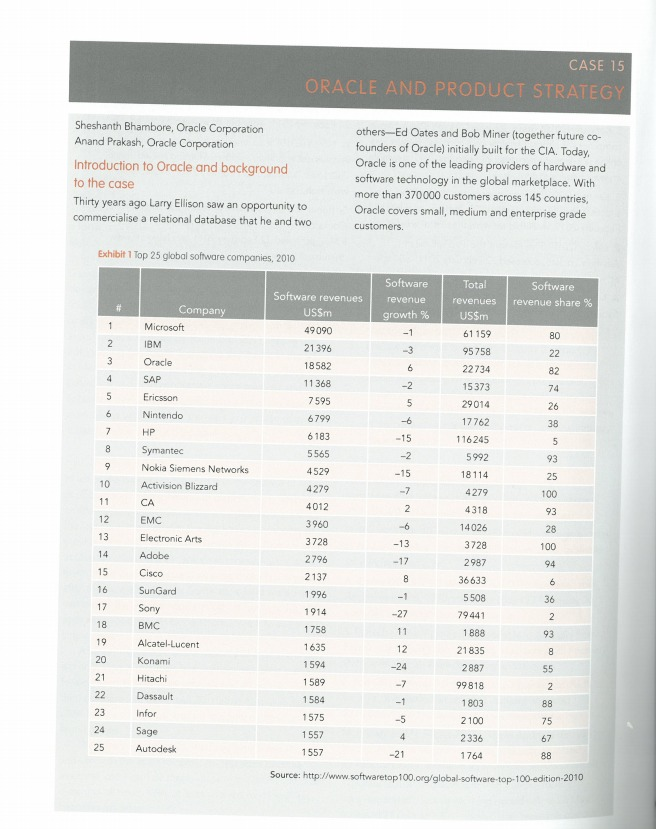
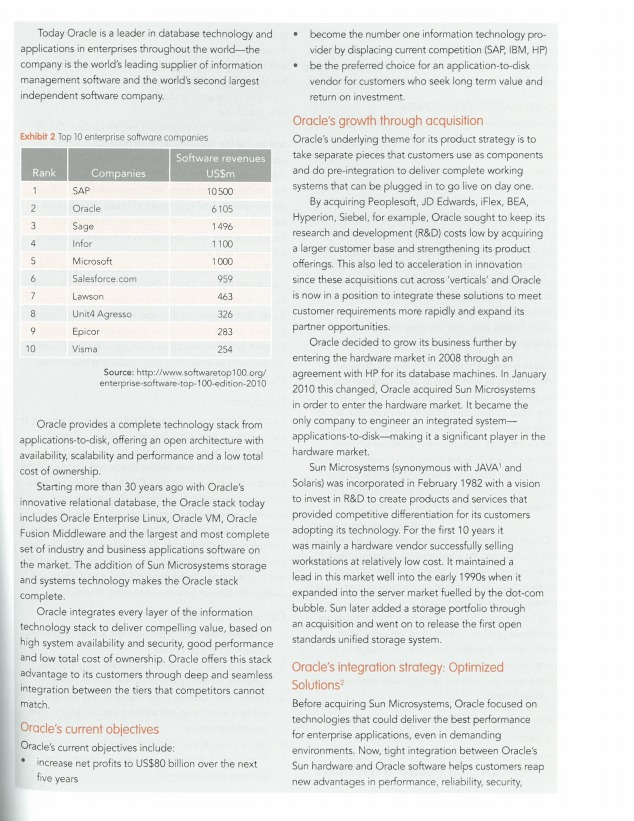
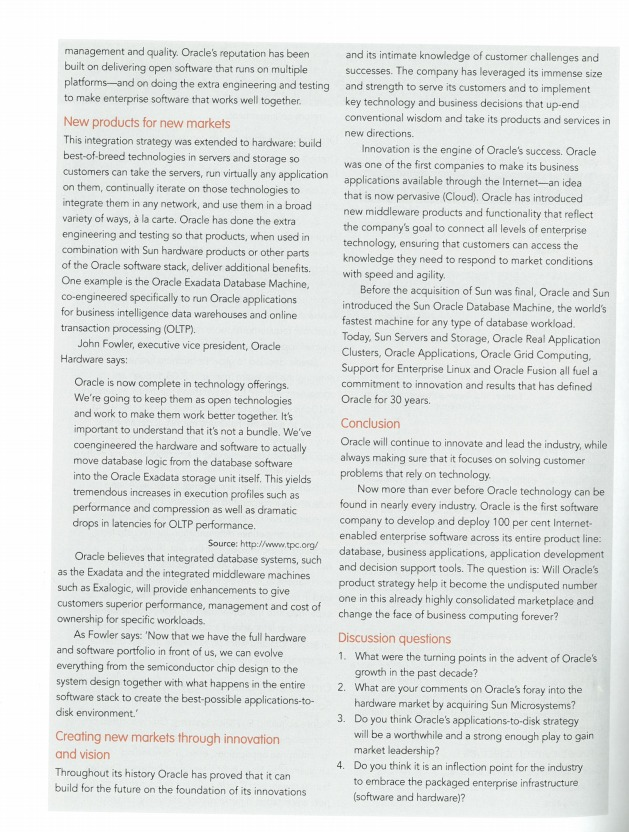
CASE 15 ORACLE AND PRODUCT STRATEGY Sheshanth Bhambore, Oracle Corporation Anand Prakash, Oracle Corporation Introduction to Oracle and background to the case Thirty years ago Larry Ellison saw an opportunity to commercialise a relational database that he and two others-Ed Oates and Bob Miner (together future co- founders of Oracle) initially built for the CIA. Today, Oracle is one of the leading providers of hardware and software technology in the global marketplace. With more than 370000 customers across 145 countries, Oracle covers small, medium and enterprise grade customers. Exhibit 1 Top 25 global software companies, 2010 Total Software revenue share % Software revenues USSM 49090 Software revenue growth % -1 -3 1 revenues US$m 61159 95758 22734 Company Microsoft IBM Oracle SAP 80 2 22 3 21396 18 582 11368 6 82 4 5 -2 74 Ericsson Nintendo 5 7595 6799 26 6 -6 38 7 15373 29014 17 762 116245 5992 18114 HP 6183 5 8 -15 -2 5565 9 Symantec Nokia Siemens Networks Activision Blizzard CA 93 25 10 -15 --7 4279 100 11 12 4529 4279 4012 3960 3728 2 4318 93 28 -6 13 EMC Electronic Arts Adobe 14026 3728 -13 100 14 2987 2796 2137 94 15 Cisco SunGard 36633 6 16 8 -1 -27 36 17 1996 1914 Sony BMC 5508 79441 2 18 11 1758 1635 93 19 Alcatel-Lucent Konami 8 12 -24 1594 55 20 21 22 Hitachi Dassault 1589 -7 1 888 21835 2887 99818 1803 2100 2336 2 -1 88 23 Infor -5 24 25 Sage Autodesk 1584 1575 1557 1557 75 67 4 -21 1764 88 Source: http://www.softwaretop100.org/global-software-top-100-edition-2010 Today Oracle is a leader in database technology and applications in enterprises throughout the worldthe company is the world's leading supplier of information management software and the world's second largest independent software company Exhibit 2 Top 10 enterprise software companies Software revenues Rank Companies USSM 1 SAP 10500 2 Oracle 6105 3 Sage 1496 4 Infor 1100 5 Microsoft 1000 6 Salesforce.com 959 7 Lawson 463 8 Unit4 Agresso 326 9 Epicor 283 10 Visma 254 5 Source: http://www.softwaretop 100.org/ enterprise-software-top-100-edition-2010 become the number one information technology pro- vider by displacing current competition (SAP, IBM, HP) be the preferred choice for an application-to-disk vendor for customers who seek long term value and return on investment Oracle's growth through acquisition Oracle's underlying theme for its product strategy is to take separate pieces that customers use as components and do pre-integration to deliver complete working systems that can be plugged in to go live on day one. By acquiring Peoplesoft, JD Edwards, iFlex, BEA, Hyperion, Siebel, for example, Oracle sought to keep its research and development (R&D) costs low by acquiring a larger customer base and strengthening its product offerings. This also led to acceleration in innovation since these acquisitions cut across 'verticals' and Oracle is now in a position to integrate these solutions to meet customer requirements more rapidly and expand its partner opportunities. Oracle decided to grow its business further by entering the hardware market in 2008 through an agreement with HP for its database machines. In January 2010 this changed, Oracle acquired Sun Microsystems in order to enter the hardware market. It became the only company to engineer an integrated system- applications-to-disk-making it a significant player in the hardware market Sun Microsystems (synonymous with JAVA and Solaris) was incorporated in February 1982 with a vision to invest in R&D to create products and services that provided competitive differentiation for its customers adopting its technology. For the first 10 years it was mainly a hardware vendor successfully selling workstations at relatively low cost. It maintained a lead in this market well into the early 1990s when it expanded into the server market fuelled by the dot-com bubble. Sun later added a storage portfolio through an acquisition and went on to release the first open standards unified storage system. Oracle's integration strategy: Optimized Solutions Before acquiring Sun Microsystems, Oracle focused on technologies that could deliver the best performance for enterprise applications, even in demanding environments. Now, tight integration between Oracle's Sun hardware and Oracle software helps customers reap new advantages in performance, reliability, security, Oracle provides a complete technology stack from applications-to-disk, offering an open architecture with availability, scalability and performance and a low total cost of ownership Starting more than 30 years ago with Oracle's innovative relational database, the Oracle stack today includes Oracle Enterprise Linux, Oracle VM, Oracle Fusion Middleware and the largest and most complete set of industry and business applications software on the market. The addition of Sun Microsystems storage and systems technology makes the Oracle stack complete Oracle integrates every layer of the information technology stack to deliver compelling value, based on high system availability and security, good performance and low total cost of ownership. Oracle offers this stack advantage to its customers through deep and seamless integration between the tiers that competitors cannot match Oracle's current objectives Oracle's current objectives include: increase net profits to US$80 billion over the next . five years management and quality. Oracle's reputation has been and its intimate knowledge of customer challenges and built on delivering open software that runs on multiple successes. The company has leveraged its immense size platforms-and on doing the extra engineering and testing and strength to serve its customers and to implement to make enterprise software that works well together. key technology and business decisions that up-end New products for new markets conventional wisdom and take its products and services in new directions. This integration strategy was extended to hardware: build Innovation is the engine of Oracle's success. Oracle best-of-breed technologies in servers and storage so was one of the first companies to make its business customers can take the servers, run virtually any application applications available through the Internet-an idea on them, continually iterate on those technologies to that is now pervasive (Cloud). Oracle has introduced integrate them in any network, and use them in a broad new middleware products and functionality that reflect variety of ways, la carte. Oracle has done the extra the company's goal to connect all levels of enterprise engineering and testing so that products, when used in technology, ensuring that customers can access the combination with Sun hardware products or other parts knowledge they need to respond to market conditions of the Oracle software stack, deliver additional benefits. with speed and agility. One example is the Oracle Exadata Database Machine, Before the acquisition of Sun was final, Oracle and Sun Co-engineered specifically to run Oracle applications introduced the Sun Oracle Database Machine, the world's for business intelligence data warehouses and online fastest machine for any type of database workload. transaction processing (OLTP). Today, Sun Servers and Storage, Oracle Real Application John Fowler, executive vice president, Oracle Clusters, Oracle Applications, Oracle Grid Computing, Hardware says: Support for Enterprise Linux and Oracle Fusion all fuel a Oracle is now complete in technology offerings. commitment to innovation and results that has defined We're going to keep them as open technologies Oracle for 30 years. and work to make them work better together. It's Conclusion important to understand that it's not a bundle. We've coengineered the hardware and software to actually Oracle will continue to innovate and lead the industry, while move database logic from the database software always making sure that it focuses on solving customer into the Oracle Exadata storage unit itself. This yields problems that rely on technology tremendous increases in execution profiles such as Now more than ever before Oracle technology can be performance and compression as well as dramatic found in nearly every industry. Oracle is the first software drops in latencies for OLTP performance. company to develop and deploy 100 per cent Internet- enabled enterprise software across its entire product line: Source: http://www.tpc.org/ Oracle believes that integrated database systems, such and decision support tools. The question is: Will Oracle's database, business applications, application development as the Exadata and the integrated middleware machines such as Exalogic, will provide enhancements to give product strategy help it become the undisputed number customers superior performance, management and cost of one in this already highly consolidated marketplace and change the face of business computing forever? ownership for specific workloads. As Fowler says: 'Now that we have the full hardware Discussion questions and software portfolio in front of us, we can evolve 1. What were the turning points in the advent of Oracle's everything from the semiconductor chip design to the growth in the past decade? system design together with what happens in the entire 2. What are your comments on Oracle's foray into the software stack to create the best possible applications-to hardware market by acquiring Sun Microsystems? disk environment.' 3. Do you think Oracle's applications-to-disk strategy Creating new markets through innovation will be a worthwhile and a strong enough play to gain market leadership? and vision 4. Do you think it is an inflection point for the industry Throughout its history Oracle has proved that it can to embrace the packaged enterprise infrastructure build for the future on the foundation of its innovations (software and hardware)









 Study Help