Question: Please answer question and include the source to how you got answer. Project Description: The Threat of Workplace Monitoring This collaborative research and writing project
 Please answer question and include the source to how you got answer.
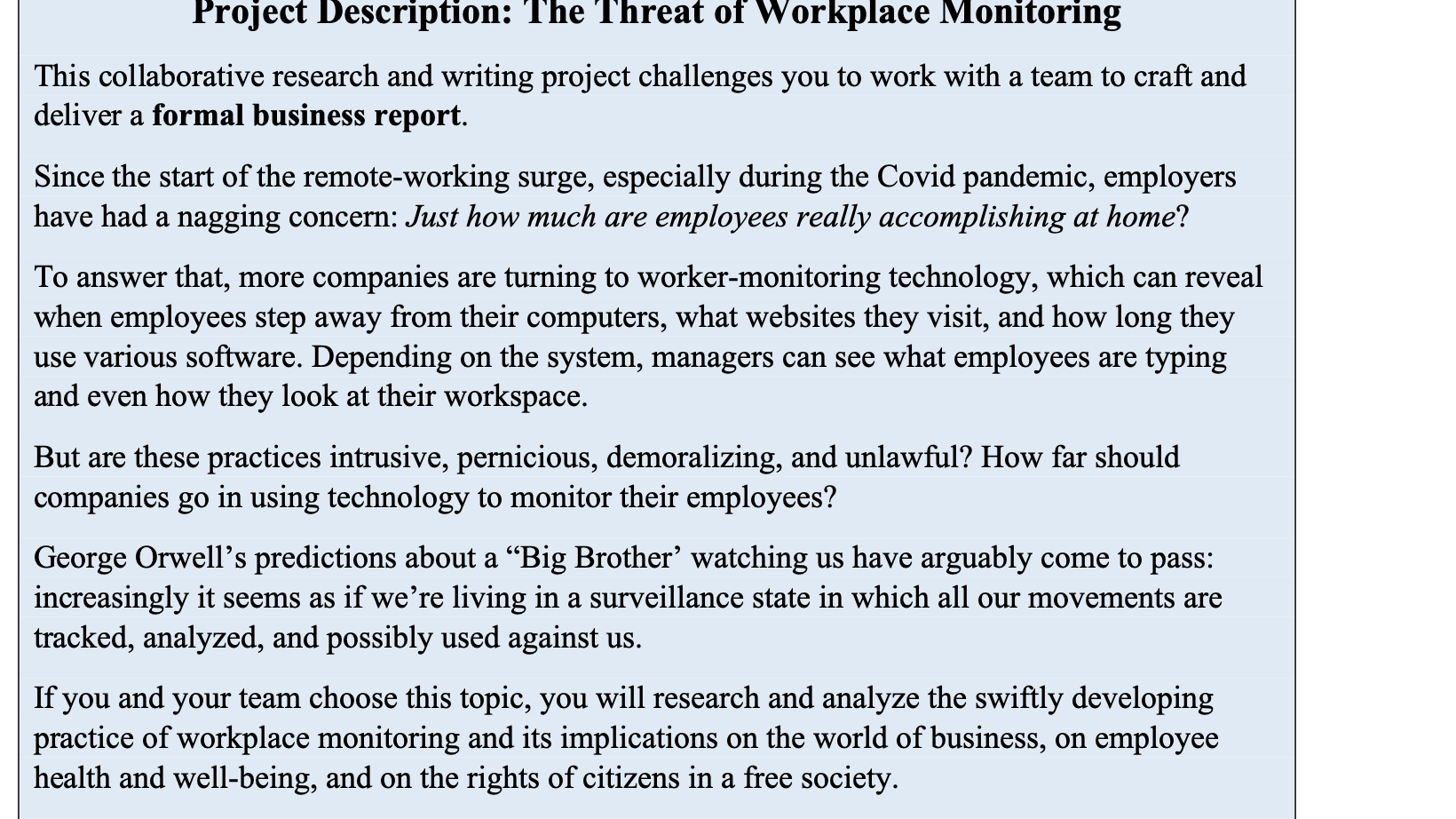
Project Description: The Threat of Workplace Monitoring This collaborative research and writing project challenges you to work with a team to craft and deliver a formal business report. Since the start of the remote-working surge, especially during the Covid pandemic, employers have had a nagging concern: Just how much are employees really accomplishing at home? To answer that, more companies are turning to worker-monitoring technology, which can reveal when employees step away from their computers, what websites they visit, and how long they use various software. Depending on the system, managers can see what employees are typing and even how they look at their workspace. But are these practices intrusive, pernicious, demoralizing, and unlawful? How far should companies go in using technology to monitor their employees? George Orwell's predictions about a "Big Brother' watching us have arguably come to pass: increasingly it seems as if we're living in a surveillance state in which all our movements are tracked, analyzed, and possibly used against us. If you and your team choose this topic, you will research and analyze the swiftly developing practice of workplace monitoring and its implications on the world of business, on employee health and well-being, and on the rights of citizens in a free society. Should hiring managers, while vetting job candidates, be allowed to ask for that person's performance data from a previous employer? Which of the following types of data are legitimate for a company to collect on its employees? Project Description: The Threat of Workplace Monitoring This collaborative research and writing project challenges you to work with a team to craft and deliver a formal business report. Since the start of the remote-working surge, especially during the Covid pandemic, employers have had a nagging concern: Just how much are employees really accomplishing at home? To answer that, more companies are turning to worker-monitoring technology, which can reveal when employees step away from their computers, what websites they visit, and how long they use various software. Depending on the system, managers can see what employees are typing and even how they look at their workspace. But are these practices intrusive, pernicious, demoralizing, and unlawful? How far should companies go in using technology to monitor their employees? George Orwell's predictions about a "Big Brother' watching us have arguably come to pass: increasingly it seems as if we're living in a surveillance state in which all our movements are tracked, analyzed, and possibly used against us. If you and your team choose this topic, you will research and analyze the swiftly developing practice of workplace monitoring and its implications on the world of business, on employee health and well-being, and on the rights of citizens in a free society. Should hiring managers, while vetting job candidates, be allowed to ask for that person's performance data from a previous employer? Which of the following types of data are legitimate for a company to collect on its employees









 Study Help