







Question: please answer question number 1 reduce costs and build a unified brand. On the other, differentiation allows firms to focus on meeting the needs of
please answer question number 1
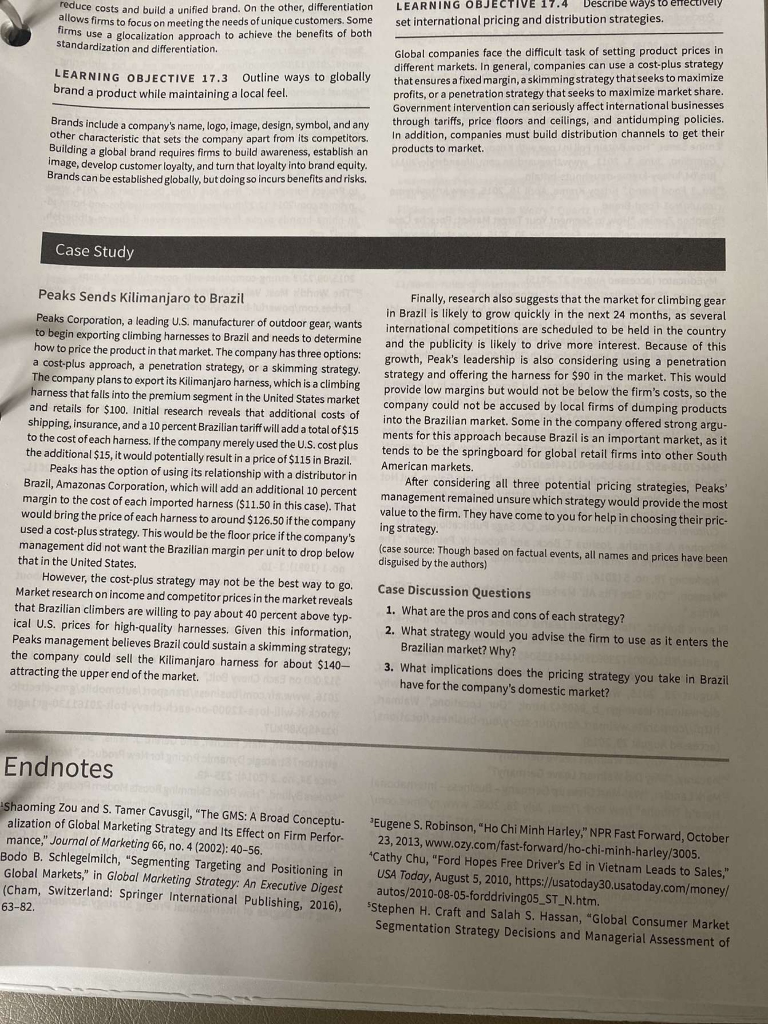
reduce costs and build a unified brand. On the other, differentiation allows firms to focus on meeting the needs of unique customers. Some ms use a glocalization approach to achieve the benefits of both standardization and differentiation. LEARNING OBJECTIVE 17.4 Describe ways to erectively set international pricing and distribution strategies. LEARNING OBJECTIVE 17.3 Outline ways to globally brand a product while maintaining a local feel. Global companies face the difficult task of setting product prices in different markets. In general, companies can use a cost-plus strategy that ensures a fixed margin, a skimming strategy that seeks to maximize profits, or a penetration strategy that seeks to maximize market share. Government intervention can seriously affect international businesses through tariffs, price floors and ceilings, and antidumping policies. In addition, companies must build distribution channels to get their products to market. Brands include a company's name, logo, image, design, symbol, and any other characteristic that sets the company apart from its competitors. building a global brand requires firms to build awareness, establish an Image, develop customer loyalty, and turn that loyalty into brand equity. Brands can be established globally, but doing so incurs benefits and risks. Case Study Peaks Sends Kilimanjaro to Brazil Peaks Corporation, a leading U.S. manufacturer of outdoor gear, wants to begin exporting climbing harnesses to Brazil and needs to determine how to price the product in that market. The company has three options: a cost-plus approach, a penetration strategy, or a skimming strategy. The company plans to export its Kilimanjaro harness, which is a climbing harness that falls into the premium segment in the United States market and retails for $100. Initial research reveals that additional costs of shipping, insurance, and a 10 percent Brazilian tariff will add a total of $15 to the cost of each harness. If the company merely used the U.S.cost plus the additional $15, it would potentially result in a price of $115 in Brazil. Peaks has the option of using its relationship with a distributor in Brazil, Amazonas Corporation, which will add an additional 10 percent margin to the cost of each imported harness ($11.50 in this case). That would bring the price of each harness to around $126.50 if the company used a cost-plus strategy. This would be the floor price if the company's management did not want the Brazilian margin per unit to drop below that in the United States. However, the cost-plus strategy may not be the best way to go. Market research on income and competitor prices in the market reveals that Brazilian climbers are willing to pay about 40 percent above typ. ical U.S. prices for high-quality harnesses. Given this information, Peaks management believes Brazil could sustain a skimming strategy: the company could sell the Kilimanjaro harness for about $140- attracting the upper end of the market. Finally, research also suggests that the market for climbing gear in Brazil is likely to grow quickly in the next 24 months, as several international competitions are scheduled to be held in the country and the publicity is likely to drive more interest. Because of this growth, Peak's leadership is also considering using a penetration strategy and offering the harness for $90 in the market. This would provide low margins but would not be below the firm's costs, so the company could not be accused by local firms of dumping products into the Brazilian market. Some in the company offered strong argu- ments for this approach because Brazil is an important market, as it tends to be the springboard for global retail firms into other South American markets. After considering all three potential pricing strategies, Peaks management remained unsure which strategy would provide the most value to the firm. They have come to you for help in choosing their pric. ing strategy. (case source: Though based on factual events, all names and prices have been disguised by the authors) Case Discussion Questions 1. What are the pros and cons of each strategy? 2. What strategy would you advise the firm to use as it enters the Brazilian market? Why? 3. What implications does the pricing strategy you take in Brazil have for the company's domestic market? Endnotes Shaoming Zou and S. Tamer Cavusgil. "The GMS: A Broad Conceptu- alization of Global Marketing Strategy and Its Effect on Firm Perfor- mance," Journal of Marketing 66, no. 4 (2002): 40-56. Bodo B. Schlegelmilch, "Segmenting Targeting and Positioning in Global Markets," in Global Marketing Strategy: An Executive Digest (Cham, Switzerland: Springer International Publishing, 2016). 63-82. 'Eugene S. Robinson, "Ho Chi Minh Harley," NPR Fast Forward, October 23, 2013, www.ozy.com/fast-forward/ho-chi-minh-harley/3005. *Cathy Chu, "Ford Hopes Free Driver's Ed in Vietnam Leads to Sales. USA Today, August 5, 2010, https://usatoday30.usatoday.com/money autos/2010-08-05-forddriving05_ST_N.htm. Stephen H. Craft and Salah S. Hassan, "Global Consumer Market Segmentation Strategy Decisions and Managerial Assessment ofStep by Step Solution
There are 3 Steps involved in it
1 Expert Approved Answer
Step: 1 Unlock

Question Has Been Solved by an Expert!
Get step-by-step solutions from verified subject matter experts
Step: 2 Unlock
Step: 3 Unlock
 Study Help