







Question: Please answer questions 1-6 using the link provided. Please provide graphs and diagrams For this assignment, please read the article, https://asmith.ucdavis.eduews/trade-war Based on your reading,
Please answer questions 1-6 using the link provided. Please provide graphs and diagrams
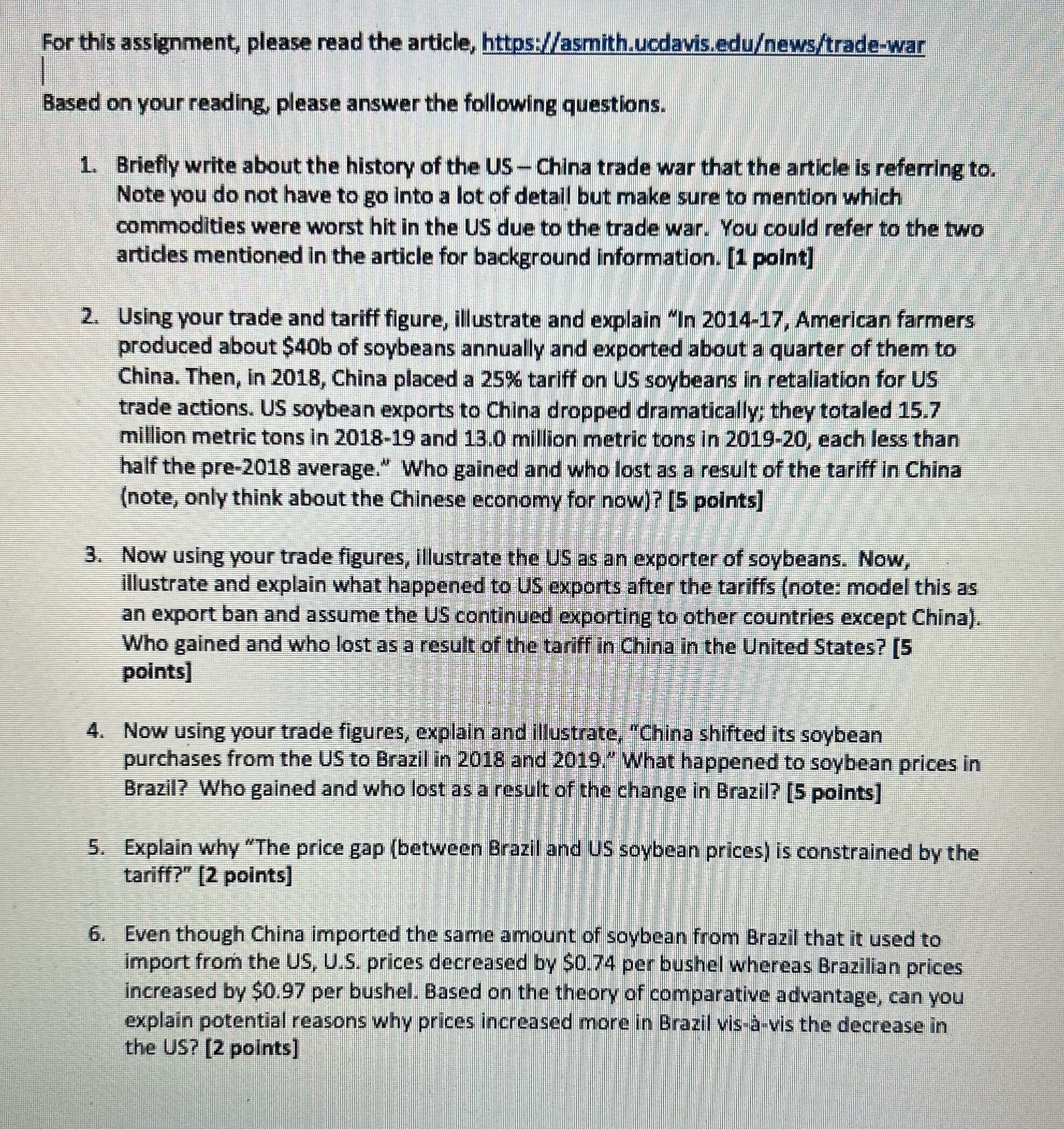
For this assignment, please read the article, https://asmith.ucdavis.eduews/trade-war Based on your reading, please answer the following questions. 1. Briefly write about the history of the US - China trade war that the article is referring to. Note you do not have to go into a lot of detail but make sure to mention which commodities were worst hit in the US due to the trade war. You could refer to the two articles mentioned in the article for background information. [1 point] 2. Using your trade and tariff figure, illustrate and explain "In 2014-17, American farmers produced about $40b of soybeans annually and exported about a quarter of them to China. Then, in 2018, China placed a 25%% tariff on US soybeans in retaliation for US trade actions. US soybean exports to China dropped dramatically; they totaled 15.7 million metric tons in 2018-19 and 13.0 million metric tons in 2019-20, each less than half the pre-2018 average." Who gained and who lost as a result of the tariff in China (note, only think about the Chinese economy for now)? [5 points] 3. Now using your trade figures, illustrate the US as an exporter of soybeans. Now, illustrate and explain what happened to US exports after the tariffs (note: model this as an export ban and assume the US continued exporting to other countries except China) Who gained and who lost as a result of the tariff in China in the United States? [5 points] 4. Now using your trade figures, explain and illustrate, "China shifted its soybean purchases from the US to Brazil in 2018 and 2019." What happened to soybean prices in Brazil? Who gained and who lost as a result of the change in Brazil? [5 points] 5. Explain why "The price gap (between Brazil and US soybean prices) is constrained by the tariff?" [2 points] 6. Even though China imported the same amount of soybean from Brazil that it used to import from the US, U.S. prices decreased by $0.74 per bushel whereas Brazilian prices increased by $0.97 per bushel. Based on the theory of comparative advantage, can you explain potential reasons why prices increased more in Brazil vis-a-vis the decrease in the US? [2 points]
Step by Step Solution
There are 3 Steps involved in it

Get step-by-step solutions from verified subject matter experts
 Study Help