





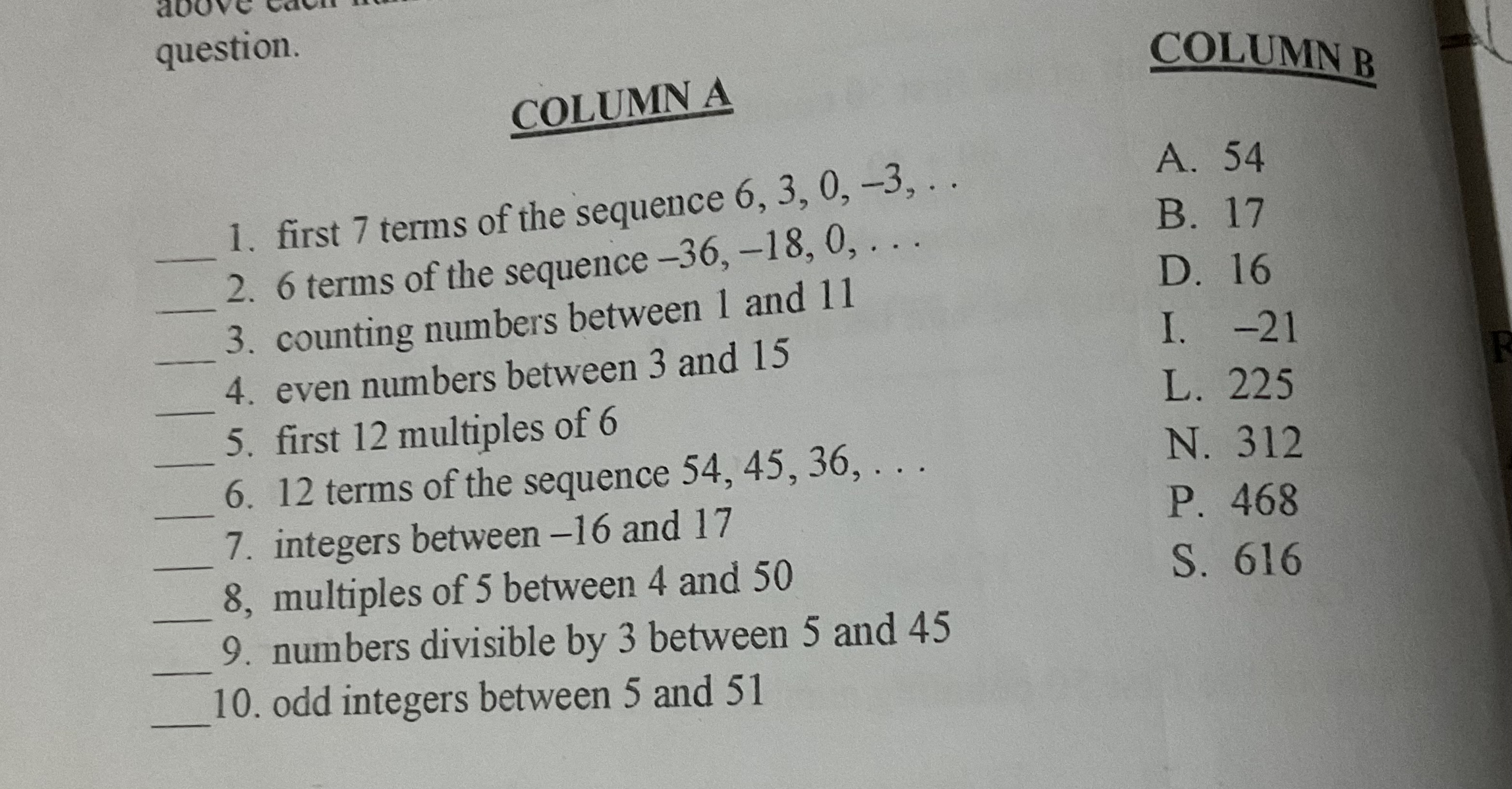
Question: please answer the following I give an example below Please follow the method of the example thank you above question. COLUMN B COLUMN A A.
please answer the following

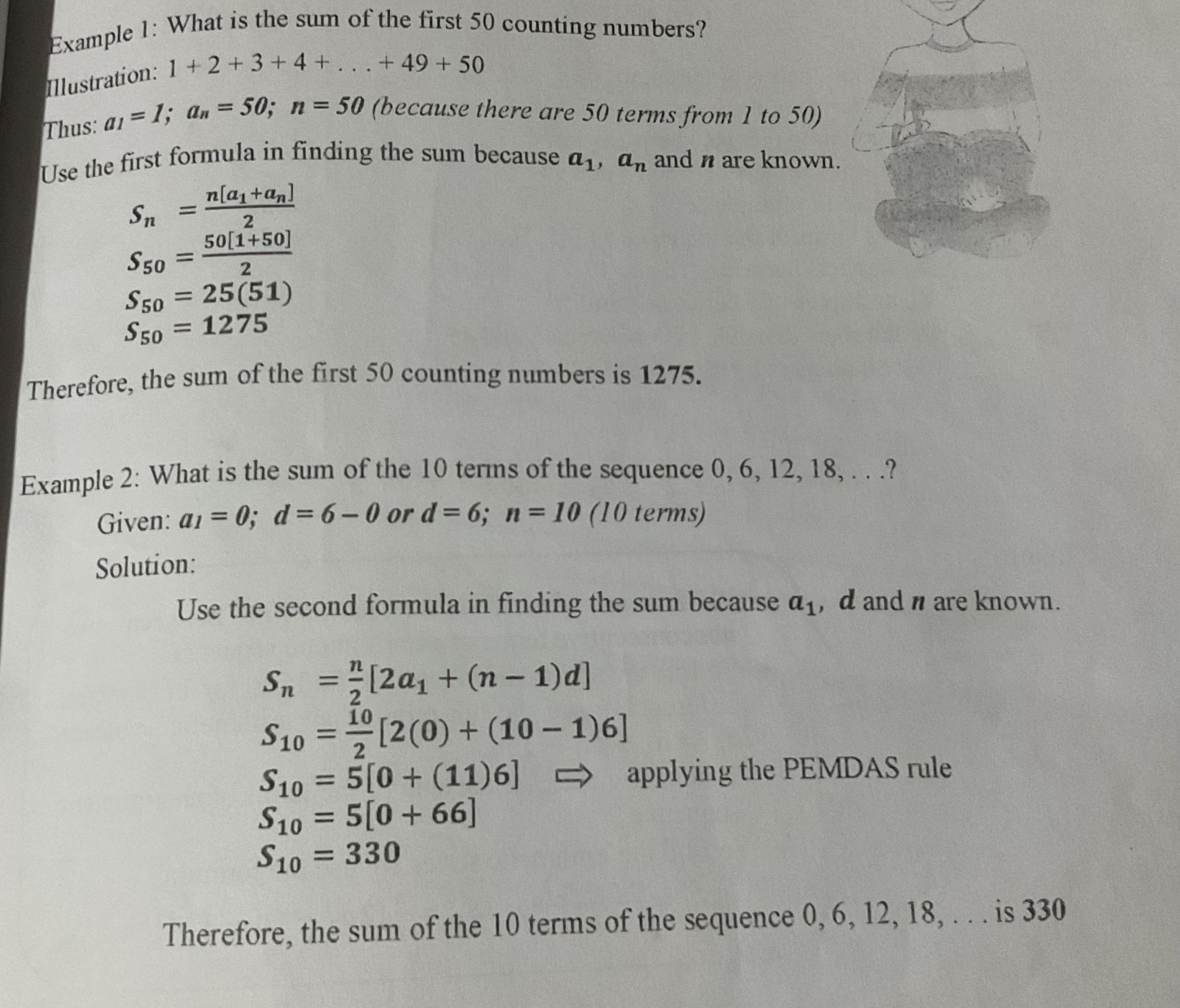
I give an example below

Please follow the method of the example

thank you
please answer the following I give an exampleplease answer the following I give an example
above question. COLUMN B COLUMN A A. 54 1. first 7 terms of the sequence 6, 3, 0, -3, . . B. 17 2. 6 terms of the sequence -36, -18, 0, ... 3. counting numbers between 1 and 11 D. 16 4. even numbers between 3 and 15 I. -21 5. first 12 multiples of 6 L. 225 6. 12 terms of the sequence 54, 45, 36, . . . N. 312 7. integers between -16 and 17 P. 468 8, multiples of 5 between 4 and 50 S. 616 9. numbers divisible by 3 between 5 and 45 10. odd integers between 5 and 51Example 1: What is the sum of the first 50 counting numbers? Illustration: 1 + 2 + 3 + 4 + . ..+ 49 + 50 Thus: a1 = 1; an = 50; n = 50 (because there are 50 terms from 1 to 50) Use the first formula in finding the sum because a1, an and n are known. Sn =najtan] 2 50[1+50] $50 = 2 S50 = 25(51) $50 = 1275 Therefore, the sum of the first 50 counting numbers is 1275. Example 2: What is the sum of the 10 terms of the sequence 0, 6, 12, 18, . ..? Given: a1 = 0; d = 6 -0 ord = 6; n = 10 (10 terms) Solution: Use the second formula in finding the sum because a1, d and n are known. Sn = =[2a1 + (n - 1)d] $10 = - [2(0) + (10-1)6] S10 = 5[0 + (11)6] > applying the PEMDAS rule $10 = 5[0 + 66] $10 = 330 Therefore, the sum of the 10 terms of the sequence 0, 6, 12, 18, . . . is 330

Step by Step Solution

There are 3 Steps involved in it

1 Expert Approved Answer
Step: 1 Unlock blur-text-image

Question Has Been Solved by an Expert!

Get step-by-step solutions from verified subject matter experts

Step: 2 Unlock
Step: 3 Unlock

Students Have Also Explored These Related Mathematics Questions!