Question: Please answer the following questions based on this article CASE 1 RECOGNITION UNDER THE CANADA LABOUR CODE Collective bargaining under the Canada Labour Code begins

Please answer the following questions based on this article Please answer the following questions based on
Please answer the following questions based on
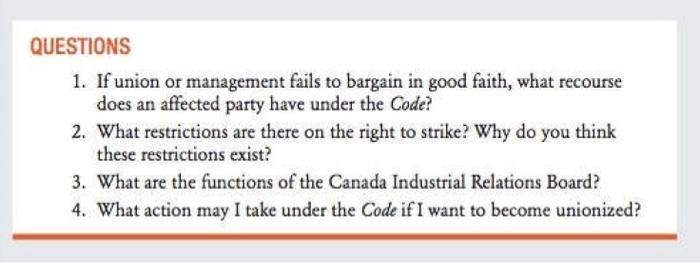
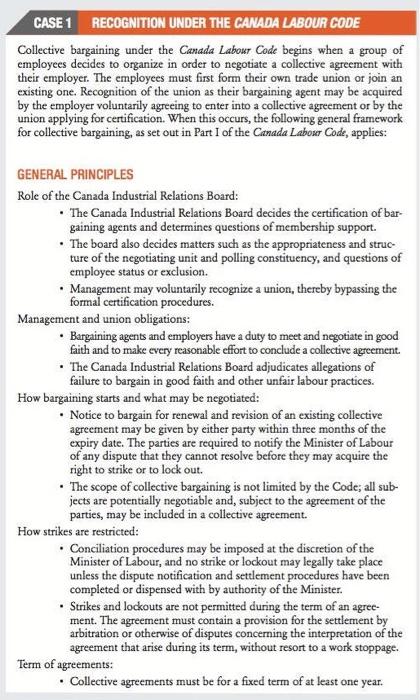
CASE 1 RECOGNITION UNDER THE CANADA LABOUR CODE Collective bargaining under the Canada Labour Code begins when a group of employees decides to organize in order to negotiate a collective agreement with their employer . The employees must first form their own trade union or join an existing one. Recognition of the union as their bargaining agent may be acquired by the employer voluntarily agreeing to enter into a collective agreement or by the union applying for certification. When this occurs, the following general framework for collective bargaining, as set out in Part I of the Canada Labour Code, applies: GENERAL PRINCIPLES Role of the Canada Industrial Relations Board: The Canada Industrial Relations Board decides the certification of bar- gaining agents and determines questions of membership support. The board also decides matters such as the appropriateness and struc- ture of the negotiating unit and polling constituency, and questions of employee status or exclusion. Management may voluntarily recognize a union, thereby bypassing the formal certification procedures. Management and union obligations: Bargaining agents and employers have a duty to meet and negotiate in good faith and to make every reasonable effort to conclude a collective agreement. The Canada Industrial Relations Board adjudicates allegations of failure to bargain in good faith and other unfair labour practices. How bargaining starts and what may be negotiated: Notice to bargain for renewal and revision of an existing collective agreement may be given by either party within three months of the expiry date. The parties are required to notify the Minister of Labour of any dispute that they cannot resolve before they may acquire the right to strike or to lock out. The scope of collective bargaining is not limited by the Code; all sub- jects are potentially negotiable and, subject to the agreement of the parties, may be included in a collective agreement. How strikes are restricted: Conciliation procedures may be imposed at the discretion of the Minister of Labour, and no strike or lockout may legally take place unless the dispute notification and settlement procedures have been completed or dispensed with by authority of the Minister. . Strikes and lockouts are not permitted during the term of an agree- ment. The agreement must contain a provision for the settlement by arbitration or otherwise of disputes concerning the interpretation of the agreement that arise during its term, without resort to a work stoppage. Term of agreements: Collective agreements must be for a fixed term of at least one year. . QUESTIONS 1. If union or management fails to bargain in good faith, what recourse does an affected party have under the Code? 2. What restrictions are there on the right to strike? Why do you think these restrictions exist? 3. What are the functions of the Canada Industrial Relations Board? 4. What action may I take under the Code if I want to become unionized

Step by Step Solution

There are 3 Steps involved in it

1 Expert Approved Answer
Step: 1 Unlock blur-text-image

Question Has Been Solved by an Expert!

Get step-by-step solutions from verified subject matter experts

Step: 2 Unlock
Step: 3 Unlock

Students Have Also Explored These Related General Management Questions!