







Question: please answer the question at the end Saved Help Save & Exit Subm Uber Continuing Case-Chapter 3: Work Environment and Ethical Responsibilities This part of
please answer the question at the end
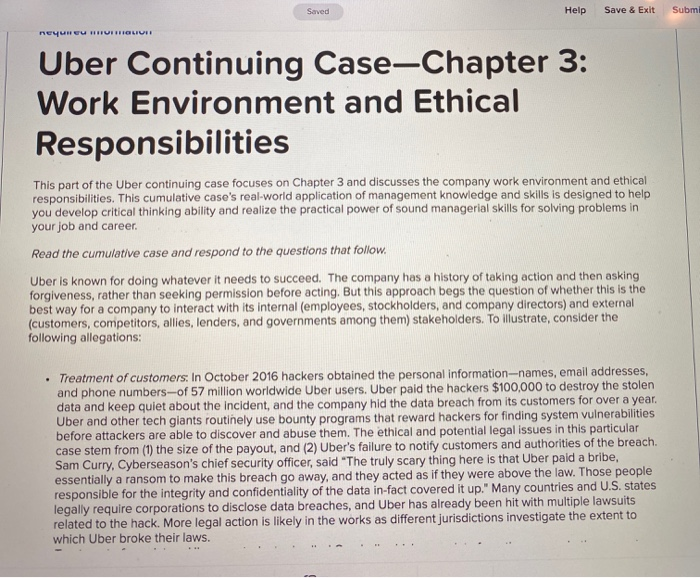
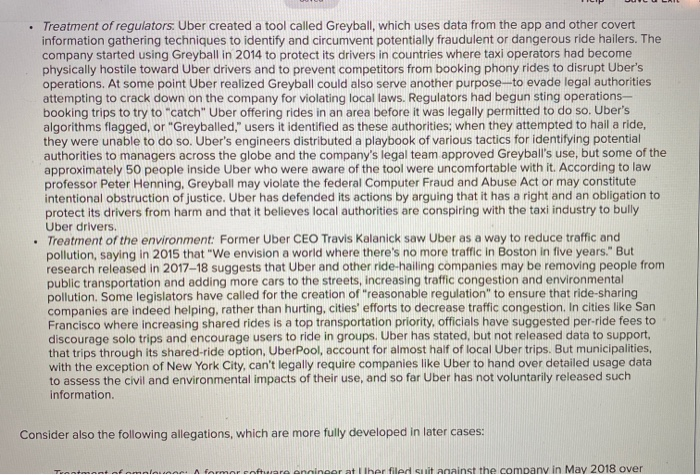
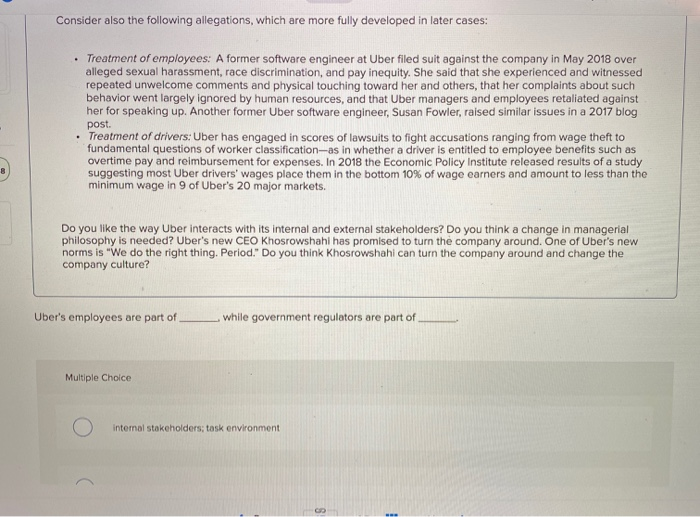
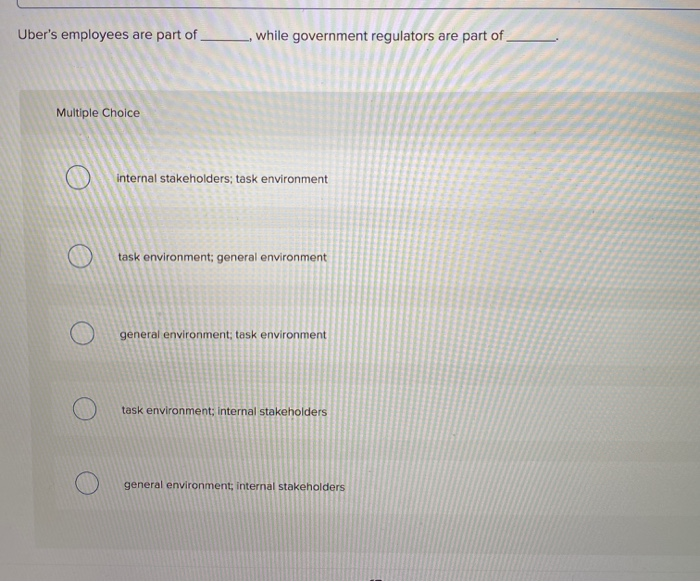
Saved Help Save & Exit Subm Uber Continuing Case-Chapter 3: Work Environment and Ethical Responsibilities This part of the Uber continuing case focuses on Chapter 3 and discusses the company work environment and ethical responsibilities. This cumulative case's real world application of management knowledge and skills is designed to help you develop critical thinking ability and realize the practical power of sound managerial skills for solving problems in your job and career. Read the cumulative case and respond to the questions that follow. Uber is known for doing whatever it needs to succeed. The company has a history of taking action and then asking forgiveness, rather than seeking permission before acting. But this approach begs the question of whether this is the best way for a company to interact with its internal (employees, stockholders, and company directors) and external (customers, competitors, allies, lenders, and governments among them) stakeholders. To illustrate, consider the following allegations: Treatment of customers: In October 2016 hackers obtained the personal information-names, email addresses, and phone numbers-of 57 million worldwide Uber users. Uber paid the hackers $100,000 to destroy the stolen data and keep quiet about the incident, and the company hid the data breach from its customers for over a year. Uber and other tech giants routinely use bounty programs that reward hackers for finding system vulnerabilities before attackers are able to discover and abuse them. The ethical and potential legal issues in this particular case stem from (1) the size of the payout, and (2) Uber's failure to notify customers and authorities of the breach. Sam Curry, Cyberseason's chief security officer, said "The truly scary thing here is that Uber paid a bribe, essentially a ransom to make this breach go away, and they acted as if they were above the law. Those people responsible for the integrity and confidentiality of the data in fact covered it up." Many countries and U.S. states legally require corporations to disclose data breaches, and Uber has already been hit with multiple lawsuits related to the hack. More legal action is likely in the works as different jurisdictions investigate the extent to which Uber broke their laws. Treatment of regulators: Uber created a tool called Greyball, which uses data from the app and other covert information gathering techniques to identify and circumvent potentially fraudulent or dangerous ride hailers. The company started using Greyball in 2014 to protect its drivers in countries where taxi operators had become physically hostile toward Uber drivers and to prevent competitors from booking phony rides to disrupt Uber's d Greyball could also serve another purpose-to evade legal authorities attempting to crack down on the company for violating local laws. Regulators had begun sting operations- booking trips to try to "catch" Uber offering rides in an area before it was legally permitted to do so. Uber's algorithms flagged, or "Greyballed,"users it identified as these authorities; when they attempted to hail a ride, they were unable to do so. Uber's engineers distributed a playbook of various tactics for identifying potential rities to managers across the globe and the company's legal team approved Greyball's use, but some of the approximately 50 people inside Uber who were aware of the tool were uncomfortable with it. According to law professor Peter Henning, Greyball may violate the federal Computer Fraud and Abuse Act or may constitute intentional obstruction of Justice. Uber has defended its actions by arguing that it has a right and an obligation to protect its drivers from harm and that it believes local authorities are conspiring with the taxi industry to bully Uber drivers, Treatment of the environment: Former Uber CEO Travis Kalanick saw Uber as a way to reduce traffic and pollution, saying in 2015 that "We envision a world where there's no more traffic in Bos research released in 2017-18 suggests that Uber and other ride-hailing companies may be removing people from public transportation and adding more cars to the streets, increasing traffic congestion and environmental pollution. Some legislators have called for the creation of "reasonable regulation to ensure that ride-sharing companies are indeed helping, rather than hurting, cities' efforts to decrease traffic congestion. In cities like San Francisco where increasing shared rides is a top transportation priority, officials have suggested per-ride fees to discourage solo trips and encourage users to ride in groups. Uber has stated, but not released data to support that trips through its shared-ride option, UberPool, account for almost half of local Uber trips. But municipalities, with the exception of New York City, can't legally require companies like Uber to hand over detailed usage data to assess the civil and environmental Impacts of their use, and so far Uber has not voluntarily released such information. Consider also the following allegations, which are more fully developed in later cases: A r entrare an incorher filer cut anainst the company in May 2018 over Consider also the following allegations, which are more fully developed in later cases: Treatment of employees: A former software engineer at Uber filed suit against the company in May 2018 over alleged sexual harassment, race discrimination, and pay inequity. She said that she experienced and witnessed repeated unwelcome comments and physical touching toward her and others, that her complaints about such behavior went largely ignored by human resources, and that Uber managers and employees retaliated against her for speaking up. Another former Uber software engineer, Susan Fowler,ralsed similar issues in a 2017 blog post. Treatment of drivers: Uber has engaged in scores of lawsuits to fight accusations ranging from wage theft to fundamental questions of worker classification-as in whether a driver is entitled to employee benefits such as overtime pay and reimbursement for expenses. In 2018 the Economic Policy Institute released results of a study suggesting most Uber drivers' wages place them in the bottom 10% of wage earners and amount to less than the minimum wage in 9 of Uber's 20 major markets. Do you like the way Uber interacts with its internal and external stakeholders? Do you think a change in managerial philosophy is needed? Uber's new CEO Khosrowshahi has promised to turn the company around. One of Uber's new norms is "We do the right thing. Period." Do you think Khosrowshahi can turn the company around and change the company culture? Uber's employees are part of while government regulators are part of Multiple Choice internal stakeholders; task environment Uber's employees are part of , while government regulators are part of Multiple Choice internal stakeholders; task environment task environment; general environment general environment; task environment task environment; internal stakeholders general environment; internal stakeholders Step by Step Solution
There are 3 Steps involved in it
1 Expert Approved Answer
Step: 1 Unlock

Question Has Been Solved by an Expert!
Get step-by-step solutions from verified subject matter experts
Step: 2 Unlock
Step: 3 Unlock
 Study Help