







Question: Please answer the questions and tables fully A . B . and C . Recently, Phil Harris, the production control manager at Brunswick, read an
Please answer the questions and tables fully A B and C Recently, Phil Harris, the production control manager at Brunswick, read an article on timephased requirements planning. He was
curlous about how this technique might work in scheduling Brunswick's engine assembly operations and decided to prepare an
example to Illustrate the use of timephased requirements planning.
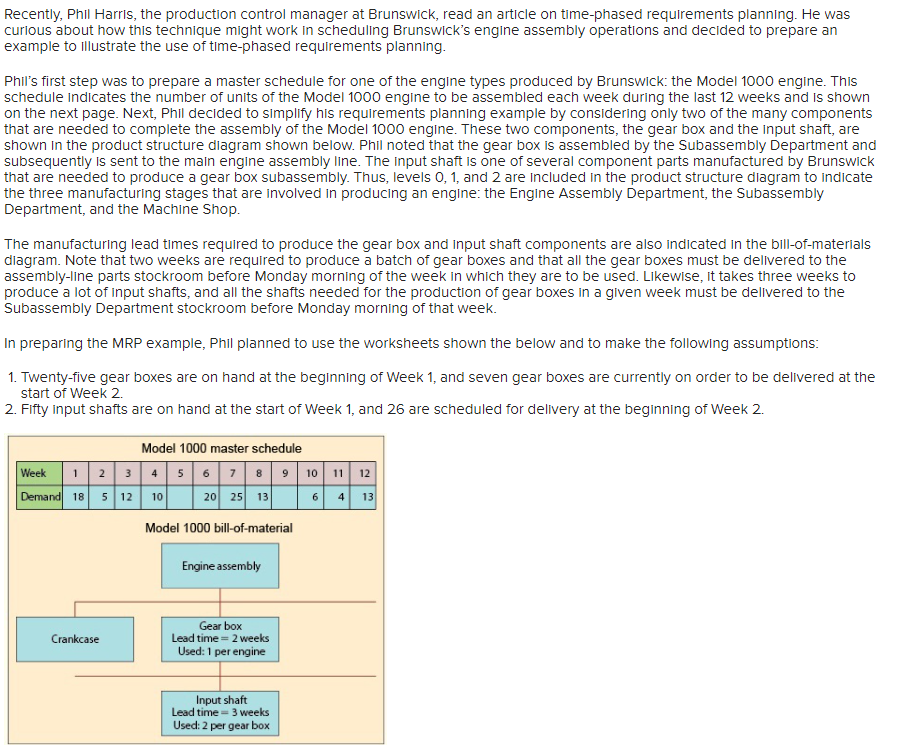
Phil's first step was to prepare a master schedule for one of the engine types produced by Brunswick: the Model engine. This
schedule indicates the number of units of the Model engine to be assembled each week during the last weeks and is shown
on the next page. Next, Phil decided to simplify his requirements planning example by considering only two of the many components
that are needed to complete the assembly of the Model engine. These two components, the gear box and the input shaft, are
shown in the product structure diagram shown below. Phil noted that the gear box is assembled by the Subassembly Department and
subsequently is sent to the main engine assembly line. The input shaft is one of several component parts manufactured by Brunswick
that are needed to produce a gear box subassembly. Thus, levels and are included in the product structure diagram to indicate
the three manufacturing stages that are involved in producing an engine: the Engine Assembly Department, the Subassembly
Department, and the Machine Shop.
The manufacturing lead times required to produce the gear box and input shaft components are also indicated in the billofmaterials
diagram. Note that two weeks are required to produce a batch of gear boxes and that all the gear boxes must be delivered to the
assemblyline parts stockroom before Monday morning of the week in which they are to be used. Likewise, it takes three weeks to
produce a lot of input shafts, and all the shafts needed for the production of gear boxes in a given week must be delivered to the
Subassembly Department stockroom before Monday morning of that week.
In preparing the MRP example, Phil planned to use the worksheets shown the below and to make the following assumptions:
Twentyfive gear boxes are on hand at the beginning of Week and seven gear boxes are currently on order to be delivered at the
start of Week
Fifty input shafts are on hand at the start of Week and are scheduled for delivery at the beginning of Week a Initially, assume that Phil wants to minimize his inventory requirements. Assume that each order will be only for what is required for
a single perlod. Calculate the net requirements and planned order releases for the gear boxes and input shafts. Assume that lot
sizing is done using lotforlot.
Gear Box Requirements
Answer is complete and correct.
Input Shaft Requirements
Answer is complete and correct. Phil would like to consider the costs that his accountants are currently using for Inventory carrying and setup for the gear boxes and
input shafts. These costs are as follows:
PART SOSTup $order Inventory carrying cost
Gear Box $unitweek
Setup $order Inventory carrying cost
Input Shaft
$unitweek
Calculate a better schedule by reducing the number of orders and carrying some inventory. Specifically, plan to recelve orders for
gear boxes only in weeks and
Gear Box Requirements
Answer is complete but not entirely correct.
Input Shaft Requirements
Answer is complete but not entirely correct. c What are the cost savings with this new schedule.
Cost of the schedule from part a
Answer is complete but not entirely correct.
Cost of the schedule you developed in part b
Answer is complete but not entirely correct.
Savings with the new schedule.
Answer is complete but not entirely correct.
Step by Step Solution
There are 3 Steps involved in it
1 Expert Approved Answer
Step: 1 Unlock

Question Has Been Solved by an Expert!
Get step-by-step solutions from verified subject matter experts
Step: 2 Unlock
Step: 3 Unlock
 Study Help