Question: Please answer the questions to the above case study. Do you think customers who saw this video changed their attitude toward Dominos? Any long-term impact?
Please answer the questions to the above case study.
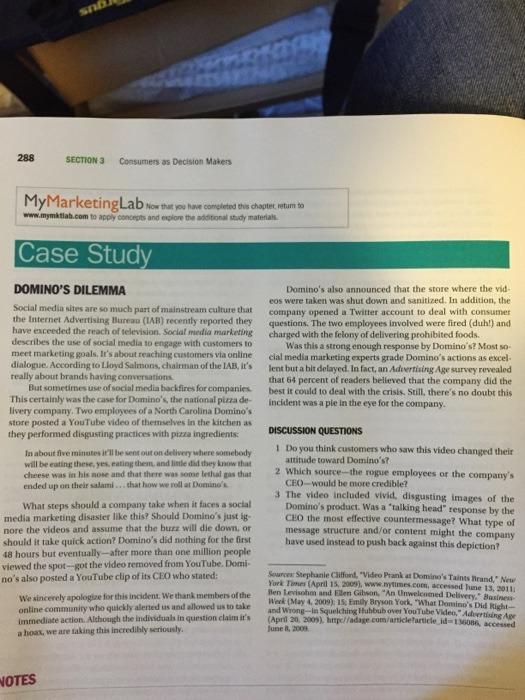
- Do you think customers who saw this video changed their attitude toward Dominos? Any long-term impact? If not, why? To recall, attitude is comprised of cognitive and affective responses and behavioral intentions.
- Which sourcethe rogue employees or the companys CEOwould be more credible? Why?
- The video involved disgusting images of the Dominos product. The response by the CEO was a talking head where the CEO apologized. Do you think that the CEOs communication model was the most effective way to deliver his message? Link to the CEOs message.
- What would you do if you were the CEO?
288 SECTION 3 Consumers as Decision Makers MyMarketingLab Now that you love completed the chapter tudo www.nymatlab.com to apply concepts and explore the contudy material Case Study Domino's also announced that the store where the vid eos were taken was shut down and sanitized. In addition, the company opened a Twitter account to deal with consumer questions. The two employees involved were fired (duh!) and charged with the felony of delivering prohibited foods. Was this a strong enough response by Domino's Most so cial media marketing experts grade Domino's actions as excel lent but a bit delayed. In fact, an Advertising Age survey revealed that 64 percent of readers belleved that the company did the best it could to deal with the crisis. Still, there's no doubt this incident was a ple in the eye for the company. DOMINO'S DILEMMA Social media sites are so much part of mainstream culture that the Internet Advertising Bureau (IAB) recently reported they have exceeded the reach of television Social media marketing describes the use of social media to engage with customers to meet marketing goals. It's about reaching customers via online dialogie. According to Lloyd Salmons, chairman of the IAB, It's really about brands having conversations But sometimes use of social media backfires for companies This certainly was the case for Domino's, the national pizza de livery company. Two employees of a North Carolina Domino's store posted a YouTube video of themselves in the kitchen as they performed disgusting practices with pizza ingredients: In about five minutes it'll be sent out on delivery where somebody will be eating there, yes, eating them, and little did they know that cheese was in his nose and that there was some lethal that ended up on their salam...that how we rollar Domino's What steps should a company take when it faces a social media marketing disaster like this should Domino's just ig. nore the videos and assume that the bus will die down, or should it take quick action? Domino's did nothing for the first 48 hours but eventually-after more than one million people viewed the spot-got the video removed from YouTube, Domi- no's also posted a YouTube clip of its CEO who stated: We sincerely apologize for this incident. We thank members of the online community who quickly alented us and allowed us to take immediate action. Although the individuals in question claim it's a hoa, we are taking this incredibly seriously. DISCUSSION QUESTIONS 1 Do you think customers who saw this video changed their attitude toward Domino's? 2 Which source-the rogue employees or the company's CEOwould be more credible? 3 The video included vivid, disgusting images of the Domino's product. Was a 'talking head" response by the CEO the most effective countermessage? What type of message structure and/or content might the company have used instead to push back against this depiction! Sour Stephanie Cliffond, Video Prank at Domino's Taints Hand," New York Times (April 1, 2009). www.nytimes.com, accessed June 13, 2011 Ben Levisohan anden Gibson, "An Unwelented Delivery Business Week (May (2009): 1. Emily Bryson York. What Domino's Did Right and Wrong-in Squelching Hubbub over YouTube Video." Adhiting Apr (April 20, 2005). http://adage.com/articleParticle_id=1M accessed June 13, 2008 NOTES









 Study Help