







Question: Please answer the questions referring to the CASE STUDY ATTACHED. please answer the questions fully and with elaborations and examples referring to the case study!
Please answer the questions referring to the CASE STUDY ATTACHED.
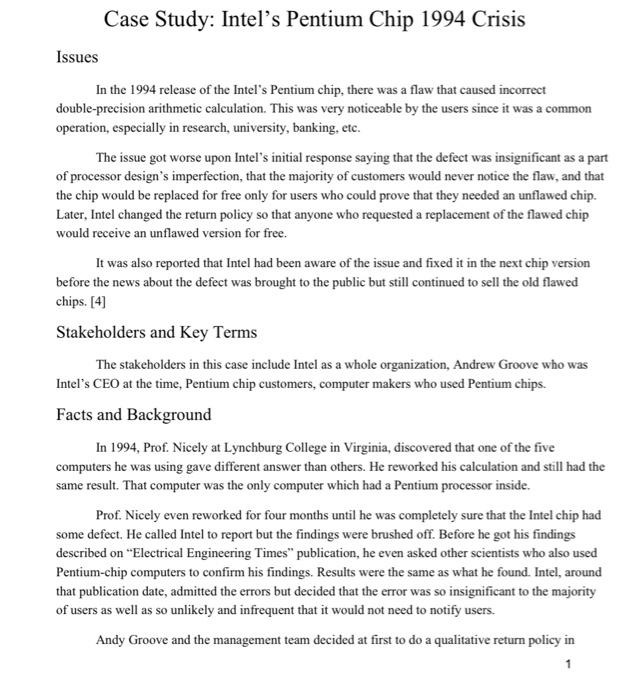
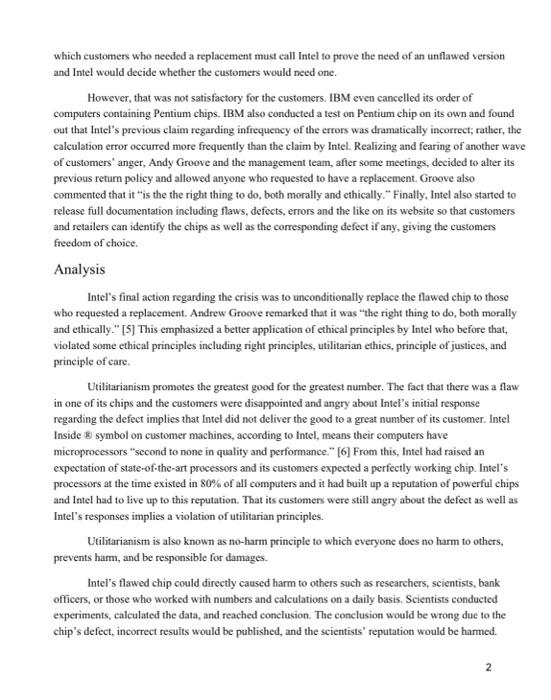
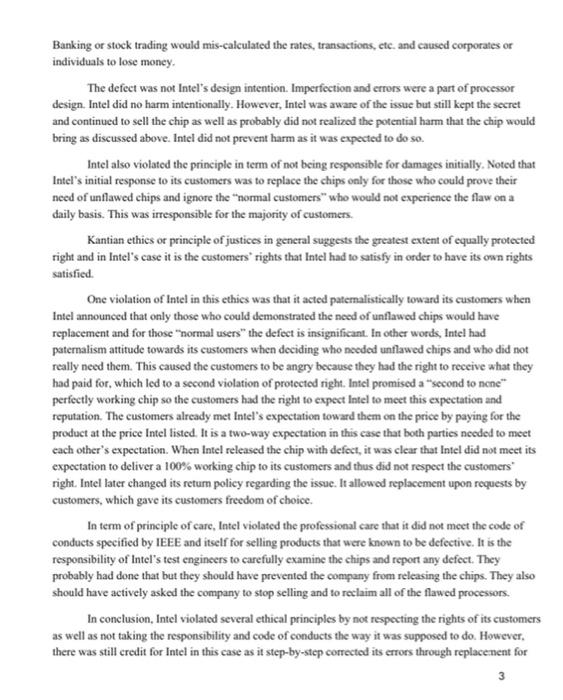
Q1 Referring to the attached file name: "Intel's Pentium Chip": (a) Do think the defect of Pentium a crisis or paracrisis for Intel? Explain. (b) Do you think that Andrew Groove and the management team considered it a crisis? Explain your reasons. (c) What lessons can we learn from the Intel case on signal detection? Case Study: Intel's Pentium Chip 1994 Crisis Issues In the 1994 release of the Intel's Pentium chip, there was a flaw that caused incorrect double-precision arithmetic calculation. This was very noticeable by the users since it was a common operation, especially in research, university, banking, etc. The issue got worse upon Intel's initial response saying that the defect was insignificant as a part of processor design's imperfection, that the majority of customers would never notice the flaw, and that the chip would be replaced for free only for users who could prove that they needed an unflawed chip. Later, Intel changed the return policy so that anyone who requested a replacement of the flawed chip would receive an unflawed version for free. It was also reported that Intel had been aware of the issue and fixed it in the next chip version before the news about the defect was brought to the public but still continued to sell the old flawed chips. [4] Stakeholders and Key Terms The stakeholders in this case include Intel as a whole organization, Andrew Groove who was Intel's CEO at the time, Pentium chip customers, computer makers who used Pentium chips. Facts and Background In 1994, Prof. Nicely at Lynchburg College in Virginia, discovered that one of the five computers he was using gave different answer than others. He reworked his calculation and still had the same result. That computer was the only computer which had a Pentium processor inside. Prof. Nicely even reworked for four months until he was completely sure that the Intel chip had some defect. He called Intel to report but the findings were brushed off. Before he got his findings described on "Electrical Engineering Times" publication, he even asked other scientists who also used Pentium-chip computers to confirm his findings. Results were the same as what he found. Intel, around that publication date, admitted the errors but decided that the error was so insignificant to the majority of users as well as so unlikely and infrequent that it would not need to notify users. Andy Groove and the management team decided at first to do a qualitative return policy in which customers who needed a replacement must call Intel to prove the need of an unflawed version and Intel would decide whether the customers would need one. However, that was not satisfactory for the customers. IBM even cancelled its order of computers containing Pentium chips. IBM also conducted a test on Pentium chip on its own and found out that Intel's previous claim regarding infrequency of the errors was dramatically incorrect, rather, the calculation error occurred more frequently than the claim by Intel. Realizing and fearing of another wave of customers' anger, Andy Groove and the management team, after some meetings, decided to alter its previous return policy and allowed anyone who requested to have a replacement. Groove also commented that it is the the right thing to do, both morally and ethically." Finally, Intel also started to release full documentation including flaws, defects, errors and the like on its website so that customers and retailers can identify the chips as well as the corresponding defect if any, giving the customers freedom of choice. Analysis Intel's final action regarding the crisis was to unconditionally replace the flawed chip to those who requested a replacement. Andrew Groove remarked that it was "the right thing to do, both morally and ethically." [5] This emphasized a better application of ethical principles by Intel who before that, violated some ethical principles including right principles, utilitaran ethics, principle of justices, and principle of care. Utilitarianism promotes the greatest good for the greatest number. The fact that there was a flaw in one of its chips and the customers were disappointed and angry about Intel's initial response regarding the defect implies that Intel did not deliver the good to a great number of its customer. Intel Inside & symbol on customer machines, according to Intel, means their computers have microprocessors "second to none in quality and performance." [6] From this, Intel had raised an expectation of state-of-the-art processors and its customers expected a perfectly working chip. Intel's processors at the time existed in 80% of all computers and it had built up a reputation of powerful chips and Intel had to live up to this reputation. That its customers were still angry about the defect as well as Intel's responses implies a violation of utilitarian principles. Utilitarianism is also known as no-harm principle to which everyone does no harm to others, prevents harm, and be responsible for damages. Intel's flawed chip could directly caused harm to others such as researchers, scientists, bank officers, or those who worked with numbers and calculations on a daily basis. Scientists conducted experiments, calculated the data, and reached conclusion. The conclusion would be wrong due to the chip's defect, incorrect results would be published, and the scientists' reputation would be harmed. 2 Banking or stock trading would mis-calculated the rates, transactions, etc. and caused corporates or individuals to lose money. The defect was not Intel's design intention. Imperfection and errors were a part of processor design. Intel did no harm intentionally. However, Intel was aware of the issue but still kept the secret and continued to sell the chip as well as probably did not realized the potential harm that the chip would bring as discussed above. Intel did not prevent harm as it was expected to do so. Intel also violated the principle in term of not being responsible for damages initially. Noted that Intel's initial response to its customers was to replace the chips only for those who could prove their need of unflawed chips and ignore the normal customers who would not experience the flawon a daily basis. This was irresponsible for the majority of customers. Kantian ethics or principle of justices in general suggests the greatest extent of equally protected right and in Intel's case it is the customers' rights that Intel had to satisfy in order to have its own rights satisfied One violation of Intel in this ethics was that it acted paternalistically toward its customers when Intel announced that only those who could demonstrated the need of unflawed chips would have replacement and for those "normal users the defect is insignificant. In other words, Intel had paternalism attitude towards its customers when deciding who needed unflawed chips and who did not really need them. This caused the customers to be angry because they had the right to receive what they had paid for, which led to a second violation of protected right. Intel promised a second to none perfectly working chip so the customers had the right to expect Intel to meet this expectation and reputation. The customers already met Intel's expectation toward them on the price by paying for the product at the price Intel listed. It is a two-way expectation in this case that both parties needed to meet each other's expectation. When Intel released the chip with defect, it was clear that Intel did not meet its expectation to deliver a 100% working chip to its customers and thus did not respect the customers right. Intel later changed its return policy regarding the issue. It allowed replacement upon requests by customers, which gave its customers freedom of choice. In term of principle of carc, Intel violated the professional care that it did not meet the code of conducts specified by IEEE and itself for selling products that were known to be defective. It is the responsibility of Intel's test engineers to carefully examine the chips and report any defect. They probably had de done that but they should have prevented the company from releasing the chips. They also should have actively asked the company to stop selling and to reclaim all of the flawed processors. In conclusion, Intel violated several ethical principles by not respecting the rights of its customers as well as not taking the responsibility and code of conducts the way it was supposed to do. However, there was still credit for Intel in this case as it step-by-step corrected its errors through replace:nent for 3 anyone who requested, revealed and disclosed all flaws in the chips. This way, Intel had corrected its ethical errors and reflected its respect to its customers' rights regarding Kantian ethics, its strive for maintaining its reputation, its pursuit to the greatest good for the greatest number" according to utilitarianism
please answer the questions fully and with elaborations and examples referring to the case study!
thank you! its urgent. 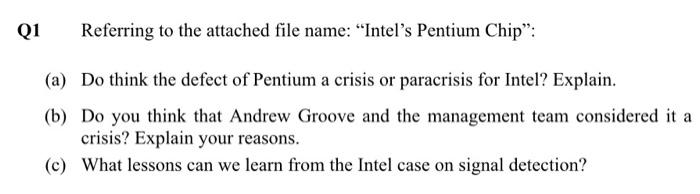

Step by Step Solution
There are 3 Steps involved in it
1 Expert Approved Answer
Step: 1 Unlock

Question Has Been Solved by an Expert!
Get step-by-step solutions from verified subject matter experts
Step: 2 Unlock
Step: 3 Unlock
 Study Help