







Question: please answer the three case study questions Can Cars Drive ThemselvesAnd Should They? Case Study Will cars really be able to drive themselves without human
please answer the three case study questions 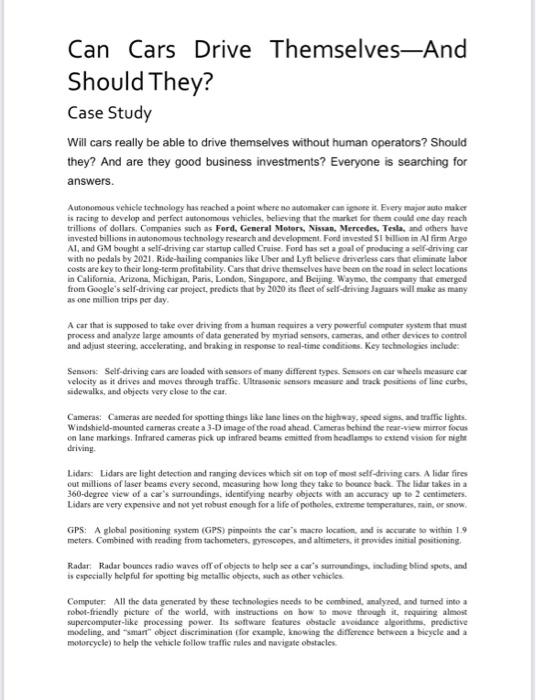
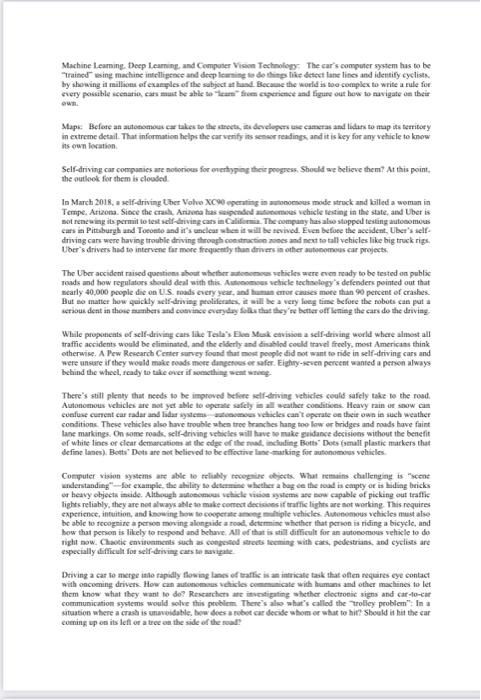
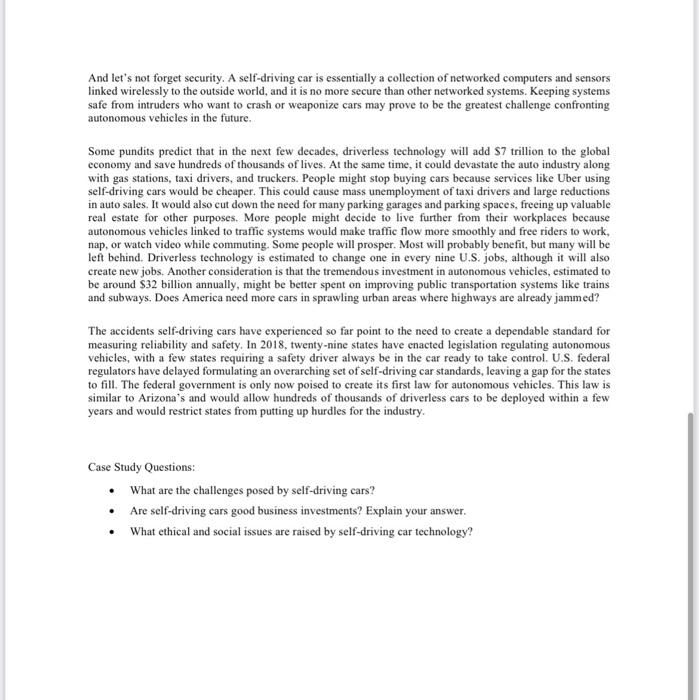
Can Cars Drive ThemselvesAnd Should They? Case Study Will cars really be able to drive themselves without human operators? Should they? And are they good business investments? Everyone is searching for answers. Autonomous vehicle technology has reached a point where ne automaker can ignote it. Every major auto maker is racing to develop and perfect autonomous vehicles, believing that the market for the could one day reach trillions of dollars. Companies such as Ford, General Motors, Nissan, Mercedes, Tesla, and others have invested billions in autonomous technology research and development. Ford invested 5 billion in Al fimm Argo Al, and GM bought a self-driving car startup called Cruise Ford has set a goal of producing a self-driving car with no pedals by 2021. Ride-hailing companies like Uber and Lyft believe driverless cars that eliminate labor costs are key to their long-term profitability. Cars that drive themselves have been on the road in select locations in California Arizona, Michigan, Paris, London, Singapore, and Beijing. Waymo, the company that emerged from Google's self-driving car project, predicts that by 2020 its fleet of self-driving Jaguars will make as many as one million trips per day A car that is supposed to take over driving from a human requires a very powerful computer system that must process and analyze large amounts of data generated by myriad sensors, cameras and other devices to control and adjust steering, accelerating, and braking in response to real-time conditions Key technologies include: Senso: Self-driving cars are loaded with sensors of many different types Sensors en cur wheels measure ca velocity as it drives and moves through traffic. Ultrasonic sensors measure and track positions of line curbs, sidewalks, and objects very close to the car. Camera: Cameras are needed for spotting things like lane lines on the highway speed signs and traffic lights Windshield-mounted cameras create a 3-D image of the road ahead. Cameras behind the rear-view mirror focus on lane markings. Infrared cameras pick up infrared beams emitted from headlamps to extend vision for night driving Lidars Lidars are light detection and ranging devices which sit on top of most self-driving cars. A lider fires out millions of laser beams every second, measuring how long they take to bounce back. The lidar takes in a 360-degree view of a car's surroundings, identifying nearby objects with an accuracy up to 2 centimeters, Lidars are very expensive and not yet robust enough for a life of potholes extreme temperatures, rain, or snow GPS: A global positioning system (GPS) pinpoints the car's macro location and is accurate to within 19 meters. Combined with reading from tachometers. gyroscopes, and altimeters it provides initial positioning Radar Radar bounces radio waves off of objects to help se a car's surroundings, including blind spots, and is specially helpful for spotting big metallic objects, such as other chicles Computer. All the data generated by these technologies needs to be combined. analyzed and turned into a robot-friendly picture of the world, with instructions on how to move through it requiring almost supercomputer-like processing power. Its software features obstacle avoidance algorithms predictive modeling, and smart" object discrimination for example, knowing the difference between a bieycle and a motorcycle) to help the vehicle follow traffic rules and navigate obstacles Machine Leaming, Deep coming and Computer Vision Technology. The car's computer system has to be Trained" sing machine intelligence and deep in to do this like detect lane lines and identify cyclists by showing it millions of examples of the subject at hand. Became the world is to complex to write a rule for every possible scenario, cats must be able to from esperience and figure out how to navigate on their Maps Before an autonomous car takes to the street, the developers use cameras and liders to map its territory in extreme detail. That information helps the car venifits sense readings and it is key for any vehicle to know its own location Self-driving car companies are notorious for overhypes their progress. Should we believe them? At this point, the outlook for them is clouded In March 2018, a self-driving the Volvo XC9perating inomos mode struck and killed a woman in Tempe. Attzon. Since the crash Anzena has suspended to chacle testing in the state and Uber is not renewing is permit to test self-driving cars in Calif. The company has also stopped testing autonomous curs in Pittsburgh and Toronto and it's unclear when it will be revived. Even before the accident. Uber's self driving cars were having trouble driving through constructions and next to tall vehicles like big truck rigs Uber's drivers had to intervene for more frequently than drivers in other autonomous car projects The Uber accident raised questions about whether items whicles were even ready to be tested on public roads mod how regulators should deal with this. Atromos vehicle technology's defenders pointed out that nearly 40.000 people die on US mods every year, and Torses more than 90 percent of crashes. But no matter how quickly self-driving proliferates, it will be a very long time before the robots can put a serious dent in those numbers and convince everyday folks that they're better off leming the cars do the driving While proponents of self-driving cars like Tesla's Elee Muskeavision a self-driving world where almost all traffic accidents would be eliminated, and the elderly and disabled could travel freely, most Americans think otherwise. A Pew Research Center survey found that most people did not want to ride in self-driving cars and were unsure if they would make roads more dangers of safer. Eighty-seven percent wanted a personalways behind the wheel, ready to take over if something went There's still plenty that needs to be improved before self-driving vehicles could safely take to the road. Autonomous vehicles are not yet able to operate safely in a seather condities Heavy rain or snow can confuse current car radar and lidar system meus vehicles can't operate on their own in such weather conditions. These vehicles also have trouble when tree branches hang too low or bridges and roads have faint Danemarkings. On some roads. self-driving vehicles will have to make guidance decisions without the benefit of white lines or clear demarcations at the edge of the trading Botts Dots (small plastic markers that define lanes). Botts Dots are not believed to be effective lanemarking for autonomous vehicles Computer vision systems are able to really recognise objects. What remains challenging is "scoe understanding"--for example, the ability to determine whether a bag ee the road is empty or is hiding bricks or heavy objects inside. Although tonomous vehicle systems are now capable of picking out traffic lights reliably, they are not always able to make correct decisions of traffic lights are not working. This requires experience, intuition, and knowing how to cooperate aegiple vehicles Arenomous vehicles must also be able to recognize a person moving alongside arood determine whether that person is riding a bicycle, and how that person is likely to respond and behave. All of that is still difficult for an autoon vehicle to do right now. Chaotic environments such as competed streming with cas, pedestrians and cyclists are especially difficult for self-driving casto savigate Driving a car to merge into rapidly flowing lanes of traffic is an intricate task that often requires eye contact with oncoming drivers. How can autonomous vehicles cicate with humans and other machines to let them know what they want to do? Researchers are stigting whether clectronic signs and car-to-cart communication systems would solve this problem. There's what's called the trolley problem". In situation where a crash is unavoidable bow does robot car decide whom or what to hit? Should it hit the car coming up on its left or a tree on the side of the And let's not forget security. A self-driving car is essentially a collection of networked computers and sensors linked wirelessly to the outside world, and it is no more secure than other networked systems. Keeping systems safe from intruders who want to crash or weaponize cars may prove to be the greatest challenge confronting autonomous vehicles in the future. Some pundits predict that in the next few decades, driverless technology will add S7 trillion to the global economy and save hundreds of thousands of lives. At the same time, it could devastate the auto industry along with gas stations, taxi drivers, and truckers. People might stop buying cars because services like Uber using self-driving cars would be cheaper. This could cause mass unemployment of taxi drivers and large reductions in auto sales. It would also cut down the need for many parking garages and parking spaces, freeing up valuable real estate for other purposes. More people might decide to live further from their workplaces because autonomous vehicles linked to traffic systems would make traffic flow more smoothly and free riders to work, nap, or watch video while commuting. Some people will prosper. Most will probably benefit, but many will be left behind. Driverless technology is estimated to change one in every nine U.S. jobs, although it will also create new jobs. Another consideration is that the tremendous investment in autonomous vehicles, estimated to be around $32 billion annually, might be better spent on improving public transportation systems like trains and subways. Does America need more cars in sprawling urban areas where highways are already jammed? The accidents self-driving cars have experienced so far point to the need to create a dependable standard for measuring reliability and safety. In 2018, twenty-nine states have enacted legislation regulating autonomous vehicles, with a few states requiring a safety driver always be in the car ready to take control. U.S. federal regulators have delayed formulating an overarching set of self-driving car standards, leaving a gap for the states to fill. The federal government is only now poised to create its first law for autonomous vehicles. This law is similar to Arizona's and would allow hundreds of thousands of driverless cars to be deployed within a few years and would restrict states from putting up hurdles for the industry. Case Study Questions: What are the challenges posed by self-driving cars? Are self-driving cars good business investments? Explain your answer. What ethical and social issues are raised by self-driving car technology
Step by Step Solution
There are 3 Steps involved in it
1 Expert Approved Answer
Step: 1 Unlock

Question Has Been Solved by an Expert!
Get step-by-step solutions from verified subject matter experts
Step: 2 Unlock
Step: 3 Unlock
 Study Help