







Question: PLEASE answer these U (1) Encrypt the message WATCH YOUR STEP by translating the letters into numbers, applying the given encryption function, and then translating
PLEASE answer these
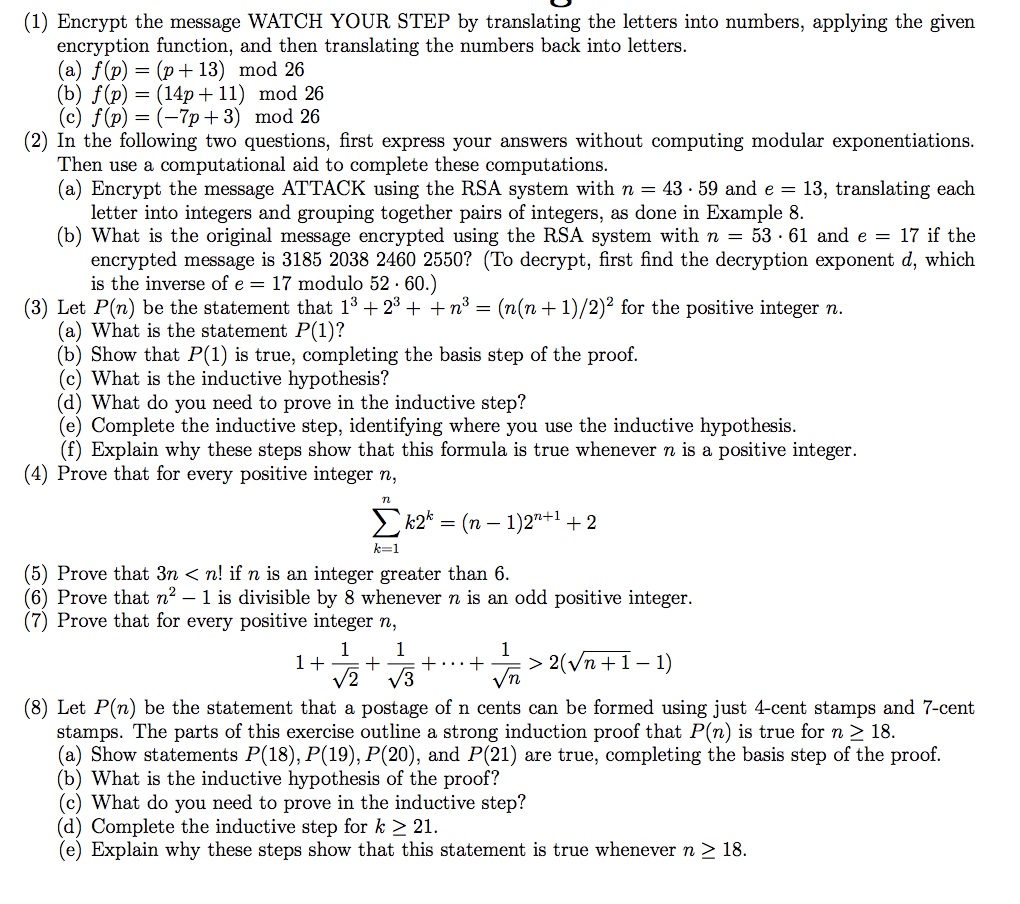
U (1) Encrypt the message WATCH YOUR STEP by translating the letters into numbers, applying the given encryption function, and then translating the numbers back into letters. (a) p) = (p+ 13) mod 26 (b) p) = (1411+ 11) mod 26 (c) p) = (7p+ 3) mod 26 (2) In the following two questions, rst express your answers without computing modular exponentiations. Then use a computational aid to complete these computations. (a) Encrypt the message ATTACK using the RSA system with n = 43 - 59 and e = 13, translating each letter into integers and grouping together pairs of integers, as done in Example 8. (b) What is the original message encrypted using the RSA system with n = 53 - 61 and e = 17 if the encrypted message is 3185 2038 2460 2550? (To decrypt, rst nd the decryption exponent d, which is the inverse of e = 1? modulo 52 - 60.) (3) Let P01.) be the statement that 13 + 23 + + n3 = (n(n + 1)/2)2 for the positive integer n. (a) What is the statement P(1)? (b) Show that 13(1) is true, completing the basis step of the proof. (c) What is the inductive hypothesis? (d) What do you need to prove in the inductive step? (e) Complete the inductive step, identifying where you use the inductive hypothesis. (f) Explain why these steps show that this formula is true whenever it is a positive integer. (4) Prove that for every positive integer n, 11. 2 ask = (n 1)2"'*+l + 2 k=1 (5) Prove that 3n 2wn+l 1) (8) Let P(n) be the statement that a postage of n cents can be formed using just 4-cent stamps and 7-cent stamps. The parts of this exercise outline a strong induction proof that P(n) is true for n 2 18. (a) Show statements P[18), P[19), P[20), and P(21) are true, completing the basis step of the proof. (b) What is the inductive hypothesis of the proof? (c) What do you need to prove in the inductive step? (d) Complete the inductive step for k 2 21. (e) Explain why these steps show that this statement is true whenever n 2 18
Step by Step Solution
There are 3 Steps involved in it

Get step-by-step solutions from verified subject matter experts
 Study Help