



Question: Please answer this asap 4. Consider the following strategic environment involving a firm manager (Manager) and two workers (Worker 1 and Worker 2). The sequence
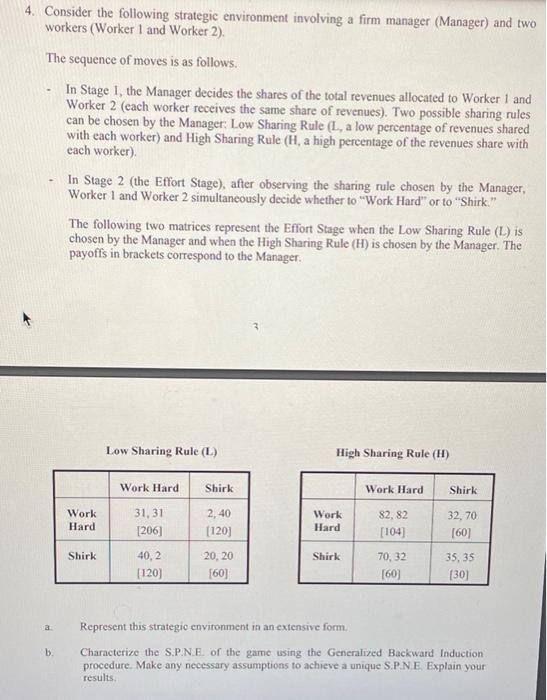
4. Consider the following strategic environment involving a firm manager (Manager) and two workers (Worker 1 and Worker 2). The sequence of moves is as follows. In Stage 1, the Manager decides the shares of the total revenues allocated to Worker 1 and Worker 2 (each worker receives the same share of revenues). Two possible sharing rules can be chosen by the Manager: Low Sharing Rule (L, a low percentage of revenues shared with each worker) and High Sharing Rule (I, a high percentage of the revenues share with each worker) In Stage 2 (the Effort Stage), after observing the sharing rule chosen by the Manager, Worker 1 and Worker 2 simultaneously decide whether to "Work Hard" or to "Shirk." The following two matrices represent the Effort Stage when the Low Sharing Rule (L) is chosen by the Manager and when the High Sharing Rule (H) is chosen by the Manager. The payoffs in brackets correspond to the Manager. Low Sharing Rule (L) High Sharing Rule (II) Work Hard Shirk Work Hard Shirk Work Hard Work Hard 31,31 [206] 40,2 (120) 2,40 [120] 20, 20 (60) 82, 82 [104] 70,32 [60] 32,70 [60] 35,35 [30] Shirk Shirk a Represent this strategic environment in an extensive form. b. Characterize the S.P.NE of the game using the Generalized Backward Induction procedure. Make any necessary assumptions to achieve a unique S.P.NE Explain your results 4. Consider the following strategic environment involving a firm manager (Manager) and two workers (Worker 1 and Worker 2). The sequence of moves is as follows. In Stage 1, the Manager decides the shares of the total revenues allocated to Worker 1 and Worker 2 (each worker receives the same share of revenues). Two possible sharing rules can be chosen by the Manager: Low Sharing Rule (L, a low percentage of revenues shared with each worker) and High Sharing Rule (I, a high percentage of the revenues share with each worker) In Stage 2 (the Effort Stage), after observing the sharing rule chosen by the Manager, Worker 1 and Worker 2 simultaneously decide whether to "Work Hard" or to "Shirk." The following two matrices represent the Effort Stage when the Low Sharing Rule (L) is chosen by the Manager and when the High Sharing Rule (H) is chosen by the Manager. The payoffs in brackets correspond to the Manager. Low Sharing Rule (L) High Sharing Rule (II) Work Hard Shirk Work Hard Shirk Work Hard Work Hard 31,31 [206] 40,2 (120) 2,40 [120] 20, 20 (60) 82, 82 [104] 70,32 [60] 32,70 [60] 35,35 [30] Shirk Shirk a Represent this strategic environment in an extensive form. b. Characterize the S.P.NE of the game using the Generalized Backward Induction procedure. Make any necessary assumptions to achieve a unique S.P.NE Explain your results
Step by Step Solution
There are 3 Steps involved in it

Get step-by-step solutions from verified subject matter experts